Loading...
Empress Dowager Cixi vs Mao Zedong
Mao Zedong leads by 24.4 pts · 2 figures compared
…
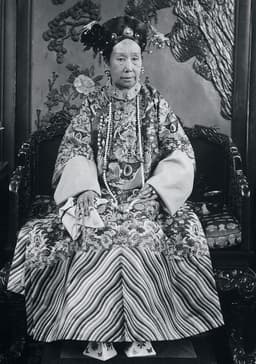
Empress Dowager Cixi
Politician · Modern
55.0Total
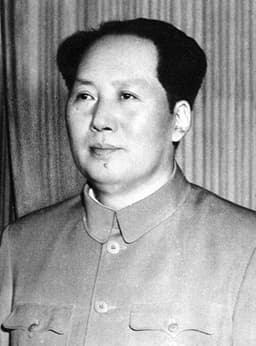
Mao Zedong
Politician · Modern
79.4Total
Basic Information
Born
1835
1893
Died
1908
1976
Era
Modern
Modern
Nationality
China
China
Occupation
Politician
Politician
Civilization
Eastern
Eastern
Score Comparison
Military (10%)
25.9
75.0
Political (20%)
53.8
88.0
Influence (20%)
58.3
85.0
Legacy (20%)
52.0
70.0
Leadership (15%)
72.0
85.0
Strategy (15%)
60.0
72.0
TOTAL
55.0
79.4
Empress Dowager Cixi — Complete Timeline
1861 AD
Self-Strengthening MovementReform◆ Major
Cixi supported the Self-Strengthening Movement, which modernized China's military and infrastructure. Arsenals, shipyards, and railways were built, and the Tongwen Guan language school was established. However, the movement avoided political reform, limiting its effectiveness.
Qing dynastyModernizationReform
Impact: nationalconstructive
Xinyou CoupPolitical Action
Cixi, with Prince Gong, staged a coup against the eight regents appointed by the dying Xianfeng Emperor. She had the regents arrested and executed, establishing herself as co-regent for the young Tongzhi Emperor. This began her effective control over the Qing government.
Qing dynastyCoupRegency
Impact: national
1898 AD
Hundred Days' Reform CoupPolitical Action◆ Major
Cixi staged a coup to end the Hundred Days' Reform, a series of modernization edicts by the Guangxu Emperor. She imprisoned the emperor, executed six reform leaders, and rescinded most reforms. This reversed political liberalization and strengthened conservative forces.
Qing dynastyReform suppressionCoup
Impact: nationaldestructive
1900 AD
Boxer RebellionWar◆ Major
Cixi declared war on eight foreign powers after the Boxers besieged foreign legations in Beijing. The Eight-Nation Alliance invaded, defeated Qing forces, and occupied Beijing. Cixi fled to Xi'an. The resulting Boxer Protocol imposed heavy reparations and further weakened the Qing.
Qing dynastyForeign interventionWar
Impact: globaldestructive
1901 AD
Late Qing ReformsReform◆ Major
After the Boxer Rebellion, Cixi initiated the Late Qing Reforms, including abolition of the civil service examination, establishment of modern schools, and military modernization. These reforms aimed to strengthen the dynasty but came too late to prevent its collapse.
Qing dynastyModernizationReform
Impact: nationalconstructive
Mao Zedong — Complete Timeline
1934 AD
Long MarchWar
Mao Zedong led the Chinese Red Army on a strategic retreat from Nationalist forces, covering approximately 6,000 miles over 370 days. The march solidified Mao's leadership within the Chinese Communist Party and became a foundational myth of the Communist revolution.
Chinese Civil WarCommunist RevolutionRetreat
Impact: national
1949 AD
Proclamation of the People's Republic of ChinaPolitical Action
Mao Zedong declared the founding of the People's Republic of China from Tiananmen Gate in Beijing. This ended the Chinese Civil War and established Communist rule over mainland China, with Mao as Chairman of the Central People's Government.
Founding of PRCCommunist VictoryRevolution
Impact: global
1958 AD
Great Leap ForwardReform◆ Major
Mao launched a campaign to rapidly industrialize China and collectivize agriculture. The policy led to widespread mismanagement, resulting in a famine that caused an estimated 15-45 million deaths between 1959 and 1961.
FamineIndustrializationCollectivization
Impact: nationaldestructive
1960 AD
Sino-Soviet SplitPolitical Action◆ Major
Mao's ideological differences with Soviet leader Nikita Khrushchev led to a breakdown in relations between China and the Soviet Union. The split ended the Sino-Soviet alliance and reshaped global Cold War dynamics, with China pursuing an independent path.
Cold WarIdeological ConflictAlliance Breakdown
Impact: global
1966 AD
Cultural RevolutionPolitical Action
Mao initiated a sociopolitical movement to purge capitalist and traditional elements from Chinese society. The Red Guard youth groups attacked intellectuals and officials, leading to widespread violence, destruction of cultural artifacts, and an estimated 1-2 million deaths.
Political PurgeSocial UpheavalRed Guard
Impact: nationaldestructive
1971 AD
Ping-Pong DiplomacyCultural◆ Major
Mao approved an invitation for the U.S. table tennis team to visit China, initiating a thaw in Sino-American relations. This cultural exchange paved the way for President Nixon's visit to China in 1972 and the eventual normalization of diplomatic ties.
DiplomacyU.S.-China RelationsCultural Exchange
Impact: globalconstructive
Expert Analysis
Mao Zedong vs Empress Dowager Cixi
The Dragon’s Two Faces
In the autumn of 1908, as the Qing dynasty gasped its last breaths, a seventy-three-year-old woman lay dying behind the Forbidden City’s vermilion walls. Half a century later, in the summer of 1976, a seventy-two-year-old man floated in a pool near Beijing, his body bloated by disease, his mind still grasping at revolution. Empress Dowager Cixi and Mao Zedong never met, yet they haunt the same question: How does one person hold a billion people in their hands? Cixi ruled from the shadows, a concubine who became a puppet master; Mao ruled from the light, a peasant’s son who became a god. One preserved an empire; the other destroyed it to build a new one. Why did their paths diverge so violently?
Origins
Cixi was born in 1835 into a Manchu banner family of modest means—her father was a minor official, her childhood spent in the provincial backwaters of Anhui. She entered the Forbidden City as a low-ranking concubine, a woman whose only currency was her beauty and her wits. The Qing dynasty she served was already rotting: opium wars had cracked its walls, foreign gunboats humiliated its emperors, and internal rebellions like the Taiping threatened to tear it apart. Cixi learned early that survival meant manipulation, not confrontation.
Mao Zedong was born in 1893 in Shaoshan, a village in Hunan province, to a prosperous peasant farmer. His father beat him; his mother prayed. He read Chinese classics by candlelight and devoured translated Western books on evolution and democracy. The Qing dynasty fell when he was eighteen, plunging China into warlord chaos. Mao grew up in a world where old certainties had collapsed, and new ideologies—nationalism, anarchism, Marxism—swirled like floodwaters. Where Cixi learned to navigate a system, Mao learned to smash it.
Rise to Power
Cixi’s ascent was a coup d’état in miniature. In 1861, the Xianfeng Emperor died, leaving eight regents to rule for his five-year-old son. Cixi, then a twenty-six-year-old concubine, forged an alliance with Prince Gong, the emperor’s brother. Together they staged the Xinyou Coup, arresting the regents, executing the chief conspirator, and installing Cixi as co-regent behind a child emperor. She never held an official title as ruler—she was always “Empress Dowager,” a widow, a mother—but from that moment, she pulled the strings.
Mao’s rise was a long march through blood. He joined the Chinese Communist Party in 1921, a fringe group in a chaotic country. After the Nationalists purged communists in 1927, Mao fled to the countryside, building a peasant army from scratch. His turning point came in 1934, when he led the Red Army on the Long March—6,000 miles of starvation, ambush, and frozen mountains. By the time they reached Yan’an, Mao had been transformed from a bureaucrat into a revolutionary icon. He did not seize power through a palace coup; he earned it through endurance.
Leadership & Governance
Cixi governed as a pragmatist. She supported the Self-Strengthening Movement (1861–1895), building arsenals, shipyards, and telegraph lines—but only to preserve the dynasty, not to change it. She modernized China’s military while keeping its Confucian soul intact. When her adopted son, the Guangxu Emperor, attempted the Hundred Days’ Reform in 1898—a radical push for constitutional monarchy, free press, and modern education—Cixi crushed it. She imprisoned the emperor and executed six reform leaders. For her, change was a tool, not a value.
Mao governed as an ideologue. In 1958, he launched the Great Leap Forward, a mad dash to industrialize China by melting farm tools into steel and herding peasants into communes. The result was famine: between 15 and 45 million people died of starvation. He did not stop. In 1966, he launched the Cultural Revolution, unleashing teenage Red Guards to destroy temples, burn books, and torture intellectuals. Mao believed that only perpetual revolution could purify China. Cixi preserved the old; Mao annihilated it.
Triumph & Tragedy
Cixi’s greatest triumph was survival. She outlasted five emperors, three foreign invasions, and a dozen rebellions. Her greatest tragedy came in 1900, when she backed the Boxer Rebellion—a violent uprising against foreign influence. She declared war on eight nations, including Britain, Japan, and the United States. The Eight-Nation Alliance marched on Beijing, looted the Forbidden City, and forced Cixi to flee in peasant disguise. She returned only to sign the humiliating Boxer Protocol, paying reparations that crippled China for decades.
Mao’s greatest triumph was unification. In 1949, he stood on Tiananmen Gate and declared the People’s Republic, ending a century of foreign domination and civil war. His greatest tragedy was the Cultural Revolution: a decade of chaos that destroyed China’s heritage, murdered its elites, and traumatized a generation. Yet Mao also engineered Ping-Pong Diplomacy in 1971, opening China to the world. He was both liberator and tyrant, builder and destroyer.
Character & Destiny
Cixi was shrewd, patient, and deeply conservative. She trusted no one—not even her own son. She once said, “I have often thought that I am the cleverest woman who ever lived.” But her cleverness was defensive; she fought only to keep her throne. Mao was visionary, ruthless, and utopian. He once wrote, “A revolution is not a dinner party.” His vision demanded sacrifice on a scale that dwarfed Cixi’s worst excesses. Where Cixi feared chaos, Mao embraced it as a creative force.
Legacy
Cixi is remembered as a reactionary, the woman who held China back. Her modernizing reforms came too late and too little. Yet she kept the Qing alive for nearly half a century in an age of empires falling like dominoes. Mao is remembered as a founder, the man who gave China a new identity. His policies killed millions, but he also lifted China from feudal poverty to nuclear power. Today, his portrait still hangs on Tiananmen. Cixi’s face has faded into history.
Conclusion
Stand at the Gate of Heavenly Peace in Beijing. On one side lies the Forbidden City, where Cixi once plotted in silk robes. On the other lies Tiananmen Square, where Mao’s mausoleum stands. Both women and men built their power on the backs of millions. But Cixi ruled a dying dragon, trying to patch its scales. Mao killed the dragon and built a new beast from its bones. The difference is not good versus evil—it is preservation versus creation, fear versus faith. In the end, China outlived them both, and still the question remains: Which dragon do we fear more—the one that holds us back, or the one that consumes us to build something new?
Rankings
🥇
Mao ZedongLeader
Mil: 75.0Pol: 88.0Inf: 85.0
79.4
🥈
Empress Dowager Cixi
Mil: 25.9Pol: 53.8Inf: 58.3
55.0
+24.4 behind
How This Comparison Works
Algorithm
Each figure is scored on 6 dimensions (0—100 scale) based on structured historical data: Military (10%), Political (20%), Influence (20%), Legacy (20%), Leadership (15%), Strategy (15%). The weighted total produces the final ranking.
Data Sources
Scores are computed from structured sub-indicators in the database. Scale factors adjust for era (Ancient ×0.85, Modern ×1.0) and civilization size (Eastern ×1.05, Other ×0.80) to account for differences in population and military scale.
Maximum 3 Figures
Comparisons are limited to 2—3 figures to ensure readability and statistical meaningfulness.
Error Margins
±5 points per dimension — Sub-scores are derived from historical records with inherent uncertainty. Two figures within 5 points on a dimension should be considered roughly equivalent in that area.
Total Score Accuracy
±3 points overall — The weighted combination of 6 dimensions produces a total score with approximately ±3 points of uncertainty. Differences of less than 3 points are not statistically significant— the figures are effectively tied.
Known Limitations
- Historical records are incomplete and uneven across civilizations
- Figures from oral-tradition societies may be underrepresented
- Occupation labels can misclassify multi-role figures
- Scores measure capability and impact, not moral character
- Quantitative scoring is a comparison tool, not absolute truth
Capability Radar
Military (10%) — Battles & Warfare
Battles
30
85
Win Rate
25
80
Expansion
15
85
Political (20%) — Governance & Reform
Reform
65
95
Diplomacy
60
80
Economy
50
70
Influence (20%) — Cultural & Global Reach
Cultural
60
90
Global
60
90
Legacy (20%) — Historical Impact
Historical
75
95
Longevity
55
85
Leadership (15%) — Power & Stability
Tenure
85
95
Stability
40
60
Strategy (15%) — Tactics & Innovation
Strategy
55
85
Tactics
40
75
Reform
70
90
Similar Comparisons
Comments & Discussion
历史考据党6/16/2026
两人根本不在同一维度。慈禧的"统治"靠的是后宫权术和满族特权,她掌权的47年间,中国GDP占比从全球1/3跌到不足5%。毛主席把中国从积贫积弱变成世界第六大工业国。数据不会说谎:1949年人均寿命35岁,1976年提高到65岁。慈禧留给中国的是一堆不平等条约,毛主席留下的是两弹一星。这叫"同一种人"?别开玩笑了。
RedArchive6/16/2026
Classics scholar here, and I’d argue both were masters of literary self-fashioning. Cixi commissioned her own portrait as Guanyin, literally playing a deity. Mao used poetry—"The Soong Dynasty’s shame fades away" to reframe history as his own epic. They both knew that power needed a myth. But Cixi’s was reactive, a costume to hide decay; Mao’s was proactive, a hammer to smash and reshape. One preserved a broken temple, the other razed it to build a museum of himself.
西风瘦马6/16/2026
别把慈禧和毛主席相提并论,这本身就是一种历史虚无主义。慈禧是封建权贵最后的总代表,靠裙带关系和宫廷阴谋掌权;毛主席是人民领袖,从井冈山到延安,始终站在农民和工人一边。慈禧卖国求荣,签订《辛丑条约》让中国赔偿4.5亿两白银;毛主席抗美援朝保家卫国,让世界看到中国的骨头。一个跪着活,一个站着死,这能比?
MaoOrBust6/16/2026
Revisionist critic here, and I’m not buying the "two faces" framing. Cixi hoarded power for itself; Mao tried to distribute it to the masses—even if the results were messy. The Cultural Revolution wasn’t about Mao’s ego; it was a desperate attempt to break bureaucratic ossification that Cixi would have loved. She banned railway projects because trains would "violate the spirits of the dead"; Mao launched nuclear submarines and satellite programs. One looked backward, the other forced China to lo
Historian4736/16/2026
Military historian here. The comparison is flawed because Cixi never commanded armies directly—she paid off foreign powers with silver and surrendered territory like Taiwan and Korea. Mao actually fought and won a civil war, then held the U.S. to a stalemate in Korea. Cixi’s navy was a joke; the Beiyang Fleet was crushed by Japan in 1895 while she spent the budget on her summer palace. Mao built a nuclear deterrent from scratch. Different leagues.