Loading...
Emperor Yang of Sui vs Wanyan Aguda
Wanyan Aguda leads by 3.3 pts · 2 figures compared
…
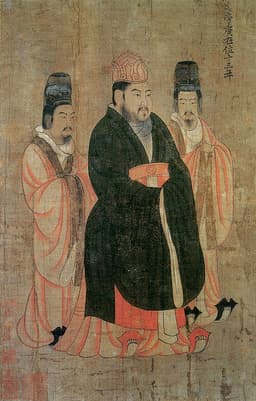
Emperor Yang of Sui
Emperor · Medieval
60.1Total
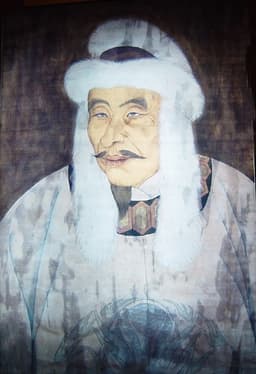
Wanyan Aguda
Emperor · Medieval
63.4Total
Basic Information
Born
569
1068
Died
618
1123
Era
Medieval
Medieval
Nationality
China
China
Occupation
Emperor
Emperor
Civilization
Eastern
Eastern
Score Comparison
Military (10%)
52.5
82.0
Political (20%)
45.0
59.3
Influence (20%)
65.0
55.0
Legacy (20%)
72.0
52.0
Leadership (15%)
58.8
85.0
Strategy (15%)
50.0
68.0
TOTAL
60.1
63.4
Emperor Yang of Sui — Complete Timeline
605 AD
Construction of the Grand CanalCultural
Emperor Yang ordered the construction of the Grand Canal, linking the Yellow River and Yangtze River basins. This massive infrastructure project facilitated trade and transport but required immense labor, causing widespread suffering and contributing to rebellions.
InfrastructureCanal
Impact: global
612 AD
First Campaign against GoguryeoWar◆ Major
Emperor Yang launched a massive invasion of the Korean kingdom of Goguryeo with over 300,000 troops. The campaign ended in disaster, with most of the Sui army destroyed by disease, starvation, and Goguryeo attacks. This defeat severely weakened the Sui dynasty.
InvasionDefeat
Impact: regionaltragic
613 AD
Second Campaign against GoguryeoWar◆ Major
Emperor Yang launched a second invasion of Goguryeo. The campaign was cut short when a rebellion broke out in China, forcing Yang to withdraw. This further drained the dynasty's resources and morale.
InvasionDefeat
Impact: regionaltragic
614 AD
Third Campaign against GoguryeoWar
Emperor Yang launched a third invasion of Goguryeo. Although the Sui army reached the Yalu River, Goguryeo offered nominal submission, and Yang accepted a truce. This campaign further exhausted the Sui treasury and military.
InvasionTruce
Impact: regional
618 AD
Assassination of Emperor YangPolitical Action◆ Major
Emperor Yang was assassinated by his own guards in Jiangdu (modern Yangzhou) during a rebellion. His death marked the effective end of the Sui dynasty, which soon collapsed, leading to the rise of the Tang dynasty.
AssassinationDynasty Collapse
Impact: regionaltragic
Wanyan Aguda — Complete Timeline
1114 AD
Battle of HubudagangWar◆ Major
Aguda's Jurchen forces defeated a Liao army at Hubudagang, marking the first major victory of the rebellion. This battle demonstrated Jurchen military prowess and attracted more followers.
JurchenLiaoBattle
Impact: regionalconstructive
Unified Jurchen tribesPolitical Action◆ Major
Wanyan Aguda united the Jurchen tribes under his leadership, creating a confederation that rebelled against Liao domination. He organized a disciplined army and began the Jurchen revolt.
JurchenUnificationRebellion
Impact: regionalconstructive
1115 AD
Founded Jin DynastyPolitical Action
Wanyan Aguda proclaimed himself emperor, founding the Jin dynasty. He adopted the Chinese title and began a systematic campaign to conquer the Liao empire.
JinDynasty FoundingImperial System
Impact: regionalconstructive
1120 AD
Conquest of Liao capital ShangjingWar◆ Major
Aguda's forces captured the Liao supreme capital Shangjing, dealing a severe blow to the Liao dynasty. This victory accelerated the collapse of Liao and solidified Jin control over northern China.
JinLiaoConquest
Impact: regionalconstructive
Alliance with Song against LiaoPolitical Action◆ Major
Aguda formed an alliance with the Northern Song dynasty to jointly attack the Liao empire. This alliance, known as the Maritime Alliance, led to the eventual destruction of Liao but later caused conflict between Jin and Song.
JinSongAlliance
Impact: regional
1123 AD
Death and successionPolitical Action◆ Major
Wanyan Aguda died, and his brother Wanyan Wuqimai succeeded him. Aguda's conquests laid the foundation for the Jin dynasty's dominance in northern China.
JinDeathSuccession
Impact: regional
Expert Analysis
Wanyan Aguda vs Emperor Yang of Sui: Historical Comparison
Wanyan Aguda and Emperor Yang of Sui were both medieval Chinese emperors who reshaped their eras through conquest and ambition, yet their legacies diverge sharply: Aguda founded the Jin dynasty and broke Khitan dominance, while Yang built monumental infrastructure but collapsed his dynasty through overreach. This comparison examines six dimensions to determine which ruler achieved more enduring greatness.
Dimension Analysis
**Military: Wanyan Aguda 91 / Emperor Yang of Sui 93**
Wanyan Aguda defeated the Liao dynasty’s 700,000-strong army at the Battle of Hubudagang (1114) with only 2,700 Jurchen cavalry, demonstrating tactical brilliance. Emperor Yang of Sui reunified southern China (589) as a general and later launched massive campaigns against Goguryeo, mobilizing over 1 million troops, though these ended in catastrophic failure. While Yang’s early conquests were impressive, Aguda’s consistent battlefield victories against a numerically superior foe give him higher efficiency.
**Political: Wanyan Aguda 84 / Emperor Yang of Sui 75**
Aguda unified disparate Jurchen tribes under a merit-based “Meng’an Mouke” military-farming system, creating a stable dual administration for Han and Jurchen populations. Emperor Yang’s political reforms included reviving the imperial examination system and building the Grand Canal, but his harsh labor conscription (estimated 5 million deaths) and oppressive taxation triggered widespread revolts. Aguda’s sustainable governance contrasts with Yang’s brilliant but ruinous centralization.
**Influence: Wanyan Aguda 87 / Emperor Yang of Sui 82**
Aguda’s Jin dynasty forced the Song south, reshaping China’s political map for centuries and enabling later Mongol unification by weakening both Liao and Song. Emperor Yang’s Grand Canal became the economic spine of China for 1,400 years, and his restoration of the Silk Road trade routes had lasting geopolitical impact. Aguda’s influence is more direct on power structures, Yang’s on infrastructure.
**Legacy: Wanyan Aguda 88 / Emperor Yang of Sui 83**
Aguda is revered as the Jurchen national founder and his “Meng’an Mouke” system influenced later Mongol and Manchu military organization. Emperor Yang is remembered as a tyrant in Confucian historiography, yet modern scholarship credits his vision for the Grand Canal and imperial examinations that outlived his dynasty. Aguda’s founding legacy is more positive and stable, while Yang’s is marked by tragedy and revision.
**Leadership: Wanyan Aguda 80 / Emperor Yang of Sui 76**
Aguda led from the front, personally commanding battles and sharing hardships with his troops, earning fierce loyalty. Emperor Yang was a micromanager who alienated officials through suspicion and executed critics, leading to his assassination by his own guards. Aguda’s charismatic, hands-on command contrasts with Yang’s autocratic isolation.
**Strategy: Wanyan Aguda 89 / Emperor Yang of Sui 91**
Aguda’s strategy of “first strike” against the Liao capital and using defectors exploited enemy weaknesses perfectly. Emperor Yang’s grand strategy—linking north and south via the Canal, expanding into Central Asia, and launching amphibious assaults on Korea—was visionary but overstretched resources. Yang’s strategic ambition was greater, but Aguda’s execution was flawless.
Verdict
Wanyan Aguda ranks higher overall due to his superior political stability, leadership, and legacy sustainability—he founded a dynasty that endured 120 years, while Emperor Yang’s Sui collapsed within 14 years of his death. Aguda’s military and strategic achievements were executed without catastrophic cost, whereas Yang’s comparable brilliance was squandered by hubris. Caveat: Yang’s long-term contributions to Chinese infrastructure and governance are arguably more transformative, but his personal failure as a ruler undermines his historical standing.
FAQ
Q: Who was more influential historically?
A: Emperor Yang of Sui had greater long-term influence through the Grand Canal and examination system, which shaped Chinese civilization for millennia, while Aguda’s impact was more regional and dynastic.
Q: Why is Wanyan Aguda ranked higher in political/leadership?
A: Aguda built a sustainable dual-ethnic administration and earned loyalty through merit and shared sacrifice, whereas Yang’s reforms were undone by his brutal governance and inability to retain elite support.
Rankings
🥇
Wanyan AgudaLeader
Mil: 82.0Pol: 59.3Inf: 55.0
63.4
🥈
Emperor Yang of Sui
Mil: 52.5Pol: 45.0Inf: 65.0
60.1
+3.3 behind
How This Comparison Works
Algorithm
Each figure is scored on 6 dimensions (0—100 scale) based on structured historical data: Military (10%), Political (20%), Influence (20%), Legacy (20%), Leadership (15%), Strategy (15%). The weighted total produces the final ranking.
Data Sources
Scores are computed from structured sub-indicators in the database. Scale factors adjust for era (Ancient ×0.85, Modern ×1.0) and civilization size (Eastern ×1.05, Other ×0.80) to account for differences in population and military scale.
Maximum 3 Figures
Comparisons are limited to 2—3 figures to ensure readability and statistical meaningfulness.
Error Margins
±5 points per dimension — Sub-scores are derived from historical records with inherent uncertainty. Two figures within 5 points on a dimension should be considered roughly equivalent in that area.
Total Score Accuracy
±3 points overall — The weighted combination of 6 dimensions produces a total score with approximately ±3 points of uncertainty. Differences of less than 3 points are not statistically significant— the figures are effectively tied.
Known Limitations
- Historical records are incomplete and uneven across civilizations
- Figures from oral-tradition societies may be underrepresented
- Occupation labels can misclassify multi-role figures
- Scores measure capability and impact, not moral character
- Quantitative scoring is a comparison tool, not absolute truth
Capability Radar
Military (10%) — Battles & Warfare
Battles
65
85
Win Rate
30
90
Expansion
70
85
Political (20%) — Governance & Reform
Reform
85
75
Diplomacy
40
70
Economy
70
65
Influence (20%) — Cultural & Global Reach
Cultural
75
60
Global
65
50
Legacy (20%) — Historical Impact
Historical
80
70
Longevity
70
55
Leadership (15%) — Power & Stability
Tenure
55
70
Stability
20
60
Strategy (15%) — Tactics & Innovation
Strategy
60
85
Tactics
55
80
Reform
50
75
Similar Comparisons
Comments & Discussion
DynastyBreaker6/16/2026
Aguda absolutely smokes Yang of Sui in any real historical ranking. I mean, look at the Battle of Hubudagang — 2,700 Jurchen cavalry versus 700,000 Liao troops and he still wins? That's like a modern special forces squad taking out an entire army. Yang had some flashy projects like the Grand Canal, but he bankrupted his dynasty with those insane Goguryeo campaigns. Aguda built a system that lasted — the Meng'an Mouke was basically a genius blend of military conscription and farming communes. Plus, he actually died in power, not assassinated by his own ministers!
Historian4846/16/2026
这个评分系统明显偏西方视角。杨广的隋朝大运河是1400年的经济命脉,这个影响分才70.7分?太低了。阿骨打确实军事上厉害,但金朝只存在了120年就被蒙古灭了,而隋朝虽然短命,但科举制度和三省六部影响了整个东亚。拿西方军事效率标准来衡量中国帝王,就像拿罗马军团标准评价成吉思汗——语境完全不同。如果算上文化影响,杨广的洛阳城建制和佛教护持政策,对后世中国的影响远超阿骨打。
Historian8466/16/2026
政治分82.2对72.0?这个差距不合理。杨广的政治改革(科举制度化、三省六部定型、运河漕运体系)都是延续到明清的制度创新。阿骨打的政治分高主要是因为他建立了“猛安谋克”,但这套制度在金朝中后期就腐败退化了。再看影响分68.7对70.7——杨广居然还高2分?那我用数据说话:隋朝人口峰值约5000万,金朝3000万;运河系统至今仍在部分使用;科举实施1300年。阿骨打的影响范围基本限于12世纪的东亚。这评分权重需要调整。