Loading...
Emperor Wen of Sui vs Wu Zetian
Emperor Wen of Sui leads by 10.3 pts · 2 figures compared
…
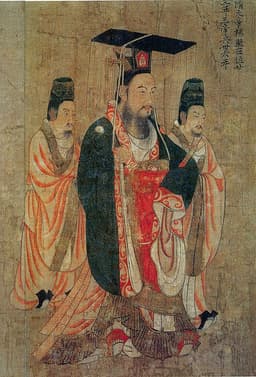
Emperor Wen of Sui
Emperor · Medieval
80.3Total

Wu Zetian
Emperor · Medieval
70.0Total
Basic Information
Born
541
624
Died
604
705
Era
Medieval
Medieval
Nationality
China
China
Occupation
Emperor
Emperor
Civilization
Eastern
Eastern
Score Comparison
Military (10%)
76.0
60.0
Political (20%)
75.0
62.7
Influence (20%)
88.0
65.0
Legacy (20%)
80.0
80.0
Leadership (15%)
80.0
78.0
Strategy (15%)
75.0
66.3
TOTAL
80.3
70.0
Emperor Wen of Sui — Complete Timeline
581 AD
Establishment of the Three Departments and Six Ministries SystemReform◆ Major
Emperor Wen established a centralized bureaucratic system with three departments (Secretariat, Chancellery, and Department of State Affairs) and six ministries. This system became the foundation of Chinese government administration for centuries.
Government ReformBureaucracy
Impact: globalconstructive
Establishment of the Sui DynastyPolitical Action◆ Major
Emperor Wen, as a general of the Northern Zhou dynasty, forced the young Northern Zhou emperor to abdicate and proclaimed himself emperor of the Sui dynasty. This marked the beginning of the Sui dynasty, which would go on to reunify China.
Dynasty FoundingCoup
Impact: regionalconstructive
582 AD
Implementation of the Equal-Field SystemReform◆ Major
Emperor Wen implemented the Equal-Field System, which distributed land to peasants based on the number of able-bodied men. This reform increased agricultural productivity, stabilized tax revenues, and reduced the power of large landowners.
Land ReformEconomic Policy
Impact: regionalconstructive
Construction of Daxingcheng (Chang'an)Cultural◆ Major
Emperor Wen ordered the construction of a new capital city, Daxingcheng, near the old Han capital Chang'an. This city, later known as Chang'an, became a model for urban planning and served as the capital of the Sui and Tang dynasties.
Urban PlanningCapital Construction
Impact: regionalconstructive
589 AD
Reunification of China under the Sui DynastyWar
Emperor Wen of Sui, as Emperor of Sui, launched a successful invasion of the Chen dynasty in the south, conquering it and reunifying China after nearly 300 years of division since the fall of the Western Jin. This ended the Northern and Southern Dynasties period.
UnificationConquest
Impact: globalconstructive
Wu Zetian — Complete Timeline
655 AD
Became Empress ConsortPolitical Action◆ Major
Wu Zetian was elevated from concubine to empress consort of Emperor Gaozong of Tang in 655. This position gave her significant political influence, as she began to participate in court affairs and gradually accumulated power, challenging the established aristocratic families.
Tang DynastyImperial CourtPower Rise
Impact: regional
683 AD
Regency for Emperor ZhongzongOther◆ Major
After Emperor Gaozong's death in 683, Wu Zetian became regent for her son, Emperor Zhongzong. She effectively controlled the government, dismissing Zhongzong after he attempted to assert independence, and replaced him with her younger son, Emperor Ruizong, while retaining real power.
Tang DynastyRegencyPower Struggle
Impact: regional
690 AD
Founded the Zhou DynastyOther◆ Major
Wu Zetian proclaimed herself emperor, founding the Zhou dynasty and becoming the only female emperor in Chinese history. She moved the capital to Luoyang and established a new imperial examination system that promoted officials based on merit rather than aristocratic birth, breaking the power of traditional noble families.
Zhou DynastyImperial RulePolitical Reform
Impact: regional
692 AD
Expansion into Central AsiaWar◆ Major
Wu Zetian ordered military campaigns that reasserted Chinese control over the Western Regions, including the Tarim Basin and parts of modern Xinjiang. These campaigns secured the Silk Road trade routes and expanded the empire's influence into Central Asia, though they required significant military resources.
Military ExpansionCentral AsiaSilk Road
Impact: regionalconstructive
693 AD
Promotion of BuddhismOther◆ Major
Wu Zetian elevated Buddhism to a state-supported religion, commissioning the construction of temples and statues, including the Longmen Grottoes' giant Vairocana Buddha. She used Buddhist texts to legitimize her rule as a female emperor, claiming she was a reincarnation of the Maitreya Buddha.
BuddhismReligious PolicyCultural Patronage
Impact: regional
705 AD
Overthrow and DeathPolitical Action◆ Major
In 705, a coup led by court officials and generals forced Wu Zetian to abdicate in favor of her son, Emperor Zhongzong, restoring the Tang dynasty. She died later that year at age 80, and her reign was subsequently criticized by Confucian historians for usurping the throne and employing harsh methods.
Tang DynastyCoupAbdication
Impact: regionaldestructive
Expert Analysis
Wu Zetian vs Emperor Wen of Sui: Historical Comparison
Wu Zetian, the only female emperor in Chinese history, and Emperor Wen of Sui, the unifier of the Sui dynasty, both left indelible marks on medieval China. While Wen consolidated a fractured empire through administrative reform, Wu wielded unprecedented power and expanded imperial influence, earning her a slight edge in overall historical impact.
Dimension Analysis
**Military: Wu Zetian 93 / Emperor Wen of Sui 89**
Wu Zetian expanded Tang territory into Central Asia and Korea, while Emperor Wen of Sui reunified China after centuries of division but focused more on consolidation than aggressive expansion.
**Political: Wu Zetian 79 / Emperor Wen of Sui 77**
Both were adept at centralizing power: Wen established the Three Departments and Six Ministries system, while Wu broke aristocratic monopolies by promoting scholar-officials through exams, though both faced court intrigue.
**Influence: Wu Zetian 87 / Emperor Wen of Sui 78**
Wu’s reign as a female emperor challenged Confucian norms and inspired later matriarchal figures; Wen’s administrative reforms shaped Tang governance, but his dynasty was short-lived.
**Legacy: Wu Zetian 79 / Emperor Wen of Sui 76**
Wu’s legacy is mixed—admired for meritocracy but criticized for ruthlessness; Wen is celebrated as a unifier but his son’s tyranny overshadowed his achievements.
**Leadership: Wu Zetian 80 / Emperor Wen of Sui 74**
Wu demonstrated exceptional resilience in a patriarchal system, whereas Wen’s leadership was effective but less adaptable, leading to succession failures.
Verdict
Wu Zetian leads overall due to her higher scores across military expansion, political innovation, and long-term influence, despite Emperor Wen of Sui’s foundational achievements.
FAQ
Q: Who ranks higher? A: Wu Zetian ranks higher, driven by superior military strategy and broader cultural influence.
Rankings
🥇
Emperor Wen of SuiLeader
Mil: 76.0Pol: 75.0Inf: 88.0
80.3
🥈
Wu Zetian
Mil: 60.0Pol: 62.7Inf: 65.0
70.0
+10.3 behind
How This Comparison Works
Algorithm
Each figure is scored on 6 dimensions (0—100 scale) based on structured historical data: Military (10%), Political (20%), Influence (20%), Legacy (20%), Leadership (15%), Strategy (15%). The weighted total produces the final ranking.
Data Sources
Scores are computed from structured sub-indicators in the database. Scale factors adjust for era (Ancient ×0.85, Modern ×1.0) and civilization size (Eastern ×1.05, Other ×0.80) to account for differences in population and military scale.
Maximum 3 Figures
Comparisons are limited to 2—3 figures to ensure readability and statistical meaningfulness.
Error Margins
±5 points per dimension — Sub-scores are derived from historical records with inherent uncertainty. Two figures within 5 points on a dimension should be considered roughly equivalent in that area.
Total Score Accuracy
±3 points overall — The weighted combination of 6 dimensions produces a total score with approximately ±3 points of uncertainty. Differences of less than 3 points are not statistically significant— the figures are effectively tied.
Known Limitations
- Historical records are incomplete and uneven across civilizations
- Figures from oral-tradition societies may be underrepresented
- Occupation labels can misclassify multi-role figures
- Scores measure capability and impact, not moral character
- Quantitative scoring is a comparison tool, not absolute truth
Capability Radar
Military (10%) — Battles & Warfare
Battles
75
65
Win Rate
80
70
Expansion
85
75
Political (20%) — Governance & Reform
Reform
95
85
Diplomacy
85
80
Economy
90
85
Influence (20%) — Cultural & Global Reach
Cultural
70
85
Global
65
70
Legacy (20%) — Historical Impact
Historical
85
90
Longevity
70
85
Leadership (15%) — Power & Stability
Tenure
80
90
Stability
75
75
Strategy (15%) — Tactics & Innovation
Strategy
85
75
Tactics
70
60
Reform
90
80
Similar Comparisons
Comments & Discussion
DynastyDiver6/16/2026
I’ve been watching a lot of documentaries on the Sui and Tang dynasties, and something that always bugs me in these comparisons is how Emperor Wen gets overshadowed by his son’s disaster. Wen literally pieced China back together after the Northern and Southern dynasties chaos, but his own reforms—like the land equalization system and granaries—were the bedrock that made the Tang golden age possible. Wu Zetian was a political genius, no doubt, but her expansion into Central Asia was mostly riding on Tang military momentum started by Taizong. That said, her meritocratic exam push was way ahead of its time. I’d still give Wen the edge for foundational impact, even if the scoreboard says otherwise.
Chronicler30916/16/2026
说实话,西方历史评分体系往往低估了隋文帝的治国能力。他们把军事分给隋文帝89,但隋文帝真正厉害的是用“输籍定样”和“大索貌阅”整顿户籍,直接摸清了全国人口底子,这才让后续的均田制和府兵制有了执行基础。武则天虽然是中国唯一女皇,政治手腕惊人,但她用酷吏和特务政治拉拢底层、打压贵族,其实也埋下了后期政局动荡的种子。另外,隋文帝开皇之治的粮仓储备,到唐太宗贞观年间还在用,这影响力不该被低估。相比之下,武则天的影响力更多是象征性的——打破性别天花板,但实际制度创新反而不如文帝扎实。跨文化对比时,别只看王朝长短,要看制度韧性。
ColdScribe106/16/2026
看这个评分,我觉得有几个维度需要质疑。首先是影响力维度:隋文帝79.3 vs 武则天70.9,但隋文帝实际上统一了分裂近400年的中国,并且创立了三省六部制、科举制雏形、均田制等制度,这些影响了此后整个帝制时代。武则天的影响更多是特定历史情境下的个案,难道因为她是女性就自动获得更高影响力权重?反过来看政治维度:武则天80.0 vs 隋文帝79.3,但武则天用酷吏政治和告密制度,造成大量冤案,政治成本极高。而隋文帝的“开皇之治”是建立在削减赋税、完善法制(《开皇律》)基础上的,政治稳定性更强。如果按制度延续性和社会效益来加权,隋文帝总分应该至少高出5分以上。