Loading...
This comparison has not been analyzed yet.
One-time AI generation (~1 minute). Scores and timeline are already available below.
Emperor Go-Sanjo vs Krishna I
Krishna I leads by 13.1 pts · 2 figures compared
…
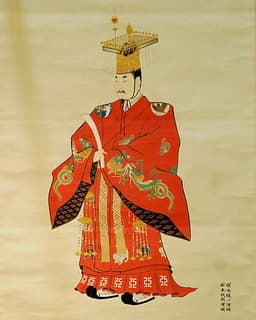
Emperor Go-Sanjo
Emperor · Medieval
44.5Total

Krishna I
Emperor · Medieval
57.6Total
Basic Information
Born
1034
756
Died
1073
774
Era
Medieval
Medieval
Nationality
Japan
India
Occupation
Emperor
Emperor
Civilization
Eastern
Indian
Score Comparison
Military (10%)
52.9
70.0
Political (20%)
35.1
68.0
Influence (20%)
47.9
56.7
Legacy (20%)
41.7
58.0
Leadership (15%)
31.2
40.0
Strategy (15%)
68.6
57.5
TOTAL
44.5
57.6
Emperor Go-Sanjo — Complete Timeline
1068 AD
Attempt to rule directly without Fujiwara regentsPolitical Action◆ Major
Upon ascending the throne, Go-Sanjo sought to govern without a Fujiwara regent, breaking the tradition of Fujiwara control over the imperial succession. He appointed non-Fujiwara officials and issued edicts directly, challenging the regency system.
Fujiwara RegencyImperial AuthorityHeian Period
Impact: nationalconstructive
1069 AD
Reform of land and tax policiesReform◆ Major
Go-Sanjo implemented policies to reclaim tax-exempt lands held by temples and aristocrats, aiming to strengthen imperial finances. These reforms reduced the economic power of the Fujiwara and other noble houses, though they faced resistance.
Land ReformTaxationEconomic Policy
Impact: nationalconstructive
1072 AD
Establishment of the Insei (cloistered government) precedentPolitical Action
Go-Sanjo abdicated in favor of his son Shirakawa but continued to exert influence from retirement, laying the groundwork for the cloistered government system. This allowed retired emperors to rule behind the scenes, bypassing Fujiwara regents.
Insei SystemImperial PoliticsHeian Period
Impact: nationalconstructive
Krishna I — Complete Timeline
760 AD
Construction of Kailasa TempleCultural◆ Major
Krishna I commissioned the Kailasa Temple at Ellora, a monolithic rock-cut Hindu temple dedicated to Shiva. The temple was carved from a single cliff face and is considered one of the largest and most impressive rock-cut structures in India.
ArchitectureElloraHindu Temple
Impact: globalconstructive
770 AD
Expansion of Rashtrakuta TerritoryWar◆ Major
Krishna I expanded the Rashtrakuta kingdom through military campaigns against the Gangas and other neighboring dynasties. These conquests consolidated Rashtrakuta control over much of the Deccan and central India.
Territorial ExpansionDeccanConquest
Impact: regional
This comparison has not been analyzed yet.
One-time AI generation (~1 minute). Scores and timeline are already available below.
Rankings
🥇
Krishna ILeader
Mil: 70.0Pol: 68.0Inf: 56.7
57.6
🥈
Emperor Go-Sanjo
Mil: 52.9Pol: 35.1Inf: 47.9
44.5
+13.1 behind
How This Comparison Works
Algorithm
Each figure is scored on 6 dimensions (0—100 scale) based on structured historical data: Military (10%), Political (20%), Influence (20%), Legacy (20%), Leadership (15%), Strategy (15%). The weighted total produces the final ranking.
Data Sources
Scores are computed from structured sub-indicators in the database. Scale factors adjust for era (Ancient ×0.85, Modern ×1.0) and civilization size (Eastern ×1.05, Other ×0.80) to account for differences in population and military scale.
Maximum 3 Figures
Comparisons are limited to 2—3 figures to ensure readability and statistical meaningfulness.
Error Margins
±5 points per dimension — Sub-scores are derived from historical records with inherent uncertainty. Two figures within 5 points on a dimension should be considered roughly equivalent in that area.
Total Score Accuracy
±3 points overall — The weighted combination of 6 dimensions produces a total score with approximately ±3 points of uncertainty. Differences of less than 3 points are not statistically significant— the figures are effectively tied.
Known Limitations
- Historical records are incomplete and uneven across civilizations
- Figures from oral-tradition societies may be underrepresented
- Occupation labels can misclassify multi-role figures
- Scores measure capability and impact, not moral character
- Quantitative scoring is a comparison tool, not absolute truth
Capability Radar
Military (10%) — Battles & Warfare
Battles
45
55
Win Rate
47
60
Expansion
51
60
Political (20%) — Governance & Reform
Reform
40
50
Diplomacy
30
55
Economy
20
60
Influence (20%) — Cultural & Global Reach
Cultural
15
70
Global
10
55
Legacy (20%) — Historical Impact
Historical
30
65
Longevity
20
60
Leadership (15%) — Power & Stability
Tenure
15
60
Stability
20
55
Strategy (15%) — Tactics & Innovation
Strategy
52
55
Tactics
60
50
Reform
61
40
Similar Comparisons
Comments & Discussion
No comments yet. Be the first to share your thoughts!