Loading...
Edward I Longshanks vs Michael of Chernigov
Edward I Longshanks leads by 21.0 pts · 2 figures compared
…
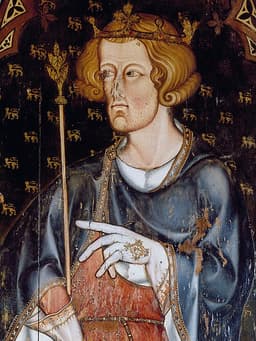
Edward I Longshanks
Emperor · Medieval
60.0Total
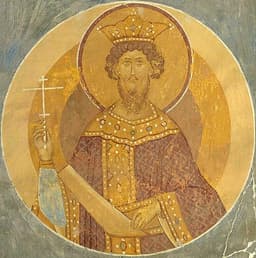
Michael of Chernigov
Emperor · Medieval
39.0Total
Basic Information
Born
1239
1185
Died
1307
1246
Era
Medieval
Medieval
Nationality
England
Kievan Rus
Occupation
Emperor
Emperor
Civilization
Western
Western
Score Comparison
Military (10%)
74.7
21.2
Political (20%)
68.0
27.9
Influence (20%)
61.0
51.8
Legacy (20%)
52.0
44.2
Leadership (15%)
53.2
38.1
Strategy (15%)
61.2
30.3
TOTAL
60.0
39.0
Edward I Longshanks — Complete Timeline
1282 AD
Conquest of WalesWar◆ Major
Edward I launched a full-scale conquest of Wales, defeating Llywelyn ap Gruffudd at the Battle of Orewin Bridge. He built castles and imposed English rule, incorporating Wales into the English crown.
ConquestWalesCastles
Impact: regionaldestructive
1284 AD
Statute of RhuddlanPolitical Action◆ Major
Edward I issued the Statute of Rhuddlan, which annexed Wales to the English crown and introduced English common law. This formalized the conquest and established English administration in Wales.
LawAnnexationWales
Impact: regionalconstructive
1295 AD
Model ParliamentPolitical Action◆ Major
Edward I summoned the Model Parliament, which included representatives from the commons, clergy, and nobility. This assembly set a precedent for parliamentary representation and taxation consent.
ParliamentRepresentationTaxation
Impact: nationalconstructive
1296 AD
Scottish Wars of IndependenceWar◆ Major
Edward I invaded Scotland after the death of Margaret, Maid of Norway, claiming overlordship. He defeated the Scots at Dunbar, captured the Stone of Scone, and attempted to impose English rule, sparking a long war.
InvasionScotlandStone of Scone
Impact: regionaldestructive
1298 AD
Battle of FalkirkWar◆ Major
Edward I defeated William Wallace's Scottish army at the Battle of Falkirk. Using longbowmen and cavalry, he broke the Scottish schiltron formations, crushing the rebellion temporarily.
BattleScotlandWilliam Wallace
Impact: regional
Michael of Chernigov — Complete Timeline
1239 AD
Prince of Chernigov during Mongol invasionWar◆ Major
Michael of Chernigov ruled as Prince of Chernigov when the Mongol Empire under Batu Khan invaded Rus'. Chernigov was besieged and captured by the Mongols in 1239. Michael fled to Hungary and then to Poland, seeking military aid against the invaders. His inability to defend his principality marked the collapse of Chernigov's independence.
Mongol invasionPrincipality lossExile
Impact: regionaltragic
1246 AD
Martyrdom at the Golden Horde courtOther◆ Major
Michael of Chernigov was summoned to the court of Batu Khan in Sarai. He refused to perform pagan rituals, including walking through fire and bowing to idols, as required by Mongol custom. For his refusal, he was executed by the Mongols along with his boyar Fedor. His death was later recognized as a martyrdom for the Orthodox faith.
MartyrdomReligious defianceMongol execution
Impact: regionaltragic
Expert Analysis
Origins
Edward I, born 1239, was the son of King Henry III of England. Educated in statecraft and warfare, he experienced a turbulent youth during the Second Barons' War. His early military campaigns in Wales and the Crusades shaped his ambitions.
Michael of Chernigov, born around 1185, was a prince of the Rurikid dynasty. He became Prince of Chernigov in 1223, inheriting a fragmented Rus' facing the Mongol threat. His early reign involved internal conflicts among Rus' princes.
Rise to Power
Edward I's rise began after the Battle of Evesham (1265), where he defeated Simon de Montfort. He joined the Ninth Crusade (1271-1272) and returned to become king in 1272. His conquest of Wales (1277-1283) solidified his power.
Michael of Chernigov rose to prominence as Prince of Chernigov, but his power was limited by Mongol invasions. After the Mongol capture of Chernigov (1239), he fled to Hungary and Poland, seeking allies. He later submitted to the Golden Horde but refused pagan rituals.
Leadership & Governance
Edward I centralized English government, issuing the Statute of Rhuddlan (1284) to annex Wales, and expanding the legal system. He summoned the Model Parliament (1295), including commoners, to gain support for wars. His military innovations used longbowmen effectively.
Michael of Chernigov governed a principality devastated by Mongol raids. His leadership focused on maintaining Russian Orthodox traditions against Mongol pressure. He lacked the resources to resist militarily, scoring 21.2 in military vs Edward's 74.7.
Triumph & Tragedy
Edward's triumph: conquering Wales and building formidable castles like Caernarfon. His tragedy: failing to subdue Scotland despite victories at Dunbar (1296) and Falkirk (1298). The Scottish Wars drained England's treasury.
Michael's triumph: his martyrdom (1246) for refusing pagan rituals, leading to canonization (1547). His tragedy: his inability to protect Chernigov from Mongol destruction, resulting in his own death and loss of his principality.
Character & Destiny
Edward I was determined and ruthless, earning the epithet 'Hammer of the Scots'. His legal reforms strengthened the crown but alienated nobles. His character drove him to pursue conquest, but his inflexibility hindered Scottish pacification.
Michael of Chernigov was devout and principled, choosing death over apostasy. His decision-making prioritized faith over political expediency. His destiny as a martyr shaped his legacy as a saint, but his political score of 27.9 reflects limited temporal impact.
Legacy
Edward I's legacy includes the English annexation of Wales, the Model Parliament's precedent, and the legal framework of common law. His score of 52.0 in legacy reflects enduring institutional changes.
Michael's legacy is primarily religious: he is venerated as a saint in the Russian Orthodox Church, symbolizing resistance to Mongol oppression. His influence score of 51.8 is comparable, but his political impact is minimal.
Conclusion
Edward I Longshanks had greater historical impact, with a total score of 60.0 vs Michael's 39.0. His military and political achievements reshaped England and its neighbors, while Michael's influence remained symbolic. The 21-point gap is justified by Edward's concrete, enduring changes to governance and territory.
Rankings
🥇
Edward I LongshanksLeader
Mil: 74.7Pol: 68.0Inf: 61.0
60.0
🥈
Michael of Chernigov
Mil: 21.2Pol: 27.9Inf: 51.8
39.0
+21.0 behind
How This Comparison Works
Algorithm
Each figure is scored on 6 dimensions (0—100 scale) based on structured historical data: Military (10%), Political (20%), Influence (20%), Legacy (20%), Leadership (15%), Strategy (15%). The weighted total produces the final ranking.
Data Sources
Scores are computed from structured sub-indicators in the database. Scale factors adjust for era (Ancient ×0.85, Modern ×1.0) and civilization size (Eastern ×1.05, Other ×0.80) to account for differences in population and military scale.
Maximum 3 Figures
Comparisons are limited to 2—3 figures to ensure readability and statistical meaningfulness.
Error Margins
±5 points per dimension — Sub-scores are derived from historical records with inherent uncertainty. Two figures within 5 points on a dimension should be considered roughly equivalent in that area.
Total Score Accuracy
±3 points overall — The weighted combination of 6 dimensions produces a total score with approximately ±3 points of uncertainty. Differences of less than 3 points are not statistically significant— the figures are effectively tied.
Known Limitations
- Historical records are incomplete and uneven across civilizations
- Figures from oral-tradition societies may be underrepresented
- Occupation labels can misclassify multi-role figures
- Scores measure capability and impact, not moral character
- Quantitative scoring is a comparison tool, not absolute truth
Capability Radar
Military (10%) — Battles & Warfare
Battles
75
15
Win Rate
70
10
Expansion
75
5
Political (20%) — Governance & Reform
Reform
65
10
Diplomacy
60
25
Economy
55
10
Influence (20%) — Cultural & Global Reach
Cultural
55
30
Global
50
20
Legacy (20%) — Historical Impact
Historical
70
35
Longevity
60
30
Leadership (15%) — Power & Stability
Tenure
70
30
Stability
50
15
Strategy (15%) — Tactics & Innovation
Strategy
80
15
Tactics
65
20
Reform
60
5
Similar Comparisons
Comments & Discussion
No comments yet. Be the first to share your thoughts!