Loading...
Eduardo Frei Montalva vs Istvan Szechenyi
Istvan Szechenyi leads by 4.9 pts · 2 figures compared
…

Eduardo Frei Montalva
Politician · Modern
53.3Total
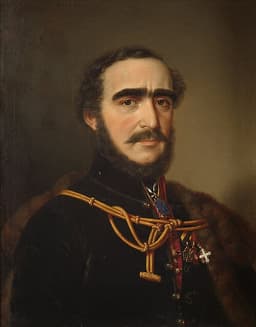
Istvan Szechenyi
Politician · Modern
58.2Total
Basic Information
Born
1911
1791
Died
1982
1860
Era
Modern
Modern
Nationality
Chile
Hungary
Occupation
Politician
Politician
Civilization
Western
Western
Score Comparison
Military (10%)
50.0
49.7
Political (20%)
62.7
72.0
Influence (20%)
58.0
56.7
Legacy (20%)
48.3
55.0
Leadership (15%)
53.2
68.0
Strategy (15%)
43.0
43.2
TOTAL
53.3
58.2
Eduardo Frei Montalva — Complete Timeline
1964 AD
Frei Montalva becomes President of ChilePolitical Action◆ Major
Eduardo Frei Montalva was elected President of Chile as the candidate of the Christian Democratic Party, winning a decisive victory. His presidency (1964-1970) aimed to implement a 'Revolution in Liberty' of social and economic reforms.
PresidencyChristian Democracy1964
Impact: national
1966 AD
Frei's Chileanization of copperReform◆ Major
Frei's government negotiated the 'Chileanization' of copper mines, acquiring a 51% stake in major U.S.-owned copper companies. This policy increased state revenue from copper exports but stopped short of full nationalization.
Copper PolicyNationalizationEconomic Reform
Impact: nationalconstructive
1967 AD
Frei's agrarian reform programReform◆ Major
Frei's government enacted a major agrarian reform law, expropriating large estates and redistributing land to peasant cooperatives. This aimed to reduce rural inequality and increase agricultural productivity, but faced opposition from landowners.
Agrarian ReformLand RedistributionRural Policy
Impact: nationalprogressive
1970 AD
Frei's role in the 1970 election and Allende's victoryPolitical Action◆ Major
Frei's presidency ended with the election of Salvador Allende, a socialist, after a close three-way race. Frei opposed Allende's victory and later supported the 1973 military coup, a decision that remains controversial.
1970 ElectionAllendePolitical Transition
Impact: national
1982 AD
Frei's death under suspicious circumstancesOther◆ Major
Eduardo Frei Montalva died in a Santiago clinic after a routine surgery. Allegations later emerged that he was poisoned by agents of the Pinochet regime, though this remains disputed. His death removed a key opposition figure.
DeathSuspiciousPinochet
Impact: nationaltragic
Istvan Szechenyi — Complete Timeline
1825 AD
Founding of the Hungarian Academy of SciencesCultural◆ Major
Istvan Szechenyi donated a year's income to found the Hungarian Academy of Sciences. The institution promoted scientific and cultural development in Hungary.
AcademyScienceCulture
Impact: nationalconstructive
1830 AD
Publication of 'Credit'Cultural◆ Major
Istvan Szechenyi published 'Credit', a book advocating for economic reforms in Hungary. The work argued for the abolition of serfdom and the modernization of agriculture.
PublicationReformEconomy
Impact: nationalconstructive
1849 AD
Chain Bridge ConstructionOther◆ Major
Istvan Szechenyi oversaw the construction of the Chain Bridge across the Danube in Budapest. The bridge connected Buda and Pest, symbolizing modernization and national unity.
InfrastructureBridgeModernization
Impact: nationalconstructive
1860 AD
SuicideOther◆ Major
Istvan Szechenyi died by suicide at the D
SuicideDeath
Impact: nationaltragic
Expert Analysis
Origins
Eduardo Frei Montalva was born on January 16, 1911, in Santiago, Chile, into a middle-class family of Swiss descent. He studied law at the Pontifical Catholic University of Chile, where he became involved in Catholic social movements. His early influences included the social teachings of the Church and European Christian democracy. Istvan Szechenyi was born on September 21, 1791, in Vienna, into one of Hungary's wealthiest aristocratic families. He served as a military officer in the Napoleonic Wars, which exposed him to Western European ideas of progress. His travels to England and France shaped his vision for modernizing Hungary.
Rise to Power
Frei's political career began in the 1930s as a founder of the National Falange, a Catholic reformist party that later evolved into the Christian Democratic Party. He served as Minister of Public Works under President Gabriel Gonzalez Videla (1945-1946) and later as senator. In 1964, he won the presidency with 56% of the vote, defeating Salvador Allende. His rise was marked by strong support from the middle class and the Catholic Church. Szechenyi's influence grew through his writings and activism. He published 'Credit' in 1830, which argued for abolishing serfdom and reforming land ownership. His key turning point was founding the Hungarian Academy of Sciences in 1825, donating a year's income. He became a leading figure in the Hungarian Reform Era, though he never held high political office. His influence stemmed from his aristocratic status and intellectual leadership.
Leadership & Governance
Frei governed as a reformist democrat, implementing the 'Revolution in Liberty' agenda. His administration (1964-1970) focused on three major reforms: agrarian reform, Chileanization of copper, and education expansion. The agrarian reform law of 1967 expropriated over 1,400 estates, redistributing land to 30,000 families. The Chileanization policy acquired 51% of U.S.-owned copper mines, increasing state revenue. He also expanded primary education enrollment by 40%. However, his reforms were moderate and faced opposition from both conservatives and leftists. Szechenyi, as a reformer without executive power, used his wealth and influence to promote modernization. He oversaw the construction of the Chain Bridge (1849), which connected Buda and Pest and became a symbol of unity. He also introduced steamship navigation on the Danube and promoted railway development. His approach was top-down, relying on aristocratic patronage and persuasion. Unlike Frei, Szechenyi had no formal authority to enforce change.
Triumph & Tragedy
Frei's greatest success was his peaceful transition of power in 1970, despite the controversial election of Allende. His agrarian reform and copper Chileanization increased state control over key sectors. However, his failure to radically redistribute wealth contributed to the polarization that led to the 1973 coup. After his presidency, he opposed Allende and initially supported the military, but later became a critic of Pinochet. His death in 1982, under suspicious circumstances (allegedly poisoned), was a tragic end. Szechenyi's triumphs include founding the Academy of Sciences and building the Chain Bridge, which accelerated Hungary's modernization. His writings inspired a generation of reformers. However, his mental health deteriorated in the 1850s, and he died by suicide in 1860. His later years were marked by disillusionment as the 1848 Revolution turned violent, and he felt his moderate reforms had been overtaken by radicalism.
Character & Destiny
Frei was a pragmatic, consensus-seeking leader, scoring 53.2 in leadership. His Christian democratic ideology emphasized gradual reform within democratic institutions. This cautious approach failed to satisfy the radical demands of peasants and workers, leading to the rise of Allende. His character—principled but cautious—shaped his destiny as a transitional figure between conservative and socialist eras. Szechenyi, with a leadership score of 68.0, was a visionary aristocrat who believed in gradual modernization from above. His character combined Enlightenment optimism with aristocratic paternalism. His destiny was to be a catalyst for change but unable to control the forces he unleashed. Both men faced the tragedy of seeing their moderate reforms overtaken by more radical movements.
Legacy
Frei's legacy is mixed. His reforms laid the groundwork for later land redistribution and state control of resources, but they also contributed to political polarization. The Christian Democratic Party remained a major force in Chile. He is remembered as a reformer who tried to prevent socialism. His death under Pinochet made him a symbol of resistance against dictatorship. Szechenyi is celebrated as 'the greatest Hungarian' for his role in modernizing the nation. The Academy of Sciences remains a prestigious institution, and the Chain Bridge is a Budapest landmark. His ideas influenced the 1848 reforms and later Hungarian development. However, his legacy is less tangible than Frei's due to his lack of political power. Szechenyi scores 55.0 in legacy, slightly higher than Frei's 48.3.
Conclusion
While both were reformers, Szechenyi had a more profound and lasting impact on Hungary's modernization. His political score of 72.0 and leadership of 68.0 reflect his ability to inspire change without formal power. Frei, with a political score of 62.7, achieved concrete reforms but failed to prevent the collapse of democracy. Szechenyi's vision created enduring institutions, while Frei's reforms were largely reversed or overshadowed by the subsequent dictatorship. Therefore, Istvan Szechenyi had a greater historical impact.
Rankings
🥇
Istvan SzechenyiLeader
Mil: 49.7Pol: 72.0Inf: 56.7
58.2
🥈
Eduardo Frei Montalva
Mil: 50.0Pol: 62.7Inf: 58.0
53.3
+4.9 behind
How This Comparison Works
Algorithm
Each figure is scored on 6 dimensions (0—100 scale) based on structured historical data: Military (10%), Political (20%), Influence (20%), Legacy (20%), Leadership (15%), Strategy (15%). The weighted total produces the final ranking.
Data Sources
Scores are computed from structured sub-indicators in the database. Scale factors adjust for era (Ancient ×0.85, Modern ×1.0) and civilization size (Eastern ×1.05, Other ×0.80) to account for differences in population and military scale.
Maximum 3 Figures
Comparisons are limited to 2—3 figures to ensure readability and statistical meaningfulness.
Error Margins
±5 points per dimension — Sub-scores are derived from historical records with inherent uncertainty. Two figures within 5 points on a dimension should be considered roughly equivalent in that area.
Total Score Accuracy
±3 points overall — The weighted combination of 6 dimensions produces a total score with approximately ±3 points of uncertainty. Differences of less than 3 points are not statistically significant— the figures are effectively tied.
Known Limitations
- Historical records are incomplete and uneven across civilizations
- Figures from oral-tradition societies may be underrepresented
- Occupation labels can misclassify multi-role figures
- Scores measure capability and impact, not moral character
- Quantitative scoring is a comparison tool, not absolute truth
Capability Radar
Military (10%) — Battles & Warfare
Battles
29
31
Win Rate
33
32
Expansion
32
33
Political (20%) — Governance & Reform
Reform
65
85
Diplomacy
55
60
Economy
50
80
Influence (20%) — Cultural & Global Reach
Cultural
45
70
Global
45
55
Legacy (20%) — Historical Impact
Historical
50
75
Longevity
40
65
Leadership (15%) — Power & Stability
Tenure
60
55
Stability
40
50
Strategy (15%) — Tactics & Innovation
Strategy
35
41
Tactics
43
40
Reform
46
45
Similar Comparisons
Comments & Discussion
No comments yet. Be the first to share your thoughts!