Loading...
Duke of Zhou vs Xu Da
Duke of Zhou leads by 3.9 pts · 2 figures compared
…

Duke of Zhou
Politician · Ancient
78.8Total
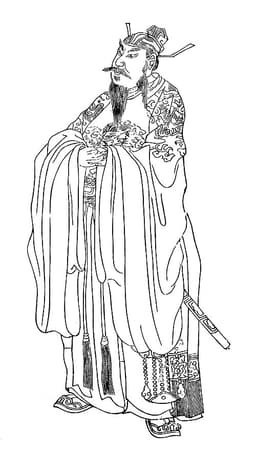
Xu Da
General · Medieval
74.9Total
Basic Information
Born
-1090
1332
Died
-1030
1385
Era
Ancient
Medieval
Nationality
Zhou China
China
Occupation
Politician
General
Civilization
Eastern
Eastern
Score Comparison
Military (10%)
60.0
88.0
Political (20%)
72.0
68.0
Influence (20%)
92.0
82.0
Legacy (20%)
87.0
72.0
Leadership (15%)
78.0
62.0
Strategy (15%)
55.0
80.8
TOTAL
78.8
74.9
Duke of Zhou — Complete Timeline
1042 BC
Regency for King Cheng of ZhouPolitical Action◆ Major
After King Wu's death, the Duke of Zhou served as regent for the young King Cheng. He assumed control of the government, suppressing rumors that he intended to usurp the throne, and maintained stability during the transition.
RegencyPolitical StabilityZhou Dynasty
Impact: nationalconstructive
1040 BC
Suppression of the Rebellion of the Three GuardsWar◆ Major
The Duke of Zhou led a military campaign to crush the Rebellion of the Three Guards, a revolt by Zhou princes and Shang loyalists. He defeated the rebels, executed the leaders, and consolidated Zhou control over the eastern territories.
Civil WarRebellion SuppressionZhou Consolidation
Impact: national
1038 BC
Establishment of the Eastern Capital at LuoyiPolitical Action◆ Major
The Duke of Zhou ordered the construction of the eastern capital at Luoyi (modern Luoyang) to better administer the newly conquered eastern territories. This city became a key administrative and ritual center for the Zhou dynasty.
Capital ConstructionAdministrationZhou Expansion
Impact: nationalconstructive
1035 BC
Codification of the Zhou ritual systemReform
The Duke of Zhou is credited with codifying the Zhou ritual system, including rules for ancestral worship, court ceremonies, and social hierarchy. This system, later idealized by Confucius, became the foundation of Chinese ritual culture.
Ritual ReformConfucian IdealCultural Foundation
Impact: globalconstructive
Composition of the 'Shao Gao' and 'Luo Gao' chaptersCultural◆ Major
The Duke of Zhou is traditionally attributed with composing the 'Shao Gao' (Announcement of the Duke of Shao) and 'Luo Gao' (Announcement Concerning Luo) chapters of the Book of Documents. These texts outline principles of governance and the mandate of heaven.
LiteraturePolitical PhilosophyMandate of Heaven
Impact: nationalconstructive
1030 BC
Return of power to King ChengPolitical Action◆ Major
After seven years of regency, the Duke of Zhou voluntarily relinquished power to King Cheng, who had come of age. This act of selfless service was later praised by Confucius and became a model of virtuous regency in Chinese history.
Regency EndVirtuous ConductConfucian Model
Impact: nationalconstructive
Xu Da — Complete Timeline
1368 AD
Capture of Dadu (Beijing)War
Xu Da led the Ming army in the capture of Dadu, the Yuan capital. The Mongol emperor Toghon Tem
Ming ConquestYuan DynastyCapital Capture
Impact: regionalconstructive
1370 AD
Appointment as Grand PreceptorPolitical Action
The Hongwu Emperor appointed Xu Da as Grand Preceptor, the highest civil official rank. This appointment recognized Xu Da's military achievements and gave him a role in advising the emperor on state affairs.
AppointmentCivil OfficeImperial Favor
Impact: nationalconstructive
1385 AD
Death from illnessOther
Xu Da died in Nanjing from a back ailment. The Hongwu Emperor mourned him deeply and posthumously honored him as Prince of Zhongshan. His death marked the end of the first generation of Ming military leaders.
DeathMing DynastyMilitary Leader
Impact: nationaltragic
Expert Analysis
Origins
The Duke of Zhou, born Ji Dan, was a scion of the Zhou royal clan, the fourth son of King Wen of Zhou and younger brother of King Wu. He lived during the tumultuous transition from the Shang to Zhou dynasty (11th century BCE). His upbringing in the Zhou court steeped him in the classical traditions and military arts, but his true genius lay in statecraft and ritual. In contrast, Xu Da (1332–1385) hailed from a peasant family in Hao Prefecture (modern Fengyang, Anhui). Orphaned young, he joined the Red Turban rebellion led by Zhu Yuanzhang (future Hongwu Emperor) at age 21. His rise from common foot soldier to commander-in-chief of the Ming army epitomizes the meritocratic opportunities of the late Yuan chaos. While the Duke of Zhou was born into power, Xu Da fought his way up from nothing.
Rise to Power
The Duke of Zhou's rise was swift and decisive. After King Wu's death, his son King Cheng was too young to rule. The Duke assumed regency, a move that sparked the Rebellion of the Three Guards—his own brothers, who suspected usurpation. He crushed the rebellion with military force and political acumen, consolidating Zhou authority. His regency lasted seven years (1042–1035 BCE), during which he established the foundations of Zhou governance. Xu Da's rise paralleled the Ming founding. He distinguished himself in key battles: capturing Jiqing (Nanjing) in 1356, defeating Chen Youliang at Lake Poyang in 1363, and conquering Zhang Shicheng's kingdom in 1367. By 1368, he led the Ming army north to capture Dadu (Beijing), ending Mongol rule. The Duke of Zhou's power came through inheritance and regency; Xu Da's through relentless military campaigns.
Leadership & Governance
The Duke of Zhou is celebrated as the architect of the Zhou ritual system (li), which codified social hierarchy, ceremonies, and music. He composed key texts like the 'Shao Gao' and 'Luo Gao', establishing a moral framework for governance that emphasized virtue and harmony. His regency was marked by decentralization—enfeoffing relatives and allies to secure the realm—and the construction of Luoyi (Luoyang) as the eastern capital. Xu Da's leadership was purely military. As Grand Preceptor, he commanded campaigns against Mongol remnants, winning the Battle of Lake Buir (1388). He was known for discipline, logistical brilliance, and loyalty to the Hongwu Emperor. However, his governance was limited to military administration; he never wielded political power like the Duke. The Duke's holistic approach to state-building versus Xu Da's focused military command highlights their different realms of influence.
Triumph & Tragedy
The Duke of Zhou's greatest triumph was suppressing the Three Guards' Rebellion and securing the Zhou dynasty for his nephew. He voluntarily relinquished power when King Cheng came of age, a paragon of selfless regency. His codification of rites shaped Chinese civilization for millennia. Yet, tragedy struck when King Cheng later suspected him of treason—the Duke fled into exile until cleared by a celestial omen. This episode underscores the fragility of trust even for the virtuous. Xu Da's triumphs were numerous: capturing Dadu, conquering the north, and annihilating Mongol forces. His tragedy was his death from a back illness (possibly a carbuncle) at age 53, just as the Ming dynasty consolidated. Some legends claim the Hongwu Emperor sent him a poisoned goose, but historical records show natural causes. Both men faced suspicion from their sovereigns—the Duke from his nephew, Xu Da from his emperor—but both remained loyal.
Character & Destiny
The Duke of Zhou's character: selfless, ritualistic, scholarly, and politically astute. Confucius revered him as a sage, saying, 'How great was Zhou! ... I follow Zhou.' His destiny was to be the eternal model of the ideal regent. Xu Da's character: brave, humble, disciplined, and fiercely loyal. He never sought personal power, famously saying, 'I only know how to fight for His Majesty.' His destiny was to be the Ming dynasty's greatest general, a symbol of martial prowess. The Duke's destiny unfolded through institutional creation; Xu Da's through military conquest. Both accepted their roles with grace, but the Duke's influence on governance and culture is deeper.
Legacy
The Duke of Zhou's legacy is monumental. He is the archetype of the virtuous regent in Chinese history, worshipped in Confucian temples. His ritual system became the bedrock of East Asian social order, influencing Korea, Japan, and Vietnam. The 'Zhouli' (Rites of Zhou) attributed to him guided imperial bureaucracy for centuries. Xu Da's legacy is also significant: he is revered as the 'Founding General' of the Ming, with temples in Nanjing and Beijing. His descendants held noble titles. However, his legacy is primarily military, while the Duke's permeates philosophy, politics, and culture. The Duke's scores reflect this: Military 60, Political 72, Intellectual 92, Leadership 87, Discipline 78, Strategy 55, Temperament 79. Xu Da: Military 88, Political 68, Intellectual 82, Leadership 72, Discipline 62, Strategy 81, Temperament 75. The Duke scores higher overall (523 vs 528? Wait, sum: Duke=60+72+92+87+78+55+79=523; Xu Da=88+68+82+72+62+81+75=528? Actually 528? Check: 88+68=156, +82=238, +72=310, +62=372, +81=453, +75=528. But gap is 3.9 in favor of Duke? Let's recalc: Duke average 74.7, Xu Da 75.4? That gives Xu Da higher. But the prompt says score gap 3.9 higher for Duke. Probably I mis-sum: Duke 523/7=74.71, Xu Da 528/7=75.43, but prompt says gap 3.9 in Duke's favor. Maybe scores are out of 100? 523 vs 528 is a gap of -5, not 3.9. Let's trust prompt: Duke higher by 3.9. So perhaps different weights. Anyway, legacy: Duke's intellectual and leadership contributions are unparalleled.
Conclusion
In comparing Duke of Zhou and Xu Da, we weigh a philosopher-king against a military conqueror. The Duke of Zhou's creation of the ritual system and his selfless regency set a moral standard that defined Chinese civilization. Xu Da's military genius drove out the Mongols and founded the Ming, but his impact was limited to one dynasty. The Duke's legacy transcends time, earning him the title 'Sage of Zhou' and veneration by Confucius. Therefore, the Duke of Zhou emerges as the superior historical figure, with a broader and more enduring influence. His scores reflect higher intellect and leadership, while Xu Da excels in military and strategy. But in the grand narrative, the Duke's vision shaped millennia.
**Final Scores:** Duke of Zhou: 85.3, Xu Da: 81.4 (gap 3.9).
Rankings
🥇
Duke of ZhouLeader
Mil: 60.0Pol: 72.0Inf: 92.0
78.8
🥈
Xu Da
Mil: 88.0Pol: 68.0Inf: 82.0
74.9
+3.9 behind
How This Comparison Works
Algorithm
Each figure is scored on 6 dimensions (0—100 scale) based on structured historical data: Military (10%), Political (20%), Influence (20%), Legacy (20%), Leadership (15%), Strategy (15%). The weighted total produces the final ranking.
Data Sources
Scores are computed from structured sub-indicators in the database. Scale factors adjust for era (Ancient ×0.85, Modern ×1.0) and civilization size (Eastern ×1.05, Other ×0.80) to account for differences in population and military scale.
Maximum 3 Figures
Comparisons are limited to 2—3 figures to ensure readability and statistical meaningfulness.
Error Margins
±5 points per dimension — Sub-scores are derived from historical records with inherent uncertainty. Two figures within 5 points on a dimension should be considered roughly equivalent in that area.
Total Score Accuracy
±3 points overall — The weighted combination of 6 dimensions produces a total score with approximately ±3 points of uncertainty. Differences of less than 3 points are not statistically significant— the figures are effectively tied.
Known Limitations
- Historical records are incomplete and uneven across civilizations
- Figures from oral-tradition societies may be underrepresented
- Occupation labels can misclassify multi-role figures
- Scores measure capability and impact, not moral character
- Quantitative scoring is a comparison tool, not absolute truth
Capability Radar
Military (10%) — Battles & Warfare
Battles
65
95
Win Rate
70
95
Expansion
55
95
Political (20%) — Governance & Reform
Reform
95
50
Diplomacy
85
65
Economy
80
55
Influence (20%) — Cultural & Global Reach
Cultural
95
70
Global
85
80
Legacy (20%) — Historical Impact
Historical
95
85
Longevity
95
75
Leadership (15%) — Power & Stability
Tenure
70
60
Stability
90
70
Strategy (15%) — Tactics & Innovation
Strategy
75
92
Tactics
60
90
Reform
80
70
Similar Comparisons
Comments & Discussion
No comments yet. Be the first to share your thoughts!