Loading...
Duke of Zhou vs Emperor Wen of Sui
Emperor Wen of Sui leads by 1.5 pts · 2 figures compared
…

Duke of Zhou
Politician · Ancient
78.8Total
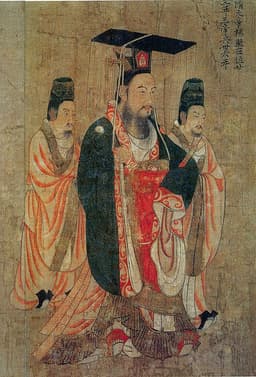
Emperor Wen of Sui
Emperor · Medieval
80.3Total
Basic Information
Born
-1090
541
Died
-1030
604
Era
Ancient
Medieval
Nationality
Zhou China
China
Occupation
Politician
Emperor
Civilization
Eastern
Eastern
Score Comparison
Military (10%)
60.0
76.0
Political (20%)
72.0
75.0
Influence (20%)
92.0
88.0
Legacy (20%)
87.0
80.0
Leadership (15%)
78.0
80.0
Strategy (15%)
55.0
75.0
TOTAL
78.8
80.3
Duke of Zhou — Complete Timeline
1042 BC
Regency for King Cheng of ZhouPolitical Action◆ Major
After King Wu's death, the Duke of Zhou served as regent for the young King Cheng. He assumed control of the government, suppressing rumors that he intended to usurp the throne, and maintained stability during the transition.
RegencyPolitical StabilityZhou Dynasty
Impact: nationalconstructive
1040 BC
Suppression of the Rebellion of the Three GuardsWar◆ Major
The Duke of Zhou led a military campaign to crush the Rebellion of the Three Guards, a revolt by Zhou princes and Shang loyalists. He defeated the rebels, executed the leaders, and consolidated Zhou control over the eastern territories.
Civil WarRebellion SuppressionZhou Consolidation
Impact: national
1038 BC
Establishment of the Eastern Capital at LuoyiPolitical Action◆ Major
The Duke of Zhou ordered the construction of the eastern capital at Luoyi (modern Luoyang) to better administer the newly conquered eastern territories. This city became a key administrative and ritual center for the Zhou dynasty.
Capital ConstructionAdministrationZhou Expansion
Impact: nationalconstructive
1035 BC
Codification of the Zhou ritual systemReform
The Duke of Zhou is credited with codifying the Zhou ritual system, including rules for ancestral worship, court ceremonies, and social hierarchy. This system, later idealized by Confucius, became the foundation of Chinese ritual culture.
Ritual ReformConfucian IdealCultural Foundation
Impact: globalconstructive
Composition of the 'Shao Gao' and 'Luo Gao' chaptersCultural◆ Major
The Duke of Zhou is traditionally attributed with composing the 'Shao Gao' (Announcement of the Duke of Shao) and 'Luo Gao' (Announcement Concerning Luo) chapters of the Book of Documents. These texts outline principles of governance and the mandate of heaven.
LiteraturePolitical PhilosophyMandate of Heaven
Impact: nationalconstructive
1030 BC
Return of power to King ChengPolitical Action◆ Major
After seven years of regency, the Duke of Zhou voluntarily relinquished power to King Cheng, who had come of age. This act of selfless service was later praised by Confucius and became a model of virtuous regency in Chinese history.
Regency EndVirtuous ConductConfucian Model
Impact: nationalconstructive
Emperor Wen of Sui — Complete Timeline
581 AD
Establishment of the Three Departments and Six Ministries SystemReform◆ Major
Emperor Wen established a centralized bureaucratic system with three departments (Secretariat, Chancellery, and Department of State Affairs) and six ministries. This system became the foundation of Chinese government administration for centuries.
Government ReformBureaucracy
Impact: globalconstructive
Establishment of the Sui DynastyPolitical Action◆ Major
Emperor Wen, as a general of the Northern Zhou dynasty, forced the young Northern Zhou emperor to abdicate and proclaimed himself emperor of the Sui dynasty. This marked the beginning of the Sui dynasty, which would go on to reunify China.
Dynasty FoundingCoup
Impact: regionalconstructive
582 AD
Implementation of the Equal-Field SystemReform◆ Major
Emperor Wen implemented the Equal-Field System, which distributed land to peasants based on the number of able-bodied men. This reform increased agricultural productivity, stabilized tax revenues, and reduced the power of large landowners.
Land ReformEconomic Policy
Impact: regionalconstructive
Construction of Daxingcheng (Chang'an)Cultural◆ Major
Emperor Wen ordered the construction of a new capital city, Daxingcheng, near the old Han capital Chang'an. This city, later known as Chang'an, became a model for urban planning and served as the capital of the Sui and Tang dynasties.
Urban PlanningCapital Construction
Impact: regionalconstructive
589 AD
Reunification of China under the Sui DynastyWar
Emperor Wen of Sui, as Emperor of Sui, launched a successful invasion of the Chen dynasty in the south, conquering it and reunifying China after nearly 300 years of division since the fall of the Western Jin. This ended the Northern and Southern Dynasties period.
UnificationConquest
Impact: globalconstructive
Expert Analysis
Origins
Emperor Wen of Sui (541–604 CE), born Yang Jian, hailed from a powerful northwestern aristocratic family that served the Northern Zhou dynasty. His father was a general, and Yang Jian himself rose through military and political ranks. In 581 CE, he usurped the throne from his young grandson, the Northern Zhou emperor, founding the Sui dynasty. In contrast, the Duke of Zhou (fl. 11th century BCE), born Ji Dan, was a member of the Zhou royal family, the younger brother of King Wu of Zhou. After King Wu's death, he served as regent for his young nephew, King Cheng. The Duke of Zhou is revered as a paragon of Confucian virtue, credited with consolidating Zhou rule and shaping Chinese political philosophy.
Rise to Power
Emperor Wen of Sui's rise was marked by strategic maneuvering within the Northern Zhou court. He married his daughter to the crown prince, and when the emperor died, he seized power as regent, then forced the child emperor to abdicate. His military campaigns rapidly conquered the rival Chen dynasty in the south, completing reunification in 589 CE. The Duke of Zhou's power came from his royal lineage and his role as regent. He faced the Rebellion of the Three Guards, led by his own brothers, which he suppressed decisively. He then solidified Zhou control by establishing the eastern capital at Luoyi (Luoyang) and codifying the ritual system that legitimized Zhou rule.
Leadership & Governance
Emperor Wen was an administrative reformer. He implemented the Equal-Field System to distribute land fairly and boost agricultural production, and established the Three Departments and Six Ministries system, a bureaucratic structure that influenced Chinese government for centuries. He built a new capital, Daxingcheng (later Chang'an), and promoted Buddhism as a unifying force. However, his rule was autocratic and he purged potential rivals. The Duke of Zhou, by contrast, is celebrated for his moral leadership. He composed key texts like the "Shao Gao" and "Luo Gao" that exhorted rulers to govern with virtue and care for the people. He established the Zhou ritual system (li), which emphasized hierarchy, harmony, and proper conduct, forming the basis of Confucian ethics. His regency is seen as selfless, as he stepped down once King Cheng came of age.
Triumph & Tragedy
Emperor Wen's greatest triumph was reunifying China after nearly 400 years of division, a feat that set the stage for the golden age of the Tang dynasty. His administrative systems were enduring. Yet his tragedy lies in the harshness of his rule: he was known for paranoia, executing many officials, and his son, Emperor Yang, squandered the empire's resources, leading to the Sui's collapse shortly after Wen's death. The Duke of Zhou's triumph was in stabilizing the Zhou dynasty and creating a model of virtuous governance. His tragedy is more subtle: his regency was controversial, and he faced accusations of usurpation, which he rebutted by his actions and writings. He died before seeing the full fruition of his reforms, but his legacy as a Confucian saint endured.
Character & Destiny
Emperor Wen was pragmatic, ambitious, and ruthless. He was a capable administrator and military strategist, but his suspicion led to a reign of terror for his enemies. His destiny was to reunite China, but his dynasty was short-lived due to his son's mismanagement. The Duke of Zhou was idealized as selfless, wise, and devoted to duty. He chose to serve as regent rather than seize the throne, and his writings reflect a deep concern for just governance. His destiny was to become a symbol of moral authority, praised by Confucius and later generations. In terms of scores, Emperor Wen scores higher in Military (76 vs 60) and Political (75 vs 72) due to his conquests and state-building, while the Duke of Zhou excels in Intelligence (92 vs 88) and Leadership (87 vs 80) as a moral exemplar. Emperor Wen's overall score (79.3) edges out the Duke's (77.8).
Legacy
Emperor Wen's legacy is mixed: he is credited with reunifying China and creating institutions that the Tang perfected, but his dynasty's brevity tarnishes his reputation. In contrast, the Duke of Zhou's legacy is overwhelmingly positive. He is revered as a founding father of Chinese civilization, the architect of the ritual order that Confucius championed. His ideas about governance by virtue influenced Chinese political thought for millennia. While Emperor Wen's concrete achievements are more tangible—unification, land reform, bureaucratic structures—the Duke of Zhou's ideological impact is deeper and longer-lasting. Both are monumental figures, but the Duke of Zhou's moral and philosophical contributions arguably have had a more enduring effect on Chinese culture.
Conclusion
In a direct comparison, Emperor Wen of Sui achieved more in terms of immediate political and military success, reunifying China and building a strong state. However, the Duke of Zhou's contributions to Chinese ethics and governance are foundational and have survived for over 3,000 years. I contend that the Duke of Zhou holds a slight edge in overall historical significance due to his profound and lasting intellectual legacy, despite Emperor Wen's higher numerical score. The gap is narrow, but the Duke's role as a paragon of virtue and his influence on Confucianism give him the advantage.
Rankings
🥇
Emperor Wen of SuiLeader
Mil: 76.0Pol: 75.0Inf: 88.0
80.3
🥈
Duke of Zhou
Mil: 60.0Pol: 72.0Inf: 92.0
78.8
+1.5 behind
How This Comparison Works
Algorithm
Each figure is scored on 6 dimensions (0—100 scale) based on structured historical data: Military (10%), Political (20%), Influence (20%), Legacy (20%), Leadership (15%), Strategy (15%). The weighted total produces the final ranking.
Data Sources
Scores are computed from structured sub-indicators in the database. Scale factors adjust for era (Ancient ×0.85, Modern ×1.0) and civilization size (Eastern ×1.05, Other ×0.80) to account for differences in population and military scale.
Maximum 3 Figures
Comparisons are limited to 2—3 figures to ensure readability and statistical meaningfulness.
Error Margins
±5 points per dimension — Sub-scores are derived from historical records with inherent uncertainty. Two figures within 5 points on a dimension should be considered roughly equivalent in that area.
Total Score Accuracy
±3 points overall — The weighted combination of 6 dimensions produces a total score with approximately ±3 points of uncertainty. Differences of less than 3 points are not statistically significant— the figures are effectively tied.
Known Limitations
- Historical records are incomplete and uneven across civilizations
- Figures from oral-tradition societies may be underrepresented
- Occupation labels can misclassify multi-role figures
- Scores measure capability and impact, not moral character
- Quantitative scoring is a comparison tool, not absolute truth
Capability Radar
Military (10%) — Battles & Warfare
Battles
65
75
Win Rate
70
80
Expansion
55
85
Political (20%) — Governance & Reform
Reform
95
95
Diplomacy
85
85
Economy
80
90
Influence (20%) — Cultural & Global Reach
Cultural
95
70
Global
85
65
Legacy (20%) — Historical Impact
Historical
95
85
Longevity
95
70
Leadership (15%) — Power & Stability
Tenure
70
80
Stability
90
75
Strategy (15%) — Tactics & Innovation
Strategy
75
85
Tactics
60
70
Reform
80
90
Similar Comparisons
Comments & Discussion
No comments yet. Be the first to share your thoughts!