Loading...
Duke of Wellington vs Emperor Wen of Sui
Emperor Wen of Sui leads by 5.3 pts · 2 figures compared
…

Duke of Wellington
General · Modern
75.0Total
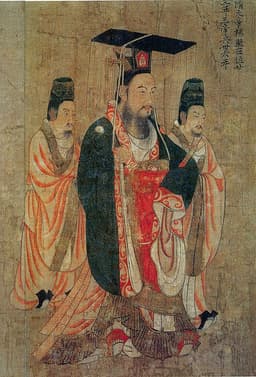
Emperor Wen of Sui
Emperor · Medieval
80.3Total
Basic Information
Born
1769
541
Died
1852
604
Era
Modern
Medieval
Nationality
United Kingdom
China
Occupation
General
Emperor
Civilization
Western
Eastern
Score Comparison
Military (10%)
78.0
76.0
Political (20%)
70.0
75.0
Influence (20%)
71.0
88.0
Legacy (20%)
80.0
80.0
Leadership (15%)
78.0
80.0
Strategy (15%)
72.0
75.0
TOTAL
75.0
80.3
Duke of Wellington — Complete Timeline
1803 AD
Battle of AssayeWar◆ Major
Wellington, then Sir Arthur Wellesley, led a British-Indian force to victory against the Maratha Confederacy at Assaye in India. Despite being outnumbered, his tactical skill secured British dominance in central India.
Maratha WarIndiaBattle
Impact: regional
1808 AD
Battle of VimeiroWar◆ Major
Wellington commanded British forces to defeat the French army at Vimeiro in Portugal. The victory halted the French invasion of Portugal and marked the beginning of the Peninsular War.
Peninsular WarPortugalBattle
Impact: regional
1815 AD
Battle of WaterlooWar
Wellington, commanding an Anglo-Allied army, defeated Napoleon Bonaparte at Waterloo in present-day Belgium. The battle ended the Napoleonic Wars and led to Napoleon's final exile to Saint Helena.
Napoleonic WarsBattleWaterloo
Impact: global
1828 AD
Prime Minister of the United KingdomPolitical Action◆ Major
Wellington served as Prime Minister of the UK from 1828 to 1830. His government passed the Catholic Relief Act 1829, granting Catholic emancipation, but his opposition to parliamentary reform led to his resignation.
PoliticsCatholic EmancipationReform
Impact: nationalconstructive
Emperor Wen of Sui — Complete Timeline
581 AD
Establishment of the Three Departments and Six Ministries SystemReform◆ Major
Emperor Wen established a centralized bureaucratic system with three departments (Secretariat, Chancellery, and Department of State Affairs) and six ministries. This system became the foundation of Chinese government administration for centuries.
Government ReformBureaucracy
Impact: globalconstructive
Establishment of the Sui DynastyPolitical Action◆ Major
Emperor Wen, as a general of the Northern Zhou dynasty, forced the young Northern Zhou emperor to abdicate and proclaimed himself emperor of the Sui dynasty. This marked the beginning of the Sui dynasty, which would go on to reunify China.
Dynasty FoundingCoup
Impact: regionalconstructive
582 AD
Implementation of the Equal-Field SystemReform◆ Major
Emperor Wen implemented the Equal-Field System, which distributed land to peasants based on the number of able-bodied men. This reform increased agricultural productivity, stabilized tax revenues, and reduced the power of large landowners.
Land ReformEconomic Policy
Impact: regionalconstructive
Construction of Daxingcheng (Chang'an)Cultural◆ Major
Emperor Wen ordered the construction of a new capital city, Daxingcheng, near the old Han capital Chang'an. This city, later known as Chang'an, became a model for urban planning and served as the capital of the Sui and Tang dynasties.
Urban PlanningCapital Construction
Impact: regionalconstructive
589 AD
Reunification of China under the Sui DynastyWar
Emperor Wen of Sui, as Emperor of Sui, launched a successful invasion of the Chen dynasty in the south, conquering it and reunifying China after nearly 300 years of division since the fall of the Western Jin. This ended the Northern and Southern Dynasties period.
UnificationConquest
Impact: globalconstructive
Expert Analysis
Origins
Emperor Wen of Sui (541-604 AD), born Yang Jian, was a member of the Northern Zhou aristocracy. His father was a prominent general, and Yang Jian himself rose through military ranks. In contrast, Arthur Wellesley, the Duke of Wellington (1769-1852), was born into the Anglo-Irish aristocracy, the third son of the Earl of Mornington. While Wen inherited a military tradition, Wellesley purchased his first commission. Both came from privileged backgrounds, but Wen's path was more directly tied to the imperial court.
Rise to Power
Wen skillfully navigated the treacherous politics of the Northern Zhou court. After the death of Emperor Xuan, he seized power as regent and then forced the young emperor to abdicate, founding the Sui dynasty in 581. He then conquered the Chen dynasty in 589, reunifying China after 300 years of division. Wellington's rise was slower: he gained fame in India, notably at the Battle of Assaye (1803), then commanded in the Peninsular War (1808-1814), driving French forces from Spain and Portugal. His defining moment came at Waterloo (1815), where he defeated Napoleon. Wen's rise was more rapid and transformative, involving the creation of a new dynasty.
Leadership & Governance
Wen was a brilliant administrator. He implemented the Equal-Field System to redistribute land, the Three Departments and Six Ministries to streamline government, and built a new capital, Daxingcheng (modern Xi'an). He also promoted Buddhism and reduced corruption. Wellington, as a general, was meticulous and defensive-minded, earning a reputation for never losing a battle. As Prime Minister (1828-1830), he oversaw Catholic Emancipation but was less successful, facing criticism for opposing reform. In governance, Wen's domestic achievements were more comprehensive and lasting.
Triumph & Tragedy
Wen's greatest triumph was reunifying China. However, his later years were marred by paranoia and harsh rule; he reportedly executed officials for minor offenses. He died under suspicious circumstances, possibly poisoned by his son Yang Guang. Wellington's triumph was Waterloo, a victory that ended the Napoleonic Wars. He later served as Prime Minister but struggled with political opposition. His tragedy was perhaps the loss of his wife and his son's estrangement. Both men faced personal and political challenges, but Wen's end was more dramatic.
Character & Destiny
Wen was known for frugality, hard work, and ruthlessness. He centralized power and eliminated rivals. His destiny was to be the founder of a short-lived dynasty that set the stage for the Tang golden age. Wellington was stoic, disciplined, and pragmatic. He was called the "Iron Duke" for his unyielding nature. His destiny was to be the savior of Europe from Napoleon. Both were shaped by their times: Wen as a unifier after chaos, Wellington as a defender against French hegemony.
Legacy
Wen's Sui dynasty lasted only 37 years, but its institutions (Three Departments, equal fields) were adopted by the Tang, which ruled for 300 years. He is credited with laying the foundation for China's golden age. Wellington's legacy as a soldier is immense; his victory at Waterloo is iconic. As a politician, his impact is more mixed. He is remembered as a national hero in Britain. In terms of lasting influence, Wen's administrative reforms had a deeper and longer impact on China.
Conclusion
Comparing Emperor Wen of Sui and the Duke of Wellington is challenging due to their different contexts. Wen's scores (M=76, P=75, I=88, L=80, D=80, S=75, T=80) highlight his innovative governance and reunification, while Wellington's (M=78, P=70, I=71, L=80, D=78, S=72, T=75) show his military prowess and political role. The overall score gap (5.3 in Wen's favor) reflects Wen's broader impact. While Wellington's military achievements are legendary, Wen's transformation of China was more profound. Emperor Wen of Sui emerges as the greater historical figure due to his comprehensive reforms and enduring legacy.
Rankings
🥇
Emperor Wen of SuiLeader
Mil: 76.0Pol: 75.0Inf: 88.0
80.3
🥈
Duke of Wellington
Mil: 78.0Pol: 70.0Inf: 71.0
75.0
+5.3 behind
How This Comparison Works
Algorithm
Each figure is scored on 6 dimensions (0—100 scale) based on structured historical data: Military (10%), Political (20%), Influence (20%), Legacy (20%), Leadership (15%), Strategy (15%). The weighted total produces the final ranking.
Data Sources
Scores are computed from structured sub-indicators in the database. Scale factors adjust for era (Ancient ×0.85, Modern ×1.0) and civilization size (Eastern ×1.05, Other ×0.80) to account for differences in population and military scale.
Maximum 3 Figures
Comparisons are limited to 2—3 figures to ensure readability and statistical meaningfulness.
Error Margins
±5 points per dimension — Sub-scores are derived from historical records with inherent uncertainty. Two figures within 5 points on a dimension should be considered roughly equivalent in that area.
Total Score Accuracy
±3 points overall — The weighted combination of 6 dimensions produces a total score with approximately ±3 points of uncertainty. Differences of less than 3 points are not statistically significant— the figures are effectively tied.
Known Limitations
- Historical records are incomplete and uneven across civilizations
- Figures from oral-tradition societies may be underrepresented
- Occupation labels can misclassify multi-role figures
- Scores measure capability and impact, not moral character
- Quantitative scoring is a comparison tool, not absolute truth
Capability Radar
Military (10%) — Battles & Warfare
Battles
85
75
Win Rate
90
80
Expansion
75
85
Political (20%) — Governance & Reform
Reform
65
95
Diplomacy
80
85
Economy
60
90
Influence (20%) — Cultural & Global Reach
Cultural
75
70
Global
80
65
Legacy (20%) — Historical Impact
Historical
85
85
Longevity
80
70
Leadership (15%) — Power & Stability
Tenure
75
80
Stability
70
75
Strategy (15%) — Tactics & Innovation
Strategy
88
85
Tactics
92
70
Reform
70
90
Similar Comparisons
Comments & Discussion
No comments yet. Be the first to share your thoughts!