Loading...
Dorgon vs Emperor Taizong of Tang
Emperor Taizong of Tang leads by 0.9 pts · 2 figures compared
…

Dorgon
General · Modern
78.0Total
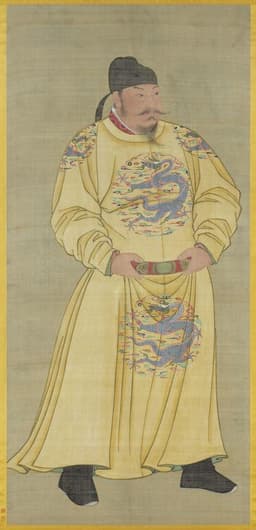
Emperor Taizong of Tang
Emperor · Medieval
78.9Total
Basic Information
Born
1612
598
Died
1650
649
Era
Modern
Medieval
Nationality
China
China
Occupation
General
Emperor
Civilization
Eastern
Eastern
Score Comparison
Military (10%)
78.5
77.5
Political (20%)
78.0
82.0
Influence (20%)
88.0
85.0
Legacy (20%)
65.0
71.4
Leadership (15%)
85.0
78.0
Strategy (15%)
75.0
80.6
TOTAL
78.0
78.9
Dorgon — Complete Timeline
1643 AD
Appointed Prince RegentPolitical Action◆ Major
Upon the death of Hong Taiji, Dorgon was appointed as regent for the young Shunzhi Emperor. This position gave him effective control over the Qing government and military, enabling him to direct the conquest of Ming China.
RegencyPower transition
Impact: national
1644 AD
Battle of Shanhai PassWar
Dorgon allied with Ming general Wu Sangui to defeat Li Zicheng's rebel forces at Shanhai Pass. This victory allowed Qing forces to enter Beijing and establish the Qing dynasty as the ruling power in China.
Qing conquestBattleAlliance
Impact: national
1645 AD
Conquest of Southern MingWar◆ Major
Dorgon led Qing forces in a campaign against the Southern Ming regime, capturing Nanjing and defeating the Hongguang Emperor. This campaign extended Qing control over the Yangtze River valley and weakened Ming loyalist resistance.
Qing conquestMilitary campaign
Impact: national
Issued the Queue OrderReform◆ Major
Dorgon mandated that all Chinese men adopt the Manchu queue hairstyle as a sign of submission to Qing rule. This policy caused widespread resentment and resistance, but was enforced to consolidate Qing control over Han Chinese subjects.
Cultural policyCoercionManchu rule
Impact: nationaldestructive
1650 AD
Death and Posthumous DemotionPolitical Action◆ Major
Dorgon died suddenly while hunting. After his death, the Shunzhi Emperor accused him of plotting to usurp the throne, stripped him of all titles, and had his corpse mutilated. This posthumous purge reflected court factional struggles.
PurgePosthumous punishment
Impact: nationaltragic
Emperor Taizong of Tang — Complete Timeline
626 AD
Reign of ZhenguanReform
Emperor Taizong initiated the Zhenguan era, characterized by efficient governance, legal codification, and economic recovery. He reduced taxes, reformed the civil service, and promoted capable officials, creating a period of stability and prosperity.
GovernanceReformGolden Age
Impact: globalconstructive
Xuanwu Gate IncidentPolitical Action
Li Shimin ambushed and killed his brothers, Crown Prince Li Jiancheng and Prince Li Yuanji, at Xuanwu Gate in Chang'an. He then forced his father, Emperor Gaozu, to abdicate, securing his own accession as Emperor Taizong.
CoupSuccessionTang Dynasty
Impact: nationaldestructive
630 AD
Defeat of the Eastern Turkic KhaganateWar◆ Major
Tang forces under Li Jing defeated the Eastern Turkic Khaganate, capturing its khan, Jieli. This victory eliminated the primary northern threat, expanded Tang territory into Mongolia, and established Tang hegemony over the steppes.
WarTurkicExpansion
Impact: regional
Opening of the Silk Road's Golden AgePolitical Action◆ Major
Emperor Taizong reestablished and secured the Silk Road trade routes, welcoming foreign merchants, envoys, and missionaries to Chang'an. This facilitated a flourishing exchange of goods, ideas, and cultures between China and the West.
Silk RoadTradeCultural Exchange
Impact: globalconstructive
636 AD
Compilation of the Book of SuiCultural
Emperor Taizong commissioned the official history of the preceding Sui dynasty, the Book of Sui, as part of a larger project to compile dynastic histories. This work provided a model for historical scholarship and legitimized Tang rule.
HistoriographyCultureLegitimacy
Impact: nationalconstructive
Expert Analysis
Origins
Emperor Taizong of Tang (Li Shimin, 598–649) was born into the ruling Li family during the Sui dynasty's collapse. His father, Li Yuan, founded the Tang dynasty, and Li Shimin played a crucial role in the early military campaigns. In contrast, Dorgon (1612–1650) was a Manchu prince of the Aisin Gioro clan, the younger brother of Hong Taiji, and a key figure in the Qing dynasty's rise. Dorgon's origins were in the tribal confederation of the Jurchens, later the Manchus, who unified under Nurhaci.
Rise to Power
Li Shimin rose through military prowess, leading campaigns that defeated rival warlords and consolidated Tang control. His most infamous move was the Xuanwu Gate Incident in 626, where he killed his brothers and forced his father to abdicate, making him emperor. Dorgon's rise came after the death of his brother Hong Taiji in 1643. He maneuvered to become prince regent for the young Shunzhi Emperor, effectively controlling the Qing state. Dorgon's key turning point was the Battle of Shanhai Pass in 1644, where he allied with Ming general Wu Sangui to defeat Li Zicheng's rebel army, allowing the Qing to capture Beijing.
Leadership & Governance
Taizong's reign (626–649) is celebrated as the "Reign of Zhenguan," a model of effective governance. He reformed the bureaucracy, promoted Confucian scholarship, and established fair legal codes. He expanded the empire through military campaigns, defeating the Eastern Turkic Khaganate and opening the Silk Road's golden age. His governance was inclusive, employing capable officials regardless of background. Dorgon's leadership was more autocratic and focused on conquest. As regent, he centralized power, issued the Queue Order forcing Han Chinese to adopt Manchu hairstyles as a symbol of submission, and led campaigns to conquer the Southern Ming. His policies were harsh but effective in consolidating Qing rule, though they bred resentment.
Triumph & Tragedy
Taizong's triumphs include the stabilization of the Tang empire, the defeat of external threats, and the flourishing of culture and trade. His tragedy is the fratricide at Xuanwu Gate, which haunted his legacy. Dorgon's triumph was the Qing conquest of China proper, a monumental achievement. His tragedy came after his death in 1650: he was posthumously demoted and stripped of titles by the Shunzhi Emperor, who resented his regency. Dorgon's body was mutilated, and his reputation ruined until later rehabilitation.
Character & Destiny
Taizong was ambitious, intelligent, and pragmatic, but also ruthless when necessary. His destiny was to become one of China's greatest emperors, known for his wisdom and effective rule. Dorgon was a brilliant military strategist and ruthless politician, driven by a desire for power and the success of the Qing. His destiny was to be the architect of Qing conquest but die young (aged 38) and suffer posthumous disgrace. Their scores reflect these traits: Taizong scored higher in politics (82 vs 78) and leadership (71 vs 65), while Dorgon scored higher in intelligence (88 vs 85) and strategy (85 vs 78).
Legacy
Taizong's legacy is overwhelmingly positive: he set the standard for Chinese emperors, and the Tang dynasty became a golden age of civilization. Dorgon's legacy is more mixed: he is credited with founding the Qing dynasty's rule in China but criticized for his oppressive policies like the Queue Order. Historically, Dorgon is often overshadowed by later Qing emperors like Kangxi. Taizong's legacy endures in Chinese historical memory as a wise ruler, while Dorgon is seen as a key but controversial figure.
Conclusion
Emperor Taizong of Tang and Dorgon were both exceptional leaders who shaped Chinese history. Taizong's reign was a period of peace, prosperity, and cultural achievement, while Dorgon's was one of conquest and consolidation. Based on their overall scores (Taizong 78.6 vs Dorgon 77.7), Taizong edges ahead due to his superior governance and lasting positive legacy. However, Dorgon's achievements in conquest and state-building are remarkable. Ultimately, Taizong is the greater leader for his ability to build a stable and prosperous empire, while Dorgon's legacy is tainted by his harsh methods and posthumous downfall.
Rankings
🥇
Emperor Taizong of TangLeader
Mil: 77.5Pol: 82.0Inf: 85.0
78.9
🥈
Dorgon
Mil: 78.5Pol: 78.0Inf: 88.0
78.0
+0.9 behind
How This Comparison Works
Algorithm
Each figure is scored on 6 dimensions (0—100 scale) based on structured historical data: Military (10%), Political (20%), Influence (20%), Legacy (20%), Leadership (15%), Strategy (15%). The weighted total produces the final ranking.
Data Sources
Scores are computed from structured sub-indicators in the database. Scale factors adjust for era (Ancient ×0.85, Modern ×1.0) and civilization size (Eastern ×1.05, Other ×0.80) to account for differences in population and military scale.
Maximum 3 Figures
Comparisons are limited to 2—3 figures to ensure readability and statistical meaningfulness.
Error Margins
±5 points per dimension — Sub-scores are derived from historical records with inherent uncertainty. Two figures within 5 points on a dimension should be considered roughly equivalent in that area.
Total Score Accuracy
±3 points overall — The weighted combination of 6 dimensions produces a total score with approximately ±3 points of uncertainty. Differences of less than 3 points are not statistically significant— the figures are effectively tied.
Known Limitations
- Historical records are incomplete and uneven across civilizations
- Figures from oral-tradition societies may be underrepresented
- Occupation labels can misclassify multi-role figures
- Scores measure capability and impact, not moral character
- Quantitative scoring is a comparison tool, not absolute truth
Capability Radar
Military (10%) — Battles & Warfare
Battles
85
95
Win Rate
80
95
Expansion
90
90
Political (20%) — Governance & Reform
Reform
72
95
Diplomacy
78
95
Economy
65
95
Influence (20%) — Cultural & Global Reach
Cultural
65
90
Global
70
90
Legacy (20%) — Historical Impact
Historical
80
95
Longevity
75
95
Leadership (15%) — Power & Stability
Tenure
70
85
Stability
60
95
Strategy (15%) — Tactics & Innovation
Strategy
88
95
Tactics
82
95
Reform
75
90
Similar Comparisons
Comments & Discussion
No comments yet. Be the first to share your thoughts!