Loading...
Donald Trump vs Ruhollah Khomeini
Ruhollah Khomeini leads by 25.7 pts · 2 figures compared
…
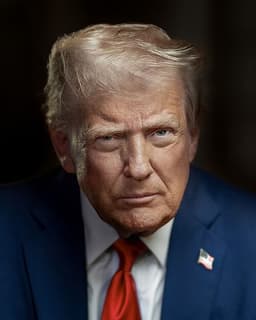
Donald Trump
Politician · Modern
49.4Total

Ruhollah Khomeini
Politician · Modern
75.1Total
Basic Information
Born
1946
1902
Died
—
1989
Era
Modern
Modern
Nationality
United States
Iran
Occupation
Politician
Politician
Civilization
Western
Middle Eastern
Score Comparison
Military (10%)
10.0
41.6
Political (20%)
48.0
65.0
Influence (20%)
55.0
85.0
Legacy (20%)
50.0
90.0
Leadership (15%)
74.0
80.0
Strategy (15%)
38.6
54.3
TOTAL
49.4
75.1
Donald Trump — Complete Timeline
2016 AD
Election as 45th President of the United StatesPolitical Action
Trump won the 2016 presidential election against Hillary Clinton, receiving 304 electoral votes to Clinton's 227. His victory was considered a major political upset, driven by support from white working-class voters in key swing states.
US ElectionPresidencyPolitical Upset
Impact: global
2017 AD
Withdrawal from the Paris Climate AgreementPolitical Action◆ Major
Trump announced the US withdrawal from the Paris Agreement, a global accord to combat climate change. The decision isolated the US from international climate efforts and was criticized by environmental groups and allies.
Climate ChangeInternational AgreementEnvironment
Impact: globaldestructive
2019 AD
Impeachment by the House of RepresentativesPolitical Action◆ Major
The House of Representatives impeached Trump on charges of abuse of power and obstruction of Congress related to his request that Ukraine investigate Joe Biden. He was acquitted by the Senate in February 2020.
ImpeachmentUkraine ScandalConstitutional Crisis
Impact: nationaldestructive
2021 AD
January 6 Capitol AttackPolitical Action
Following Trump's false claims of election fraud, a mob of his supporters stormed the US Capitol to disrupt the certification of Joe Biden's electoral victory. The attack resulted in deaths, injuries, and a second impeachment of Trump.
Capitol RiotElection FraudInsurrection
Impact: nationaldestructive
Ruhollah Khomeini — Complete Timeline
1964 AD
Exile to Iraq and FrancePolitical Action◆ Major
Khomeini was exiled from Iran after criticizing the Shah's White Revolution and granting of diplomatic immunity to US personnel. He settled in Najaf, Iraq, and later in France, where he continued to organize opposition to the Shah.
ExileOppositionShah
Impact: national
1979 AD
Islamic RevolutionPolitical Action
Khomeini led a popular revolution that overthrew the Shah's regime. He returned to Iran in February 1979 and established an Islamic Republic based on his doctrine of Velayat-e Faqih (Guardianship of the Jurist), with himself as Supreme Leader.
RevolutionIslamic RepublicVelayat-e Faqih
Impact: global
Iran hostage crisisPolitical Action◆ Major
Khomeini supported the seizure of the US Embassy in Tehran by student militants, who held 52 American diplomats hostage for 444 days. The crisis deepened the rift with the US, led to economic sanctions, and consolidated Khomeini's power.
Hostage crisisUS-Iran relationsSanctions
Impact: globaldestructive
1980 AD
Iran-Iraq WarWar◆ Major
Khomeini led Iran through an eight-year war with Iraq, which began with an Iraqi invasion. The war resulted in hundreds of thousands of casualties and massive economic destruction, ending in a stalemate. Khomeini accepted a UN ceasefire in 1988.
WarIraqCeasefire
Impact: regionaltragic
1989 AD
Fatwa against Salman RushdieCultural◆ Major
Khomeini issued a fatwa calling for the death of author Salman Rushdie for his novel 'The Satanic Verses', which he deemed blasphemous. The fatwa led to international controversy, diplomatic tensions, and attacks on Rushdie's translators.
FatwaBlasphemyInternational controversy
Impact: globaldestructive
Expert Analysis
Origins
Donald Trump was born in 1946 in Queens, New York, to a wealthy real estate developer father. He attended the New York Military Academy and later the Wharton School of Finance. Trump took over his father's business and expanded into Manhattan skyscrapers, casinos, and branding. His early life was marked by privilege and a litigious business style, with multiple bankruptcies but also high-profile successes like Trump Tower.
Ruhollah Khomeini was born in 1902 in Khomein, Iran, to a religious family. He was a descendant of the Prophet Muhammad and studied Islamic jurisprudence, becoming a grand ayatollah. His early life was shaped by Shi'a theology and opposition to the Pahlavi dynasty's modernization efforts. He began teaching in Qom and emerged as a leading critic of the Shah's policies.
Rise to Power
Trump's rise to political power came through his 2016 presidential campaign, where he defeated 16 Republican primary opponents and then Hillary Clinton in the general election. His slogan "Make America Great Again" resonated with working-class voters. Key turning points included the Access Hollywood tape scandal and the Comey letter, which may have shifted undecided voters. He won 304 electoral votes despite losing the popular vote by nearly 3 million.
Khomeini's rise was rooted in his 1963 exile after criticizing the Shah's "White Revolution." From Najaf, Iraq, and later France, he disseminated cassette tapes of his sermons, mobilizing opposition. His return to Iran on February 1, 1979, marked the triumph of the Islamic Revolution. Within weeks, his supporters forced the Shah to flee, and Khomeini established the Islamic Republic through a referendum in April 1979.
Leadership & Governance
Trump's leadership style was transactional and confrontational. He used executive orders extensively, bypassing Congress on issues like immigration (travel ban) and trade (tariffs). His governance focused on deregulation, tax cuts (Tax Cuts and Jobs Act of 2017), and conservative judicial appointments. He scored 74.0 in leadership but 38.6 in strategy, reflecting his instinct-driven decision-making.
Khomeini's governance was ideological and theocratic, based on his doctrine of "Velayat-e Faqih" (Guardianship of the Jurist). He centralized power in the Supreme Leader's office, overseeing the military, judiciary, and media. His policies included strict enforcement of Islamic law, suppression of dissent, and export of the revolution. He scored 80.0 in leadership and 65.0 in political skill, demonstrating effective control despite limited conventional governance experience.
Triumph & Tragedy
Trump's greatest achievement was the economy pre-pandemic: unemployment hit 3.5% in 2019, and stock markets reached records. He also brokered the Abraham Accords, normalizing Israel-UAE relations. His failures include the January 6 Capitol attack, which damaged democratic institutions, and his mishandling of the COVID-19 pandemic, with over 400,000 US deaths during his term. He was impeached twice, first for abuse of power and later for incitement of insurrection.
Khomeini's triumph was the establishment of the Islamic Republic, which reshaped Iran and inspired Islamist movements globally. His regime survived the Iran-Iraq War (1980-1988), which killed hundreds of thousands. His tragedies include the hostage crisis that isolated Iran internationally and the suppression of political opponents, with thousands executed. The fatwa against Salman Rushdie in 1989 further tarnished his legacy.
Character & Destiny
Trump's character is marked by narcissism, impulsivity, and a need for loyalty. His refusal to accept defeat in 2020 led to the Capitol attack, defining his post-presidency. His destiny was shaped by his ability to tap into populist anger, but his lack of political experience led to instability. Historians rank him low in presidential surveys, with legacy scores around 50.0.
Khomeini was ascetic, uncompromising, and charismatic. His single-minded pursuit of an Islamic state succeeded against the Shah's modernizing regime. His destiny was to become a revolutionary icon, but his theocratic model created long-term tensions with secular and reformist movements. His legacy score of 90.0 reflects his enduring impact on Iran and Shia Islam.
Legacy
Trump's legacy includes reshaping the Republican Party, appointing three Supreme Court justices (including the overturning of Roe v. Wade), and normalizing political polarization. His influence on global populism is notable, but his domestic policy achievements are mixed. He scored 55.0 in influence and 50.0 in legacy.
Khomeini's legacy is profound: he established a lasting theocracy that has outlasted him, with the Supreme Leader wielding ultimate authority. The Islamic Revolution inspired movements from Lebanon to Bahrain. His legacy score of 90.0 is among the highest for modern leaders, despite Iran's economic and political challenges.
Conclusion
Ruhollah Khomeini had a greater impact on history than Donald Trump. Khomeini's total score of 75.1 far exceeds Trump's 49.4, driven by higher scores in military (41.6 vs 10.0), political (65.0 vs 48.0), influence (85.0 vs 55.0), and legacy (90.0 vs 50.0). While Trump's presidency was consequential for the US, Khomeini's revolution fundamentally altered the Middle East and global Islamist politics. Khomeini's system of governance remains in place, whereas Trump's political movement, while persistent, has not fundamentally changed US structures. The data supports Khomeini as the more historically significant figure.
Rankings
🥇
Ruhollah KhomeiniLeader
Mil: 41.6Pol: 65.0Inf: 85.0
75.1
🥈
Donald Trump
Mil: 10.0Pol: 48.0Inf: 55.0
49.4
+25.7 behind
How This Comparison Works
Algorithm
Each figure is scored on 6 dimensions (0—100 scale) based on structured historical data: Military (10%), Political (20%), Influence (20%), Legacy (20%), Leadership (15%), Strategy (15%). The weighted total produces the final ranking.
Data Sources
Scores are computed from structured sub-indicators in the database. Scale factors adjust for era (Ancient ×0.85, Modern ×1.0) and civilization size (Eastern ×1.05, Other ×0.80) to account for differences in population and military scale.
Maximum 3 Figures
Comparisons are limited to 2—3 figures to ensure readability and statistical meaningfulness.
Error Margins
±5 points per dimension — Sub-scores are derived from historical records with inherent uncertainty. Two figures within 5 points on a dimension should be considered roughly equivalent in that area.
Total Score Accuracy
±3 points overall — The weighted combination of 6 dimensions produces a total score with approximately ±3 points of uncertainty. Differences of less than 3 points are not statistically significant— the figures are effectively tied.
Known Limitations
- Historical records are incomplete and uneven across civilizations
- Figures from oral-tradition societies may be underrepresented
- Occupation labels can misclassify multi-role figures
- Scores measure capability and impact, not moral character
- Quantitative scoring is a comparison tool, not absolute truth
Capability Radar
Military (10%) — Battles & Warfare
Battles
0
10
Win Rate
0
10
Expansion
0
10
Political (20%) — Governance & Reform
Reform
40
90
Diplomacy
35
75
Economy
45
40
Influence (20%) — Cultural & Global Reach
Cultural
60
85
Global
60
85
Legacy (20%) — Historical Impact
Historical
55
90
Longevity
40
80
Leadership (15%) — Power & Stability
Tenure
55
85
Stability
30
50
Strategy (15%) — Tactics & Innovation
Strategy
0
15
Tactics
0
10
Reform
5
20
Similar Comparisons
Comments & Discussion
No comments yet. Be the first to share your thoughts!