Loading...
This comparison has not been analyzed yet.
One-time AI generation (~1 minute). Scores and timeline are already available below.
Djemal Pasha vs Philippe Petain
Philippe Petain leads by 12.6 pts · 2 figures compared
…
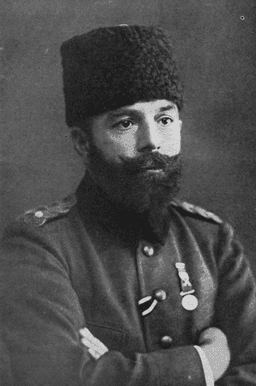
Djemal Pasha
General · Modern
56.3Total

Philippe Petain
General · Modern
68.9Total
Basic Information
Born
1872
1856
Died
1922
1951
Era
Modern
Modern
Nationality
Ottoman Empire
France
Occupation
General
General
Civilization
Middle Eastern
Western
Score Comparison
Military (10%)
50.0
70.0
Political (20%)
68.0
68.0
Influence (20%)
54.9
82.0
Legacy (20%)
46.7
55.0
Leadership (15%)
65.0
71.0
Strategy (15%)
60.0
68.1
TOTAL
56.3
68.9
Djemal Pasha — Complete Timeline
1914 AD
Appointment as Minister of Public WorksPolitical Action
Djemal Pasha was appointed Minister of Public Works in 1914 as part of the Committee of Union and Progress government. He later became Minister of the Navy and was given command of the Fourth Army in Syria.
Ottoman GovernmentMinisterCUP
Impact: national
1915 AD
Command of the Fourth Army in SyriaWar◆ Major
Djemal Pasha commanded the Ottoman Fourth Army in Syria and Palestine from 1915 to 1917. He launched an unsuccessful attack on the Suez Canal in February 1915 and later faced the Arab Revolt. His harsh rule in Syria included executions of Arab nationalists.
World War ISyria CampaignArab Revolt
Impact: regionaldestructive
1922 AD
Assassination in TbilisiOther◆ Major
Djemal Pasha was assassinated on July 21, 1922, in Tbilisi, Georgia, by Armenian agents as part of Operation Nemesis. He was killed in retaliation for his role in the Armenian Genocide while traveling to negotiate with Soviet authorities.
AssassinationOperation NemesisArmenian Genocide
Impact: globaltragic
Philippe Petain — Complete Timeline
1916 AD
Battle of VerdunWar
Pétain commanded the French Second Army during the Battle of Verdun, organizing the defense and supply lines. His leadership and the phrase 'They shall not pass' made him a national hero, though the battle was a bloody stalemate.
World War IWestern FrontDefense
Impact: national
1917 AD
Suppressed the 1917 French Army MutiniesPolitical Action◆ Major
After the failed Nivelle Offensive, P
World War IMutinyCommand
Impact: national
1940 AD
Appointed Prime Minister of Vichy FrancePolitical Action
After the French defeat by Germany, P
World War IIVichy FranceCollaboration
Impact: nationaldestructive
Implemented the Vichy Regime's Anti-Semitic LawsPolitical Action◆ Major
Pétain's government enacted the Statut des Juifs, excluding Jews from public life and many professions. This was part of a broader collaboration with Nazi Germany, including the deportation of French Jews to concentration camps.
World War IIAnti-SemitismCollaboration
Impact: nationaldestructive
1945 AD
Tried and Convicted for TreasonPolitical Action◆ Major
After the liberation of France, P
World War IITrialJustice
Impact: national
This comparison has not been analyzed yet.
One-time AI generation (~1 minute). Scores and timeline are already available below.
Rankings
🥇
Philippe PetainLeader
Mil: 70.0Pol: 68.0Inf: 82.0
68.9
🥈
Djemal Pasha
Mil: 50.0Pol: 68.0Inf: 54.9
56.3
+12.6 behind
How This Comparison Works
Algorithm
Each figure is scored on 6 dimensions (0—100 scale) based on structured historical data: Military (10%), Political (20%), Influence (20%), Legacy (20%), Leadership (15%), Strategy (15%). The weighted total produces the final ranking.
Data Sources
Scores are computed from structured sub-indicators in the database. Scale factors adjust for era (Ancient ×0.85, Modern ×1.0) and civilization size (Eastern ×1.05, Other ×0.80) to account for differences in population and military scale.
Maximum 3 Figures
Comparisons are limited to 2—3 figures to ensure readability and statistical meaningfulness.
Error Margins
±5 points per dimension — Sub-scores are derived from historical records with inherent uncertainty. Two figures within 5 points on a dimension should be considered roughly equivalent in that area.
Total Score Accuracy
±3 points overall — The weighted combination of 6 dimensions produces a total score with approximately ±3 points of uncertainty. Differences of less than 3 points are not statistically significant— the figures are effectively tied.
Known Limitations
- Historical records are incomplete and uneven across civilizations
- Figures from oral-tradition societies may be underrepresented
- Occupation labels can misclassify multi-role figures
- Scores measure capability and impact, not moral character
- Quantitative scoring is a comparison tool, not absolute truth
Capability Radar
Military (10%) — Battles & Warfare
Battles
55
75
Win Rate
40
70
Expansion
35
20
Political (20%) — Governance & Reform
Reform
55
40
Diplomacy
40
55
Economy
30
30
Influence (20%) — Cultural & Global Reach
Cultural
30
50
Global
30
60
Legacy (20%) — Historical Impact
Historical
45
70
Longevity
25
55
Leadership (15%) — Power & Stability
Tenure
60
65
Stability
20
25
Strategy (15%) — Tactics & Innovation
Strategy
50
85
Tactics
45
80
Reform
30
60
Similar Comparisons
Comments & Discussion
No comments yet. Be the first to share your thoughts!