Loading...
Daniel Ortega vs Napoleon Bonaparte
Napoleon Bonaparte leads by 22.8 pts · 2 figures compared
…
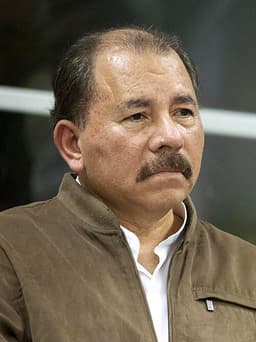
Daniel Ortega
Revolutionary · Modern
48.1Total

Napoleon Bonaparte
General · Modern
70.9Total
Basic Information
Born
1945
1769
Died
—
1821
Era
Modern
Modern
Nationality
Nicaragua
France
Occupation
Revolutionary
General
Civilization
Western
Western
Score Comparison
Military (10%)
45.0
94.0
Political (20%)
42.3
72.0
Influence (20%)
51.0
40.0
Legacy (20%)
42.5
80.0
Leadership (15%)
67.0
78.0
Strategy (15%)
38.6
90.0
TOTAL
48.1
70.9
Daniel Ortega — Complete Timeline
1979 AD
Sandinista RevolutionWar
Ortega was a key commander in the Sandinista National Liberation Front (FSLN) that overthrew the Somoza dictatorship. The revolution ended decades of authoritarian rule and established a socialist-oriented government, with Ortega becoming a member of the ruling junta.
RevolutionSandinistaSomoza
Impact: nationalconstructive
1984 AD
Election as President of NicaraguaPolitical Action◆ Major
Ortega was elected president in Nicaragua's first democratic election after the revolution, winning 67% of the vote. His government faced a US-backed Contra war and implemented land reform, literacy campaigns, and social programs.
ElectionSandinistaSocial Reform
Impact: nationalconstructive
1990 AD
Electoral defeat and transition of powerPolitical Action◆ Major
Ortega lost the presidential election to Violeta Chamorro, marking the first peaceful transfer of power in Nicaragua's history. The defeat ended 11 years of Sandinista rule and was a result of war fatigue and economic crisis.
ElectionDefeatDemocracy
Impact: national
2007 AD
Return to presidencyPolitical Action◆ Major
Ortega was re-elected president after 17 years in opposition, winning 38% of the vote. His return marked a shift toward authoritarianism, as he consolidated power, controlled the judiciary, and suppressed political opposition.
ElectionReturnAuthoritarianism
Impact: national
2018 AD
2018 protests and crackdownPolitical Action◆ Major
Mass protests erupted against Ortega's government over social security reforms, which were later withdrawn. The government responded with a violent crackdown, resulting in hundreds of deaths and thousands of arrests, leading to international condemnation.
ProtestsRepressionHuman Rights
Impact: nationaldestructive
Napoleon Bonaparte — Complete Timeline
1799 AD
Coup of 18 BrumaireOther◆ Major
Napoleon Bonaparte, with support from his brother Lucien and key political figures, overthrew the Directory in a bloodless coup. He established the Consulate with himself as First Consul, effectively becoming the ruler of France. This event ended the French Revolution's most unstable period.
French RevolutionCoupRise to Power
Impact: regional
1804 AD
Promulgation of the Napoleonic CodeOther◆ Major
Napoleon enacted the Civil Code of the French, known as the Napoleonic Code, a comprehensive set of laws that replaced the fragmented feudal legal systems. The code established legal equality, protected property rights, and secularized law. It became the basis for legal systems in many European and world countries.
Legal ReformNapoleonic CodeCivil Law
Impact: globalconstructive
1805 AD
Battle of AusterlitzWar◆ Major
Napoleon's Grande Arm
Napoleonic WarsBattleDecisive Victory
Impact: global
1812 AD
Invasion of RussiaWar◆ Major
Napoleon led the Grande Arm
Napoleonic WarsInvasionDisaster
Impact: globaldestructive
1815 AD
Battle of WaterlooWar◆ Major
Napoleon's French army was defeated by the combined forces of the Duke of Wellington's Anglo-Allied army and Gebhard Leberecht von Bl
Napoleonic WarsBattleFinal Defeat
Impact: globaldestructive
Expert Analysis
daniel-ortega-vs-napoleon-bonaparte
### The Corsican and the Sandinista: Two Revolutions, Two Destinies
On a June morning in 1815, a short, pale man in a green coat stood on a muddy field near Waterloo, watching his empire dissolve into chaos. On an April evening in 2018, a gray-haired man in Managua watched his own people flood the streets, not to cheer him, but to demand his head. Both were revolutionaries who became rulers. Both promised liberation and delivered something far more complicated. Napoleon Bonaparte and Daniel Ortega are separated by two centuries, an ocean, and a chasm of scale—yet their stories echo each other in ways that reveal the strange, recurring tragedy of power.
**Origins**
Napoleon was born in 1769 on the island of Corsica, a place that had just been sold to France by Genoa. His family was minor nobility, poor and resentful. He spoke Italian before French, and the sting of being an outsider never left him. He entered military school at nine, driven by a ferocious ambition to prove himself to a country he barely considered his own. The French Revolution, erupting when he was twenty, shattered the old order and opened a path for talents like his. He was a child of chaos, forged in the fire of a collapsing world.
Daniel Ortega was born in 1945 in La Libertad, Nicaragua, a small mining town. His family was middle-class but radicalized by the brutal Somoza dictatorship, which had turned the country into a personal fiefdom. As a teenager, Ortega joined the Sandinista National Liberation Front (FSLN), a guerrilla movement named after Augusto Sandino, a rebel killed in 1934. He was arrested, tortured, and imprisoned for seven years. When he emerged in 1974, the regime had only grown more repressive. Ortega, like Napoleon, was shaped by a world of injustice—but his revolution was not a ladder to empire; it was a war of survival.
**Rise to Power**
Napoleon’s ascent was meteoric. In 1793, at twenty-four, he recaptured the port of Toulon from British-backed royalists, earning promotion to brigadier general. By 1796, he commanded the Army of Italy, where his lightning campaigns crushed the Austrians and made him a national hero. He then launched an audacious expedition to Egypt in 1798, hoping to strike at British India. The campaign failed militarily, but Napoleon returned to France in 1799 to find the government in crisis. In November, he staged a coup and became First Consul. Within five years, he crowned himself Emperor. His rise was a masterpiece of timing, ruthlessness, and sheer will.
Ortega’s path was slower, bloodier, and more collective. In 1979, the Sandinista Revolution overthrew Anastasio Somoza Debayle after a decade of guerrilla war. Ortega was a key commander, but not the sole leader—the FSLN was a nine-man directorate. He became a coordinator of the new junta, then was elected president in 1984 with 67% of the vote. Unlike Napoleon, Ortega did not seize power alone. He inherited a revolution shared by poets, priests, and peasants. His rise was a coalition, not a coronation.
**Leadership & Governance**
Napoleon ruled as a military genius and a political reformer. His Napoleonic Code, enacted in 1804, standardized law across France, enshrining equality before the law, property rights, and secular administration. He centralized the state, created the Bank of France, and built roads and schools. But he also suppressed dissent, censored the press, and restored slavery in French colonies. His military strategy was revolutionary: fast marches, massed artillery, and decisive battles. He won at Austerlitz in 1805, Jena in 1806, and Wagram in 1809. Yet his governance grew increasingly autocratic. He placed his brothers on thrones, divorced his wife for a Habsburg princess, and treated Europe as a chessboard.
Ortega’s first term (1985–1990) was defined by war and survival. The United States funded the Contras, a counter-revolutionary army, and imposed an economic embargo. Ortega’s government responded with land reform, literacy campaigns, and mass mobilization—but also with forced conscription, press restrictions, and human rights abuses. After losing the 1990 election to Violeta Chamorro, Ortega spent seventeen years in opposition, transforming himself from a Marxist revolutionary into a pragmatic populist. When he returned to power in 2007, he had changed. He allied with the Catholic Church, made deals with business elites, and consolidated control over the courts and military. His governance became a slow drift toward authoritarianism—less spectacular than Napoleon’s, but just as corrosive.
**Triumph & Tragedy**
Napoleon’s greatest moment was Austerlitz, December 2, 1805, where he destroyed a combined Russian-Austrian army. His worst was the invasion of Russia in 1812, a catastrophic miscalculation that cost half a million lives and destroyed his Grand Army. He was exiled to Elba in 1814, returned for a Hundred Days, and met final defeat at Waterloo on June 18, 1815. His tragedy was hubris: he could not stop, could not share power, could not accept limits.
Ortega’s triumph was the 1979 revolution, a genuine popular uprising that ended a dynasty. His tragedy unfolded in 2018, when protests over social security reforms exploded into a nationwide uprising. His government responded with lethal force: snipers, paramilitaries, and mass arrests. Hundreds died, thousands fled. The revolutionary hero became the repressive strongman. Unlike Napoleon, Ortega did not lose a war—he lost his moral legitimacy.
**Character & Destiny**
Napoleon was driven by an insatiable hunger for glory. “Impossible is a word to be found only in the dictionary of fools,” he said. He believed he could bend history to his will. That belief made him great, and it destroyed him. Ortega, by contrast, seems motivated by survival and control. He learned in prison that the world is a hostile place. His character is cautious, calculating, and deeply suspicious. Where Napoleon gambled on glory, Ortega gambles on endurance. One burned bright and fast; the other dims slowly, clinging to power.
**Legacy**
Napoleon’s legacy is immense. He reshaped Europe’s borders, spread nationalism, and inspired legal systems from Quebec to Japan. He is remembered as a genius and a tyrant, a liberator and a conqueror. Ortega’s legacy is more ambiguous. In Nicaragua, he is both the man who overthrew Somoza and the man who crushed the 2018 protests. His scores reflect a figure of moderate influence but declining reputation: Military 36, Political 61, Legacy 58. He is a cautionary tale of how revolutions can devour their children.
**Conclusion**
Standing at opposite ends of the modern era, Napoleon and Ortega share a common arc: revolutionary, ruler, autocrat. But their differences reveal the weight of context. Napoleon dominated a continent with armies and ideas; Ortega controls a small country by exploiting the machinery of a failed revolution. Napoleon’s downfall was dramatic and final; Ortega’s is slow and corrosive. Both remind us that the fire that lights a revolution can burn the hand that holds it. The question is not whether power corrupts, but how long it takes—and how much it costs.
Rankings
🥇
Napoleon BonaparteLeader
Mil: 94.0Pol: 72.0Inf: 40.0
70.9
🥈
Daniel Ortega
Mil: 45.0Pol: 42.3Inf: 51.0
48.1
+22.8 behind
How This Comparison Works
Algorithm
Each figure is scored on 6 dimensions (0—100 scale) based on structured historical data: Military (10%), Political (20%), Influence (20%), Legacy (20%), Leadership (15%), Strategy (15%). The weighted total produces the final ranking.
Data Sources
Scores are computed from structured sub-indicators in the database. Scale factors adjust for era (Ancient ×0.85, Modern ×1.0) and civilization size (Eastern ×1.05, Other ×0.80) to account for differences in population and military scale.
Maximum 3 Figures
Comparisons are limited to 2—3 figures to ensure readability and statistical meaningfulness.
Error Margins
±5 points per dimension — Sub-scores are derived from historical records with inherent uncertainty. Two figures within 5 points on a dimension should be considered roughly equivalent in that area.
Total Score Accuracy
±3 points overall — The weighted combination of 6 dimensions produces a total score with approximately ±3 points of uncertainty. Differences of less than 3 points are not statistically significant— the figures are effectively tied.
Known Limitations
- Historical records are incomplete and uneven across civilizations
- Figures from oral-tradition societies may be underrepresented
- Occupation labels can misclassify multi-role figures
- Scores measure capability and impact, not moral character
- Quantitative scoring is a comparison tool, not absolute truth
Capability Radar
Military (10%) — Battles & Warfare
Battles
35
95
Win Rate
40
90
Expansion
20
95
Political (20%) — Governance & Reform
Reform
40
95
Diplomacy
45
80
Economy
30
85
Influence (20%) — Cultural & Global Reach
Cultural
40
85
Global
35
90
Legacy (20%) — Historical Impact
Historical
45
95
Longevity
40
90
Leadership (15%) — Power & Stability
Tenure
65
85
Stability
25
70
Strategy (15%) — Tactics & Innovation
Strategy
35
95
Tactics
30
98
Reform
25
92
Similar Comparisons
Comments & Discussion
No comments yet. Be the first to share your thoughts!