Loading...
Claudius vs Lucius Tarquinius Priscus
Lucius Tarquinius Priscus leads by 4.2 pts · 2 figures compared
…
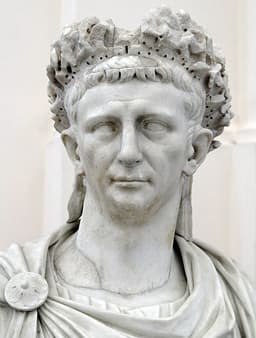
Claudius
Emperor · Ancient
54.4Total

Lucius Tarquinius Priscus
Emperor · Ancient
58.6Total
Basic Information
Born
-10
-616
Died
54
-579
Era
Ancient
Ancient
Nationality
Roman Empire
Roman Kingdom
Occupation
Emperor
Emperor
Civilization
Western
Western
Score Comparison
Military (10%)
50.0
55.0
Political (20%)
68.0
68.0
Influence (20%)
54.9
55.7
Legacy (20%)
49.2
47.5
Leadership (15%)
53.2
74.0
Strategy (15%)
51.7
60.0
TOTAL
54.4
58.6
Claudius — Complete Timeline
41 AD
Accession as EmperorPolitical Action◆ Major
After Caligula's assassination, Claudius was found hiding and proclaimed emperor by the Praetorian Guard. The Senate reluctantly accepted him, marking the first time the Guard directly chose an emperor.
SuccessionPraetorian GuardImperial Rule
Impact: global
42 AD
Construction of the Port of OstiaOther◆ Major
Claudius initiated the construction of a new harbor at Ostia to improve Rome's grain supply. The project included a large artificial basin and a lighthouse, facilitating trade and food imports.
InfrastructureGrain SupplyRome
Impact: nationalconstructive
43 AD
Conquest of BritainWar
Claudius ordered the invasion of Britain, sending four legions under Aulus Plautius. He later visited the island to accept the surrender of the British tribes, incorporating southern Britain into the Roman Empire.
ConquestBritainExpansion
Impact: regionalconstructive
48 AD
Expansion of Roman CitizenshipReform◆ Major
Claudius extended Roman citizenship to certain provincial communities, particularly in Gaul. He also admitted Gauls into the Senate, promoting integration of the empire's elites.
CitizenshipIntegrationProvincial Policy
Impact: regionalprogressive
49 AD
Marriage to Agrippina the YoungerPolitical Action◆ Major
Claudius married his niece Agrippina the Younger, who then maneuvered to have her son Nero adopted as Claudius's heir. This marriage led to Claudius's eventual poisoning and Nero's succession.
MarriageSuccessionNero
Impact: nationaldestructive
Lucius Tarquinius Priscus — Complete Timeline
600 BC
War with the SabinesWar
Tarquinius Priscus waged a successful war against the Sabines, capturing the town of Collatia and other territories. He celebrated a triumph for his victory, bringing wealth and slaves to Rome, and strengthening his position as king.
Roman ExpansionSabine WarTriumph
Impact: regional
Construction of the Circus MaximusCultural◆ Major
Tarquinius Priscus initiated the construction of the Circus Maximus, Rome's first and largest chariot racing stadium, in the valley between the Palatine and Aventine hills. This venue became a central site for public games and entertainment, hosting the Ludi Romani.
EntertainmentChariot RacingPublic Works
Impact: nationalconstructive
Construction of the Cloaca MaximaCultural◆ Major
Tarquinius Priscus began the construction of the Cloaca Maxima, Rome's great sewer system, to drain the marshy lowlands between the hills. This engineering project improved sanitation and allowed for the development of the Roman Forum as a public space.
InfrastructureSanitationUrban Planning
Impact: nationalconstructive
Introduction of Etruscan InsigniaCultural
Tarquinius Priscus introduced Etruscan symbols of authority to Rome, including the fasces, the curule chair, and the purple toga. These insignia became standard for Roman magistrates and symbolized the power and dignity of the state.
Cultural AdoptionRoyal InsigniaEtruscan Influence
Impact: nationalconstructive
579 BC
Assassination by the Sons of Ancus MarciusPolitical Action◆ Major
Tarquinius Priscus was assassinated by the sons of his predecessor, Ancus Marcius, who sought to reclaim the throne. The assassination occurred after a reign of 38 years, and the conspirators failed to seize power as Servius Tullius became king.
AssassinationRoyal MurderSuccession Crisis
Impact: nationaltragic
Expert Analysis
Origins
Claudius (born 10 BC, Lugdunum, Gaul) was the son of Nero Claudius Drusus and Antonia Minor, a nephew of Emperor Tiberius. Afflicted with a limp and a stammer, he was often dismissed as mentally unfit. He was largely excluded from public life until Caligula's reign, when he held minor magistracies. His family's prominence and his survival instincts shaped his cautious, scholarly nature.
Lucius Tarquinius Priscus (traditionally reigned 616–579 BC) was born in Tarquinii, Etruria, of Etruscan descent. His original name was Lucumo; he later adopted the Roman name Lucius Tarquinius. He migrated to Rome with his wife Tanaquil, an Etruscan noblewoman, after being advised by an eagle that he would become king. His background as a wealthy and ambitious Etruscan immigrant deeply influenced his vision for Rome's urban development.
Rise to Power
Claudius rose to power unexpectedly after the assassination of Caligula in AD 41. Hiding behind a curtain in the palace, he was discovered by a Praetorian guard and hailed as emperor. The Senate debated restoring the Republic but reluctantly accepted Claudius under military pressure. His accession marked the first time the Praetorian Guard directly installed a ruler, setting a precedent for future imperial successions.
Tarquinius Priscus rose through appointment by King Ancus Marcius, who made him guardian of his sons. After Ancus's death, Tarquinius convinced the popular assembly to elect him king, bypassing the sons. He became Rome's fifth king and the first of Etruscan origin, bringing Etruscan culture and engineering expertise to the city. His rise demonstrates the fluidity of early Roman monarchy and the influence of Etruscan elites.
Leadership & Governance
Claudius governed as an administrator focused on efficiency and integration. He expanded Roman citizenship to provincials, admitted Gauls into the Senate, and reformed the legal system. He built the Port of Ostia to secure grain supplies and completed aqueducts like the Aqua Claudia. However, his delegation of power to freedmen and wives led to corruption and court intrigues. His marriage to Agrippina the Younger ultimately cost him his life, as she poisoned him in AD 54 to install her son Nero.
Tarquinius Priscus governed as a builder-king, transforming Rome's infrastructure. He initiated the Circus Maximus, the Cloaca Maxima (sewer system), and the foundations of the Temple of Jupiter Optimus Maximus on the Capitoline Hill. He also introduced Etruscan symbols of authority (fasces, curule chair, purple toga) that became standard for Roman magistrates. His governance focused on public works and ritual, establishing Rome as a city worthy of its growing power. He expanded Roman territory through wars with the Sabines and Latins, celebrating triumphs.
Triumph & Tragedy
Claudius's greatest triumph was the conquest of Britain in AD 43, adding a significant province to the empire. He personally visited Britain to accept the surrender of the British tribes, a rare feat for an emperor. His expansion of citizenship and administrative reforms strengthened the empire's cohesion. His tragedies include his failed marriages—his third wife Messalina conspired against him, and his fourth wife Agrippina murdered him. His trust in unscrupulous freedmen (like Narcissus and Pallas) and his inability to control his household tarnished his reputation.
Tarquinius Priscus's greatest triumph was the construction of the Circus Maximus and Cloaca Maxima, which allowed Rome to drain marshes and host large public spectacles. His wars expanded Roman territory and brought plunder for public works. His tragedy was his assassination by the sons of Ancus Marcius after 38 years of rule. The murder occurred during a riot staged by the assassins, but his wife Tanaquil concealed his death long enough to secure the succession of Servius Tullius, her son-in-law.
Character & Destiny
Claudius was scholarly, intelligent, but physically awkward and often underestimated. His survival under Caligula depended on feigning stupidity. His character led him to focus on administration and legal reforms, but his indecisiveness and dependence on advisors allowed others to manipulate him. Ancient historians like Suetonius and Tacitus portray him as weak-willed, though modern assessments note his effective governance. His destiny was to be an accidental emperor who achieved solid administrative gains but fell victim to palace intrigue.
Tarquinius Priscus was ambitious, visionary, and pragmatic. As an Etruscan immigrant, he understood the value of public works and cultural integration. His character drove him to transform Rome physically and institutionally. His destiny was to be a foundational figure who set Rome on a path of urban grandeur, but his assassination highlighted the precarious nature of early Roman kingship. He scored 74.0 in leadership, the highest among all categories, reflecting his decisive and transformative rule.
Legacy
Claudius's legacy is mixed: his conquest of Britain endured for centuries, and his administrative reforms influenced provincial governance. The expansion of citizenship foreshadowed the universal grant under Caracalla. However, his personal reputation suffered due to negative ancient sources. In popular culture, he is remembered through Robert Graves's novel "I, Claudius." His total score of 54.4 reflects moderate impact.
Tarquinius Priscus's legacy is monumental in urban infrastructure. The Circus Maximus became the model for Roman circuses, and the Cloaca Maxima remained in use for millennia. His introduction of Etruscan insignia became symbols of Roman authority. He is remembered as a builder-king who set the template for Roman public works. His total score of 58.6 is higher than Claudius's, driven by higher leadership and strategy scores.
Conclusion
While Claudius achieved significant territorial expansion and administrative reforms, Tarquinius Priscus had a greater foundational impact on Rome's physical and symbolic identity. Tarquinius's infrastructure projects—the Circus Maximus, Cloaca Maxima, and Temple of Jupiter—provided the essential framework for Rome's growth as an imperial capital. His introduction of Etruscan symbols shaped Roman political culture for centuries. Claudius's conquest of Britain was important but less enduring than the physical and cultural transformations initiated by Tarquinius. With a total score of 58.6 versus Claudius's 54.4, Tarquinius Priscus emerges as the more impactful figure, particularly in leadership (74.0 vs. 53.2) and strategy (60.0 vs. 51.7). The builder-king who drained marshes and built the first circus left a deeper imprint on Rome's destiny than the scholarly emperor who conquered an island.
Rankings
🥇
Lucius Tarquinius PriscusLeader
Mil: 55.0Pol: 68.0Inf: 55.7
58.6
🥈
Claudius
Mil: 50.0Pol: 68.0Inf: 54.9
54.4
+4.2 behind
How This Comparison Works
Algorithm
Each figure is scored on 6 dimensions (0—100 scale) based on structured historical data: Military (10%), Political (20%), Influence (20%), Legacy (20%), Leadership (15%), Strategy (15%). The weighted total produces the final ranking.
Data Sources
Scores are computed from structured sub-indicators in the database. Scale factors adjust for era (Ancient ×0.85, Modern ×1.0) and civilization size (Eastern ×1.05, Other ×0.80) to account for differences in population and military scale.
Maximum 3 Figures
Comparisons are limited to 2—3 figures to ensure readability and statistical meaningfulness.
Error Margins
±5 points per dimension — Sub-scores are derived from historical records with inherent uncertainty. Two figures within 5 points on a dimension should be considered roughly equivalent in that area.
Total Score Accuracy
±3 points overall — The weighted combination of 6 dimensions produces a total score with approximately ±3 points of uncertainty. Differences of less than 3 points are not statistically significant— the figures are effectively tied.
Known Limitations
- Historical records are incomplete and uneven across civilizations
- Figures from oral-tradition societies may be underrepresented
- Occupation labels can misclassify multi-role figures
- Scores measure capability and impact, not moral character
- Quantitative scoring is a comparison tool, not absolute truth
Capability Radar
Military (10%) — Battles & Warfare
Battles
30
20
Win Rate
40
25
Expansion
60
35
Political (20%) — Governance & Reform
Reform
60
60
Diplomacy
55
50
Economy
50
55
Influence (20%) — Cultural & Global Reach
Cultural
45
45
Global
45
30
Legacy (20%) — Historical Impact
Historical
55
50
Longevity
50
45
Leadership (15%) — Power & Stability
Tenure
65
55
Stability
55
50
Strategy (15%) — Tactics & Innovation
Strategy
45
25
Tactics
35
30
Reform
30
40
Similar Comparisons
Comments & Discussion
No comments yet. Be the first to share your thoughts!