Loading...
This comparison has not been analyzed yet.
One-time AI generation (~1 minute). Scores and timeline are already available below.
Chung Il-kwon vs Mohamed Mediène
Chung Il-kwon leads by 1.0 pts · 2 figures compared
…

Chung Il-kwon
General · Modern
54.1Total
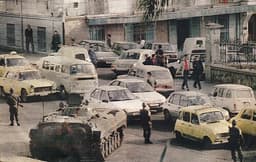
Mohamed Mediène
General · Modern
53.1Total
Basic Information
Born
1917
1939
Died
1994
—
Era
Modern
Modern
Nationality
South Korea
Algeria
Occupation
General
General
Civilization
Eastern
Middle Eastern
Score Comparison
Military (10%)
40.0
50.0
Political (20%)
68.0
62.7
Influence (20%)
51.0
53.3
Legacy (20%)
43.3
50.0
Leadership (15%)
80.0
62.0
Strategy (15%)
43.3
35.7
TOTAL
54.1
53.1
Chung Il-kwon — Complete Timeline
1940 AD
Served as an officer in the Manchukuo Imperial ArmyWar◆ Major
Chung Il-kwon graduated from the Japanese Military Academy and served as an officer in the Manchukuo Imperial Army. He fought in the Second Sino-Japanese War, gaining military experience under Japanese command.
World War IIManchukuoMilitary Service
Impact: regional
1946 AD
Defected to South Korea and joined the ROK ArmyPolitical Action◆ Major
After Japan's defeat, Chung Il-kwon defected to South Korea and joined the Republic of Korea Army. He was among the first Korean officers to be trained by the U.S. military, rising quickly through the ranks.
Korean ArmyDefectionPost-War
Impact: nationalconstructive
1950 AD
Commanded the ROK 3rd Division during the Korean WarWar◆ Major
As commander of the ROK 3rd Division, Chung Il-kwon led his troops in the defense of the Pusan Perimeter and later in the UN counteroffensive. His division recaptured Seoul in September 1950, a key victory in the war.
Korean WarPusan PerimeterSeoul
Impact: regional
1964 AD
Served as Prime Minister of South KoreaPolitical Action◆ Major
Chung Il-kwon served as Prime Minister of South Korea from 1964 to 1970 under President Park Chung-hee. He oversaw economic development and administrative reforms during a period of rapid industrialization.
Korean PoliticsEconomic DevelopmentPrime Minister
Impact: nationalconstructive
Mohamed Mediène — Complete Timeline
1990 AD
Appointed Head of DRSPolitical Action◆ Major
Mediène, known as Toufik, was appointed head of the Department of Intelligence and Security (DRS) in 1990. He became the most powerful figure in Algeria, controlling intelligence and security services for over two decades.
DRSIntelligencePowerbroker
Impact: national
1992 AD
Role in the Algerian Civil WarWar
Mediène was a key architect of the military's crackdown on Islamists after the 1992 election cancellation. The DRS under his leadership was accused of involvement in massacres and disappearances, though he denied direct responsibility.
Civil WarHuman RightsDRS
Impact: nationaldestructive
2015 AD
Dismissal from DRSPolitical Action◆ Major
Mediène was dismissed in 2015 by President Bouteflika, who dismantled the DRS and reduced its powers. The move ended Toufik's 25-year reign as intelligence chief, marking a significant shift in Algeria's political landscape.
DRSBouteflikaReform
Impact: national
This comparison has not been analyzed yet.
One-time AI generation (~1 minute). Scores and timeline are already available below.
Rankings
🥇
Chung Il-kwonLeader
Mil: 40.0Pol: 68.0Inf: 51.0
54.1
🥈
Mohamed Mediène
Mil: 50.0Pol: 62.7Inf: 53.3
53.1
+1.0 behind
How This Comparison Works
Algorithm
Each figure is scored on 6 dimensions (0—100 scale) based on structured historical data: Military (10%), Political (20%), Influence (20%), Legacy (20%), Leadership (15%), Strategy (15%). The weighted total produces the final ranking.
Data Sources
Scores are computed from structured sub-indicators in the database. Scale factors adjust for era (Ancient ×0.85, Modern ×1.0) and civilization size (Eastern ×1.05, Other ×0.80) to account for differences in population and military scale.
Maximum 3 Figures
Comparisons are limited to 2—3 figures to ensure readability and statistical meaningfulness.
Error Margins
±5 points per dimension — Sub-scores are derived from historical records with inherent uncertainty. Two figures within 5 points on a dimension should be considered roughly equivalent in that area.
Total Score Accuracy
±3 points overall — The weighted combination of 6 dimensions produces a total score with approximately ±3 points of uncertainty. Differences of less than 3 points are not statistically significant— the figures are effectively tied.
Known Limitations
- Historical records are incomplete and uneven across civilizations
- Figures from oral-tradition societies may be underrepresented
- Occupation labels can misclassify multi-role figures
- Scores measure capability and impact, not moral character
- Quantitative scoring is a comparison tool, not absolute truth
Capability Radar
Military (10%) — Battles & Warfare
Battles
35
0
Win Rate
40
0
Expansion
25
0
Political (20%) — Governance & Reform
Reform
40
60
Diplomacy
45
65
Economy
35
30
Influence (20%) — Cultural & Global Reach
Cultural
20
20
Global
15
30
Legacy (20%) — Historical Impact
Historical
30
50
Longevity
20
40
Leadership (15%) — Power & Stability
Tenure
55
70
Stability
40
55
Strategy (15%) — Tactics & Innovation
Strategy
30
15
Tactics
30
10
Reform
20
20
Similar Comparisons
Comments & Discussion
No comments yet. Be the first to share your thoughts!