Loading...
Chukwuemeka Odumegwu Ojukwu vs Xue Yue
Chukwuemeka Odumegwu Ojukwu leads by 1.2 pts · 2 figures compared
…
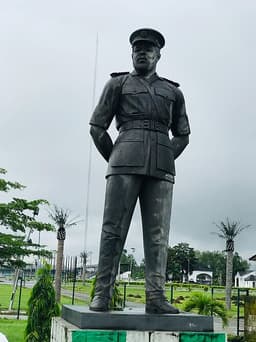
Chukwuemeka Odumegwu Ojukwu
General · Modern
56.9Total

Xue Yue
General · Modern
55.7Total
Basic Information
Born
1933
1896
Died
—
1998
Era
Modern
Modern
Nationality
Nigeria
China
Occupation
General
General
Civilization
Other
Eastern
Score Comparison
Military (10%)
40.0
70.0
Political (20%)
68.0
37.9
Influence (20%)
60.0
58.0
Legacy (20%)
50.0
50.0
Leadership (15%)
64.5
68.0
Strategy (15%)
55.0
58.0
TOTAL
56.9
55.7
Chukwuemeka Odumegwu Ojukwu — Complete Timeline
1967 AD
Led Biafra in the Nigerian Civil WarWar◆ Major
Ojukwu served as the military leader and head of state of Biafra throughout the 30-month Nigerian Civil War (1967-1970). He commanded Biafran forces against the Nigerian federal army, directing the defense of the secessionist state through a prolonged and devastating conflict.
Civil WarBiafraMilitary Leadership
Impact: regional
Declared Independence of BiafraPolitical Action
On May 30, 1967, Lieutenant Colonel Chukwuemeka Odumegwu Ojukwu declared the secession of the Eastern Region of Nigeria as the independent Republic of Biafra. This act followed months of ethnic violence against Igbo people in the north and failed negotiations with the federal government.
SecessionBiafraNigeria
Impact: regional
1970 AD
Surrendered and Went into ExileWar◆ Major
On January 12, 1970, Ojukwu fled Biafra for Ivory Coast as Nigerian forces closed in. His chief of staff, Philip Effiong, surrendered Biafra three days later. Ojukwu remained in exile in Ivory Coast for 13 years, granted asylum by President F
SurrenderExileBiafra
Impact: regionaltragic
Xue Yue — Complete Timeline
1939 AD
Commanded the Battle of Changsha (1939)War◆ Major
Xue Yue commanded Chinese forces in the First Battle of Changsha, successfully defending the city against a Japanese offensive. The victory boosted Chinese morale and marked the first major Japanese defeat in the war.
Second Sino-Japanese WarVictory
Impact: regionalconstructive
Commander of the 9th War ZonePolitical Action◆ Major
Xue Yue was appointed commander of the 9th War Zone, responsible for defending Hunan and Jiangxi provinces. He held this command through multiple battles, becoming one of the most effective Nationalist commanders.
Military CommandWorld War II
Impact: regional
1941 AD
Commanded the Battle of Changsha (1941)War◆ Major
Xue Yue led Chinese forces to victory in the Third Battle of Changsha, repelling a Japanese offensive. The battle resulted in heavy Japanese casualties and was one of the largest Chinese victories of the war.
Second Sino-Japanese WarVictory
Impact: regionalconstructive
1944 AD
Defeated at the Battle of Changsha (1944)War◆ Major
Xue Yue's forces were defeated in the Fourth Battle of Changsha during Operation Ichigo. Japanese forces captured the city, and Xue Yue's command was criticized for its failure to hold the strategic position.
Second Sino-Japanese WarDefeat
Impact: regionaltragic
Expert Analysis
Origins
Chukwuemeka Odumegwu Ojukwu was born on November 4, 1933, in Zaria, Nigeria, into a wealthy Igbo family. His father, Sir Louis Odumegwu Ojukwu, was a prominent businessman and one of the richest men in Nigeria. Ojukwu studied at the University of Oxford (Lincoln College), earning a degree in history in 1955. He then joined the Nigerian Army, training at Eaton Hall in England and the Royal Military Academy Sandhurst. His comfortable upbringing and exposure to British education shaped his ambition and confidence.
Xue Yue was born on December 26, 1896, in Guangdong Province, China, into a poor farming family. He lost his father at age seven and was raised by his mother. Xue attended the Yunnan Military Academy, graduating in 1914. He joined the National Revolutionary Army and rose through the ranks during the Northern Expedition. His early life was marked by hardship and reliance on military discipline.
Rise to Power
Ojukwu's rise accelerated after Nigeria's independence in 1960. He became military governor of the Eastern Region in 1966 following a coup. The 1966 anti-Igbo pogroms in the north radicalized him. On May 30, 1967, he declared the independence of Biafra, becoming its head of state. This decision followed failed negotiations at the Aburi Conference in Ghana. Ojukwu's charisma and oratory mobilized Igbo support, but his military experience was limited to battalion command.
Xue Yue rose through the Kuomintang (KMT) hierarchy by demonstrating tactical competence. He fought in the Northern Expedition (1926-1928) and the Encirclement Campaigns against the Communists. In 1937, he commanded the 19th Army Group at the Battle of Shanghai. His major breakthrough came in 1939 when he was appointed commander of the 9th War Zone, responsible for defending Hunan and Jiangxi. He successfully defended Changsha three times (1939, 1941, 1942), earning a reputation as a defensive genius.
Leadership & Governance
Ojukwu's leadership was centralized and personal. He controlled Biafra's government, military, and propaganda. He issued decrees, managed foreign diplomacy seeking recognition, and directed the war effort. However, his governance suffered from food blockades and internal dissent. He failed to delegate effectively, often micromanaging. His political score of 68.0 reflects his ability to create a functioning state, but his military score of 40.0 shows his tactical limitations. For example, he ordered the invasion of Midwest Nigeria in 1967, which initially succeeded but overextended Biafran forces.
Xue Yue led by example and decentralized command. He allowed his division commanders flexibility, focusing on defensive positions and counterattacks. His governance was limited to military administration; he did not hold political office. His leadership score of 68.0 and military score of 70.0 indicate competence in battle. He emphasized fortifications, intelligence, and local militia support. In 1941, he encircled Japanese forces at Changsha, inflicting 30,000 casualties. However, his political score of 37.9 shows he lacked influence beyond the military sphere.
Triumph & Tragedy
Ojukwu's greatest triumph was the survival of Biafra for 30 months against a larger Nigerian force. He secured international attention, including French support and Red Cross aid. His greatest tragedy was the famine that killed perhaps 1 million Biafrans, for which he bears responsibility. He fled to Ivory Coast on January 12, 1970, days before Biafra's surrender. His strategy of holding out for diplomatic intervention failed.
Xue Yue's greatest triumphs were the three Changsha victories, which preserved Chinese morale and tied down Japanese divisions. The Third Battle of Changsha (1941) was a textbook defense. His tragedy came in 1944 during Operation Ichigo, when his forces were overwhelmed and Changsha fell. He was relieved of command, and his reputation tarnished. He followed the KMT to Taiwan, where he lived in obscurity until his death in 1998.
Character & Destiny
Ojukwu was charismatic, articulate, and stubborn. He believed in Biafran independence to the point of rejecting compromise. His decision to declare secession without securing international recognition proved fatal. He was a political leader who relied on military advisors, but his tactical decisions were often flawed. His exile in Ivory Coast lasted 12 years; he returned to Nigeria in 1982 and later contested presidential elections, though without success.
Xue Yue was disciplined, methodical, and loyal to the KMT. He followed orders without question, even when they led to disaster. His success at Changsha stemmed from meticulous planning; his defeat in 1944 resulted from underestimating Japanese strength. He lacked political ambition, which limited his career after the war. His destiny was to be a regional commander, not a national leader.
Legacy
Ojukwu is remembered as a symbol of Igbo nationalism and secession. He scored 50.0 in legacy. Biafra remains a potent political reference in Nigeria, with separatist movements citing him. His writings and speeches continue to influence. However, his military failures and the humanitarian disaster tarnish his reputation.
Xue Yue is celebrated in China as a hero of the Anti-Japanese War. His defensive tactics are studied in military academies. He scored 50.0 in legacy. However, his association with the KMT means he is largely ignored in mainland China's official history, while honored in Taiwan.
Conclusion
Ojukwu had greater impact on a global scale due to Biafra's symbolic role in post-colonial conflicts and humanitarian crises. His total score of 56.9 slightly exceeds Xue Yue's 55.7. Ojukwu's political influence (68.0) dwarfs Xue's (37.9), while Xue's military score (70.0) surpasses Ojukwu's (40.0). The secession of Biafra reshaped Nigerian politics and set precedents for African sovereignty. Xue Yue's victories were tactical, not strategic; they did not alter the war's outcome. Therefore, Chukwuemeka Odumegwu Ojukwu had a greater overall impact.
Rankings
🥇
Chukwuemeka Odumegwu OjukwuLeader
Mil: 40.0Pol: 68.0Inf: 60.0
56.9
🥈
Xue Yue
Mil: 70.0Pol: 37.9Inf: 58.0
55.7
+1.2 behind
How This Comparison Works
Algorithm
Each figure is scored on 6 dimensions (0—100 scale) based on structured historical data: Military (10%), Political (20%), Influence (20%), Legacy (20%), Leadership (15%), Strategy (15%). The weighted total produces the final ranking.
Data Sources
Scores are computed from structured sub-indicators in the database. Scale factors adjust for era (Ancient ×0.85, Modern ×1.0) and civilization size (Eastern ×1.05, Other ×0.80) to account for differences in population and military scale.
Maximum 3 Figures
Comparisons are limited to 2—3 figures to ensure readability and statistical meaningfulness.
Error Margins
±5 points per dimension — Sub-scores are derived from historical records with inherent uncertainty. Two figures within 5 points on a dimension should be considered roughly equivalent in that area.
Total Score Accuracy
±3 points overall — The weighted combination of 6 dimensions produces a total score with approximately ±3 points of uncertainty. Differences of less than 3 points are not statistically significant— the figures are effectively tied.
Known Limitations
- Historical records are incomplete and uneven across civilizations
- Figures from oral-tradition societies may be underrepresented
- Occupation labels can misclassify multi-role figures
- Scores measure capability and impact, not moral character
- Quantitative scoring is a comparison tool, not absolute truth
Capability Radar
Military (10%) — Battles & Warfare
Battles
55
75
Win Rate
40
70
Expansion
30
30
Political (20%) — Governance & Reform
Reform
40
20
Diplomacy
45
30
Economy
35
20
Influence (20%) — Cultural & Global Reach
Cultural
45
30
Global
45
30
Legacy (20%) — Historical Impact
Historical
55
55
Longevity
40
30
Leadership (15%) — Power & Stability
Tenure
50
50
Stability
20
25
Strategy (15%) — Tactics & Innovation
Strategy
55
75
Tactics
50
80
Reform
45
40
Similar Comparisons
Comments & Discussion
No comments yet. Be the first to share your thoughts!