Loading...
This comparison has not been analyzed yet.
One-time AI generation (~1 minute). Scores and timeline are already available below.
Christian IV vs Emir of Hadejia
Christian IV leads by 10.1 pts · 2 figures compared
…
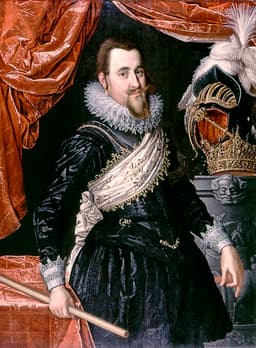
Christian IV
Emperor · Modern
55.4Total

Emir of Hadejia
Emperor · Modern
45.3Total
Basic Information
Born
1577
1850
Died
1648
1906
Era
Modern
Modern
Nationality
Denmark
Nigeria
Occupation
Emperor
Emperor
Civilization
Western
Other
Score Comparison
Military (10%)
55.0
50.0
Political (20%)
45.0
37.9
Influence (20%)
60.0
48.6
Legacy (20%)
49.2
37.5
Leadership (15%)
66.0
67.0
Strategy (15%)
60.0
30.3
TOTAL
55.4
45.3
Christian IV — Complete Timeline
1624 AD
Founding of Christiania (Oslo)Cultural◆ Major
After a fire destroyed Oslo, Christian IV ordered the city rebuilt on a new site and renamed it Christiania. He designed the new city with a grid plan and Renaissance architecture, which became the foundation of modern Oslo, Norway's capital.
Urban PlanningArchitectureNorway
Impact: regionalconstructive
1625 AD
Danish intervention in the Thirty Years' WarWar◆ Major
Christian IV led Denmark-Norway into the Thirty Years' War as a Protestant champion. His campaign ended in disaster after defeat by Imperial forces under Albrecht von Wallenstein at the Battle of Lutter (1626), leading to Danish occupation and loss of territory.
WarThirty Years' WarDefeat
Impact: regionaldestructive
1629 AD
Treaty of LübeckPolitical Action◆ Major
Christian IV signed the Treaty of L
TreatyThirty Years' WarDiplomacy
Impact: regional
1642 AD
Construction of the Round TowerCultural◆ Major
Christian IV commissioned the construction of the Round Tower in Copenhagen as an astronomical observatory. Part of the Trinitatis Complex, it was built to advance scientific knowledge and remains a symbol of his patronage of the arts and sciences.
ArchitectureScienceCopenhagen
constructive
Emir of Hadejia — Complete Timeline
1850 AD
Accession as Emir of HadejiaPolitical Action◆ Major
Emir of Hadejia ascended to the throne of the Hadejia Emirate, a Fulani state within the Sokoto Caliphate. He inherited a position of authority over a region known for its agricultural wealth and strategic location. His rule aimed to maintain autonomy within the caliphate.
SuccessionHadejiaFulani Emirate
1870 AD
Conflict with Kano EmirateWar
Emir of Hadejia engaged in a border conflict with the Kano Emirate over territorial disputes. The conflict resulted in a stalemate, with neither side gaining significant advantage. The war strained relations between the two emirates and required mediation by the Sokoto Caliph.
ConflictKanoBorder Dispute
destructive
1903 AD
Resistance to British Colonial ConquestWar◆ Major
Emir of Hadejia led resistance against the British colonial forces under Frederick Lugard. The Hadejia army was defeated at the Battle of Hadejia, and the emir was captured. This defeat led to the incorporation of Hadejia into the British Northern Nigeria Protectorate.
ResistanceBritish ColonialismDefeat
Impact: regionaltragic
This comparison has not been analyzed yet.
One-time AI generation (~1 minute). Scores and timeline are already available below.
Rankings
🥇
Christian IVLeader
Mil: 55.0Pol: 45.0Inf: 60.0
55.4
🥈
Emir of Hadejia
Mil: 50.0Pol: 37.9Inf: 48.6
45.3
+10.1 behind
How This Comparison Works
Algorithm
Each figure is scored on 6 dimensions (0—100 scale) based on structured historical data: Military (10%), Political (20%), Influence (20%), Legacy (20%), Leadership (15%), Strategy (15%). The weighted total produces the final ranking.
Data Sources
Scores are computed from structured sub-indicators in the database. Scale factors adjust for era (Ancient ×0.85, Modern ×1.0) and civilization size (Eastern ×1.05, Other ×0.80) to account for differences in population and military scale.
Maximum 3 Figures
Comparisons are limited to 2—3 figures to ensure readability and statistical meaningfulness.
Error Margins
±5 points per dimension — Sub-scores are derived from historical records with inherent uncertainty. Two figures within 5 points on a dimension should be considered roughly equivalent in that area.
Total Score Accuracy
±3 points overall — The weighted combination of 6 dimensions produces a total score with approximately ±3 points of uncertainty. Differences of less than 3 points are not statistically significant— the figures are effectively tied.
Known Limitations
- Historical records are incomplete and uneven across civilizations
- Figures from oral-tradition societies may be underrepresented
- Occupation labels can misclassify multi-role figures
- Scores measure capability and impact, not moral character
- Quantitative scoring is a comparison tool, not absolute truth
Capability Radar
Military (10%) — Battles & Warfare
Battles
45
20
Win Rate
30
25
Expansion
30
20
Political (20%) — Governance & Reform
Reform
65
30
Diplomacy
40
30
Economy
60
25
Influence (20%) — Cultural & Global Reach
Cultural
60
20
Global
40
10
Legacy (20%) — Historical Impact
Historical
55
20
Longevity
50
15
Leadership (15%) — Power & Stability
Tenure
70
40
Stability
45
30
Strategy (15%) — Tactics & Innovation
Strategy
35
20
Tactics
40
20
Reform
50
15
Similar Comparisons
Comments & Discussion
No comments yet. Be the first to share your thoughts!