Loading...
Christian IV vs Sayajirao Gaekwad III
Sayajirao Gaekwad III leads by 7.7 pts · 2 figures compared
…
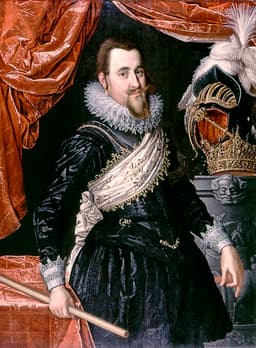
Christian IV
Emperor · Modern
55.4Total

Sayajirao Gaekwad III
Emperor · Modern
63.1Total
Basic Information
Born
1577
1863
Died
1648
1939
Era
Modern
Modern
Nationality
Denmark
India
Occupation
Emperor
Emperor
Civilization
Western
Indian
Score Comparison
Military (10%)
55.0
45.0
Political (20%)
45.0
88.0
Influence (20%)
60.0
60.0
Legacy (20%)
49.2
49.2
Leadership (15%)
66.0
80.7
Strategy (15%)
60.0
60.0
TOTAL
55.4
63.1
Christian IV — Complete Timeline
1624 AD
Founding of Christiania (Oslo)Cultural◆ Major
After a fire destroyed Oslo, Christian IV ordered the city rebuilt on a new site and renamed it Christiania. He designed the new city with a grid plan and Renaissance architecture, which became the foundation of modern Oslo, Norway's capital.
Urban PlanningArchitectureNorway
Impact: regionalconstructive
1625 AD
Danish intervention in the Thirty Years' WarWar◆ Major
Christian IV led Denmark-Norway into the Thirty Years' War as a Protestant champion. His campaign ended in disaster after defeat by Imperial forces under Albrecht von Wallenstein at the Battle of Lutter (1626), leading to Danish occupation and loss of territory.
WarThirty Years' WarDefeat
Impact: regionaldestructive
1629 AD
Treaty of LübeckPolitical Action◆ Major
Christian IV signed the Treaty of L
TreatyThirty Years' WarDiplomacy
Impact: regional
1642 AD
Construction of the Round TowerCultural◆ Major
Christian IV commissioned the construction of the Round Tower in Copenhagen as an astronomical observatory. Part of the Trinitatis Complex, it was built to advance scientific knowledge and remains a symbol of his patronage of the arts and sciences.
ArchitectureScienceCopenhagen
constructive
Sayajirao Gaekwad III — Complete Timeline
1890 AD
Modernized Baroda's InfrastructureReform◆ Major
Sayajirao oversaw the construction of railways, roads, irrigation systems, and public buildings in Baroda. He also established a modern water supply and electricity system, transforming the state's infrastructure.
InfrastructureModernizationDevelopment
Impact: regionalconstructive
1900 AD
Abolished Untouchability in BarodaReform◆ Major
Sayajirao issued a decree abolishing untouchability in the state of Baroda. He opened temples, wells, and schools to all castes, and promoted social equality, though implementation faced resistance.
Social ReformCaste SystemEquality
Impact: regionalprogressive
1906 AD
Introduced Compulsory Primary EducationReform
Sayajirao made primary education compulsory and free for all children in Baroda. This was one of the earliest such reforms in India, significantly increasing literacy rates and setting a precedent for other princely states.
Education ReformSocial ReformModernization
Impact: regionalprogressive
1908 AD
Established the Bank of BarodaReform◆ Major
Sayajirao founded the Bank of Baroda to provide banking services and credit to the people of Baroda. The bank grew into a major financial institution in India, supporting economic development and trade.
Economic ReformBankingDevelopment
Impact: regionalconstructive
1909 AD
Hosted the Indian National Congress SessionPolitical Action
Sayajirao hosted the annual session of the Indian National Congress in Baroda. He supported the nationalist movement and provided a platform for leaders like Gopal Krishna Gokhale and Bal Gangadhar Tilak to advocate for self-rule.
Indian National CongressNationalismPolitical Support
Impact: nationalconstructive
Expert Analysis
Origins
Christian IV was born in 1577 at Frederiksborg Castle, Denmark, into the Oldenburg dynasty. He was the eldest son of King Frederick II and Sophie of Mecklenburg. His education emphasized statecraft and military arts, preparing him for rule from a young age. He ascended the throne in 1588 at age 11, with a regency lasting until 1596.
Sayajirao Gaekwad III was born in 1863 in Kavi, Gujarat, into the Maratha Gaekwad clan. He was adopted by the childless Maharaja Khanderao Gaekwad II in 1875, becoming the heir to the princely state of Baroda. His upbringing was supervised by British officials, and he received English education, which shaped his progressive outlook. He ascended the throne in 1875 at age 12, with a regency until 1881.
Rise to Power
Christian IV assumed full power in 1596 after his coronation. His early reign focused on strengthening Denmark's economy and military. He personally oversaw the construction of the Round Tower (1642) and the founding of Christiania (1624), which later became Oslo. His ambition to make Denmark a Protestant great power led him to intervene in the Thirty Years' War in 1625, but his military campaign ended disastrously after defeat by Imperial forces under Albrecht von Wallenstein at the Battle of Lutter (1626). The Treaty of Lübeck (1629) ended Denmark's involvement, forcing Christian to accept terms that preserved his territory but diminished his influence.
Sayajirao Gaekwad III ascended the throne after a succession dispute. His regency was managed by British officials, but he asserted his authority after coming of age in 1881. He modernized Baroda through a series of reforms, starting with education. In 1906, he introduced compulsory primary education for all children, one of the earliest such initiatives in India. He also established the Bank of Baroda in 1908 to provide credit and banking services. His progressive policies gained him respect among Indian nationalists, and he hosted the Indian National Congress session in Baroda in 1886, supporting the independence movement.
Leadership & Governance
Christian IV was an absolute monarch who personally involved himself in administration and construction projects. He built many of Copenhagen's iconic buildings, including the Round Tower, the Stock Exchange, and Rosenborg Castle. His governance was focused on centralizing power and promoting trade, but his military ambitions often strained the treasury. He scored 66.0 in leadership, reflecting his hands-on approach but also his strategic overreach.
Sayajirao Gaekwad III was a progressive ruler who adopted a constitutional approach within the princely state. He implemented social reforms such as abolishing untouchability in 1924, opening temples and schools to all castes. He invested in infrastructure, building railways, roads, and irrigation systems. His political score of 88.0 reflects his adept navigation of British colonial constraints while advancing modernization. He also supported higher education, establishing the Maharaja Sayajirao University of Baroda in 1949.
Triumph & Tragedy
Christian IV's greatest triumph was his architectural legacy, which transformed Copenhagen into a Renaissance city. His founding of Christiania established a new capital for Norway. However, his intervention in the Thirty Years' War was a tragedy, leading to defeat, financial ruin, and a decline in Danish power. His military score of 55.0 reflects these failures.
Sayajirao Gaekwad III's triumphs include introducing compulsory education and abolishing untouchability, which improved social equity. The Bank of Baroda became a major financial institution. However, his reforms were limited by British oversight, and he faced criticism from conservative factions. His military score of 45.0 is low, but his political and leadership scores (88.0 and 80.7) highlight his effective governance.
Character & Destiny
Christian IV was ambitious and energetic, but also impulsive and overconfident. His desire to emulate Protestant champions led him into a war he could not win. His character drove him to build and create, but also to overextend. Historical assessments note his charm and vision, but also his poor judgment in foreign policy.
Sayajirao Gaekwad III was pragmatic and forward-thinking. He understood the need to work within the British system while pushing for social change. His character was cautious but determined, and he was respected by both British officials and Indian nationalists. His destiny was to be remembered as a model progressive ruler, though his impact was confined to a princely state.
Legacy
Christian IV's legacy is visible in Copenhagen's architecture, including the Round Tower, which remains a popular tourist attraction. His founding of Oslo (Christiania) shaped Norway's capital. However, his military failures limited Denmark's influence. His overall legacy score is 49.2.
Sayajirao Gaekwad III's legacy is more durable in terms of social impact. His education reforms set a precedent in India, and the Bank of Baroda continues to operate. His abolition of untouchability was a bold step that influenced the broader independence movement. His legacy score is also 49.2, but his impact on social progress is arguably more significant.
Conclusion
While Christian IV left a physical mark on Scandinavia, his strategic failures diminished Denmark's power. Sayajirao Gaekwad III, despite ruling a smaller state, achieved lasting social reforms that improved lives. Sayajirao's higher total score (63.1 vs 55.4) reflects his greater effectiveness in governance and modernization. Christian IV's legacy is monumental but flawed; Sayajirao's is progressive and enduring. Therefore, Sayajirao Gaekwad III had the greater impact, as his reforms addressed systemic inequalities and laid foundations for modern India.
Rankings
🥇
Sayajirao Gaekwad IIILeader
Mil: 45.0Pol: 88.0Inf: 60.0
63.1
🥈
Christian IV
Mil: 55.0Pol: 45.0Inf: 60.0
55.4
+7.7 behind
How This Comparison Works
Algorithm
Each figure is scored on 6 dimensions (0—100 scale) based on structured historical data: Military (10%), Political (20%), Influence (20%), Legacy (20%), Leadership (15%), Strategy (15%). The weighted total produces the final ranking.
Data Sources
Scores are computed from structured sub-indicators in the database. Scale factors adjust for era (Ancient ×0.85, Modern ×1.0) and civilization size (Eastern ×1.05, Other ×0.80) to account for differences in population and military scale.
Maximum 3 Figures
Comparisons are limited to 2—3 figures to ensure readability and statistical meaningfulness.
Error Margins
±5 points per dimension — Sub-scores are derived from historical records with inherent uncertainty. Two figures within 5 points on a dimension should be considered roughly equivalent in that area.
Total Score Accuracy
±3 points overall — The weighted combination of 6 dimensions produces a total score with approximately ±3 points of uncertainty. Differences of less than 3 points are not statistically significant— the figures are effectively tied.
Known Limitations
- Historical records are incomplete and uneven across civilizations
- Figures from oral-tradition societies may be underrepresented
- Occupation labels can misclassify multi-role figures
- Scores measure capability and impact, not moral character
- Quantitative scoring is a comparison tool, not absolute truth
Capability Radar
Military (10%) — Battles & Warfare
Battles
45
0
Win Rate
30
0
Expansion
30
0
Political (20%) — Governance & Reform
Reform
65
90
Diplomacy
40
80
Economy
60
90
Influence (20%) — Cultural & Global Reach
Cultural
60
60
Global
40
40
Legacy (20%) — Historical Impact
Historical
55
55
Longevity
50
50
Leadership (15%) — Power & Stability
Tenure
70
85
Stability
45
85
Strategy (15%) — Tactics & Innovation
Strategy
35
0
Tactics
40
0
Reform
50
20
Similar Comparisons
Comments & Discussion
No comments yet. Be the first to share your thoughts!