Loading...
Chen Yi vs Gunther von Kluge
Chen Yi leads by 5.4 pts · 2 figures compared
…
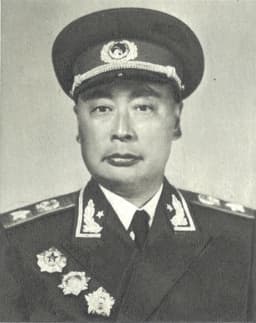
Chen Yi
General · Modern
57.5Total

Gunther von Kluge
General · Modern
52.1Total
Basic Information
Born
1901
1882
Died
1972
1944
Era
Modern
Modern
Nationality
China
Germany
Occupation
General
General
Civilization
Eastern
Western
Score Comparison
Military (10%)
52.5
52.5
Political (20%)
68.0
43.7
Influence (20%)
57.2
53.3
Legacy (20%)
50.0
46.7
Leadership (15%)
62.0
65.0
Strategy (15%)
60.0
55.0
TOTAL
57.5
52.1
Chen Yi — Complete Timeline
1945 AD
Commander of the Third Field Army in the Chinese Civil WarWar◆ Major
Chen Yi commanded the Third Field Army, which played a key role in the Huaihai Campaign and the capture of Nanjing and Shanghai. His forces were instrumental in the Communist victory in eastern China.
Chinese Civil WarMilitary Campaign
Impact: nationaldestructive
1949 AD
First Mayor of Communist ShanghaiPolitical Action◆ Major
Chen Yi was appointed the first mayor of Shanghai after the Communist takeover. He oversaw the transition of China's largest city from Nationalist to Communist control, implementing economic stabilization and political consolidation.
GovernmentShanghaiCommunist China
Impact: nationalconstructive
1955 AD
Appointed Marshal of the People's Liberation ArmyPolitical Action◆ Major
Chen Yi was appointed as one of the ten marshals of the People's Liberation Army. This honor recognized his military leadership during the civil war and his role in the Communist victory.
Military HonorPLA
Impact: nationalconstructive
1958 AD
Minister of Foreign Affairs of the People's Republic of ChinaPolitical Action◆ Major
Chen Yi was appointed Minister of Foreign Affairs, serving until 1972. He represented China at international conferences, including the Geneva Conference on Laos, and advocated for the Bandung principles of non-alignment.
DiplomacyForeign Policy
Impact: global
Gunther von Kluge — Complete Timeline
1941 AD
Commanded 4th Army in Operation BarbarossaWar◆ Major
Von Kluge commanded the 4th Army during the invasion of the Soviet Union. His forces participated in the Battle of Bialystok-Minsk and the advance on Moscow. He was known for his cautious approach and frequent disagreements with Hitler over strategy.
World War IIOperation BarbarossaEastern Front
Impact: regionaldestructive
Appointed Commander of Army Group CenterPolitical Action◆ Major
After Fedor von Bock's dismissal, von Kluge was appointed commander of Army Group Center in December 1941. He oversaw the German defense during the Soviet winter counteroffensive, preventing a complete collapse of the front.
World War IIEastern FrontArmy Group Center
Impact: regional
1944 AD
Implicated in the July 20 PlotPolitical Action◆ Major
Von Kluge was aware of the conspiracy to assassinate Hitler but did not actively participate. After the failed July 20 bomb plot, he was implicated by Gestapo investigations. He was recalled to Berlin and ordered to report to Hitler, which he interpreted as a death sentence.
World War IIJuly 20 PlotConspiracy
Impact: nationaltragic
Committed SuicideOther◆ Major
Facing arrest and trial for his alleged involvement in the July 20 plot, von Kluge committed suicide by cyanide on August 19, 1944. He left a letter to Hitler urging him to end the war. His death was officially reported as a heart attack.
World War IISuicideJuly 20 Plot
Impact: nationaltragic
Expert Analysis
Origins
Chen Yi was born on August 26, 1901, in Lezhi County, Sichuan, China, into a moderately wealthy landowning family. He received a classical education and later studied in France from 1919 to 1921 as part of the work-study program, where he was exposed to Marxist ideas. He returned to China and joined the Chinese Communist Party in 1923. Gunther von Kluge was born on October 30, 1882, in Posen, Prussia (now Poznan, Poland), into a Prussian military family. He entered the Prussian Cadet Corps at age 12 and was commissioned as a lieutenant in 1901. He served in World War I and remained in the Reichswehr after the war.
Rise to Power
Chen Yi's rise began during the Chinese Civil War. He participated in the Nanchang Uprising in 1927 and later joined Mao Zedong in the Jiangxi Soviet. He was a commander in the Long March (1934-1935) and later commanded the New Fourth Army during the Second Sino-Japanese War. After World War II, he led the Third Field Army in the Chinese Civil War, achieving decisive victories in the Huaihai Campaign (1948-1949) and capturing Nanjing and Shanghai in 1949. Von Kluge rose through the ranks of the Reichswehr and Wehrmacht. He served as a staff officer in the 1920s and commanded the 6th Army Corps in the Polish campaign (1939). He led the 4th Army in the Battle of France (1940) and was promoted to field marshal. During Operation Barbarossa (1941), his 4th Army participated in the encirclement battles at Bialystok-Minsk and Smolensk. In December 1941, he succeeded Fedor von Bock as commander of Army Group Center.
Leadership & Governance
Chen Yi's leadership style was pragmatic and adaptive. As mayor of Shanghai from 1949 to 1958, he managed the transition from Nationalist to Communist rule, stabilizing the economy and integrating Shanghai into the new regime. He used persuasion and political education rather than brute force. As foreign minister from 1958 to 1972, he represented China at the Geneva Conference (1961-1962) and promoted the Bandung spirit of Afro-Asian solidarity. Von Kluge was a competent but cautious commander. He excelled in defensive operations, as seen in the Soviet winter counteroffensive of 1941-1942. However, he lacked the strategic boldness of other German generals. He clashed with Hitler over tactical withdrawals and was often overruled. His governance was limited to military command, with no political role outside the army.
Triumph & Tragedy
Chen Yi's greatest triumph was the peaceful takeover of Shanghai in 1949, where he prevented widespread destruction and restored order. He also played a key role in the Huaihai Campaign, a decisive battle that broke Nationalist resistance in central China. His tragedy came during the Cultural Revolution (1966-1976), when he was purged and criticized as a 'capitalist roader.' He was stripped of his posts and died of illness in 1972, partially rehabilitated after his death. Von Kluge's triumph was his successful command of Army Group Center during the defensive battles of 1942-1943, preventing a Soviet breakthrough. His tragedy was his involvement in the July 20, 1944, plot to assassinate Hitler. He knew of the conspiracy but did not act decisively. After the plot failed, he was implicated and committed suicide by cyanide on August 19, 1944.
Character & Destiny
Chen Yi was known for his literary and diplomatic skills, often writing poetry and engaging in witty banter. He was a loyal party member but maintained a degree of independence. His flexibility allowed him to survive political purges until the Cultural Revolution. Von Kluge was a professional soldier who followed orders but grew disillusioned with Hitler's leadership. His indecisiveness in the July 20 plot sealed his fate. Historian William Shirer described him as 'a competent but uninspired commander.' His scores reflect this: Military 52.5, Political 43.7, Leadership 65.0.
Legacy
Chen Yi is remembered as one of the ten marshals of the People's Liberation Army and a key figure in the establishment of Communist China. His tenure as Shanghai's mayor set a precedent for urban governance under communism. He is also honored for his diplomatic work. Von Kluge's legacy is mixed. He is remembered as a skilled defensive commander but tainted by his association with the Nazi regime and his involvement in the plot. He is often cited as an example of the German officer corps' moral dilemma.
Conclusion
Chen Yi had a greater impact than Gunther von Kluge. His total score of 57.5 surpasses von Kluge's 52.1. Chen Yi's contributions to the Chinese Communist victory and the governance of Shanghai had lasting effects on China's development. Von Kluge, while competent, operated within a doomed regime and his actions did not alter the course of history. Chen Yi's legacy endures in China, while von Kluge is a footnote in World War II history.
Rankings
🥇
Chen YiLeader
Mil: 52.5Pol: 68.0Inf: 57.2
57.5
🥈
Gunther von Kluge
Mil: 52.5Pol: 43.7Inf: 53.3
52.1
+5.4 behind
How This Comparison Works
Algorithm
Each figure is scored on 6 dimensions (0—100 scale) based on structured historical data: Military (10%), Political (20%), Influence (20%), Legacy (20%), Leadership (15%), Strategy (15%). The weighted total produces the final ranking.
Data Sources
Scores are computed from structured sub-indicators in the database. Scale factors adjust for era (Ancient ×0.85, Modern ×1.0) and civilization size (Eastern ×1.05, Other ×0.80) to account for differences in population and military scale.
Maximum 3 Figures
Comparisons are limited to 2—3 figures to ensure readability and statistical meaningfulness.
Error Margins
±5 points per dimension — Sub-scores are derived from historical records with inherent uncertainty. Two figures within 5 points on a dimension should be considered roughly equivalent in that area.
Total Score Accuracy
±3 points overall — The weighted combination of 6 dimensions produces a total score with approximately ±3 points of uncertainty. Differences of less than 3 points are not statistically significant— the figures are effectively tied.
Known Limitations
- Historical records are incomplete and uneven across civilizations
- Figures from oral-tradition societies may be underrepresented
- Occupation labels can misclassify multi-role figures
- Scores measure capability and impact, not moral character
- Quantitative scoring is a comparison tool, not absolute truth
Capability Radar
Military (10%) — Battles & Warfare
Battles
55
65
Win Rate
60
60
Expansion
40
30
Political (20%) — Governance & Reform
Reform
50
20
Diplomacy
55
40
Economy
45
30
Influence (20%) — Cultural & Global Reach
Cultural
40
20
Global
35
30
Legacy (20%) — Historical Impact
Historical
50
45
Longevity
40
25
Leadership (15%) — Power & Stability
Tenure
60
55
Stability
50
25
Strategy (15%) — Tactics & Innovation
Strategy
55
75
Tactics
50
70
Reform
30
40
Similar Comparisons
Comments & Discussion
No comments yet. Be the first to share your thoughts!