Loading...
Chen Yi vs Napoleon Bonaparte
Napoleon Bonaparte leads by 13.4 pts · 2 figures compared
…
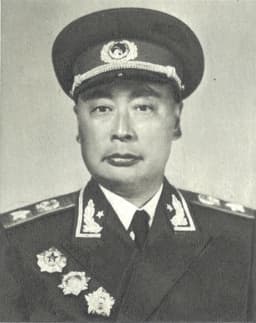
Chen Yi
General · Modern
57.5Total

Napoleon Bonaparte
General · Modern
70.9Total
Basic Information
Born
1901
1769
Died
1972
1821
Era
Modern
Modern
Nationality
China
France
Occupation
General
General
Civilization
Eastern
Western
Score Comparison
Military (10%)
52.5
94.0
Political (20%)
68.0
72.0
Influence (20%)
57.2
40.0
Legacy (20%)
50.0
80.0
Leadership (15%)
62.0
78.0
Strategy (15%)
60.0
90.0
TOTAL
57.5
70.9
Chen Yi — Complete Timeline
1945 AD
Commander of the Third Field Army in the Chinese Civil WarWar◆ Major
Chen Yi commanded the Third Field Army, which played a key role in the Huaihai Campaign and the capture of Nanjing and Shanghai. His forces were instrumental in the Communist victory in eastern China.
Chinese Civil WarMilitary Campaign
Impact: nationaldestructive
1949 AD
First Mayor of Communist ShanghaiPolitical Action◆ Major
Chen Yi was appointed the first mayor of Shanghai after the Communist takeover. He oversaw the transition of China's largest city from Nationalist to Communist control, implementing economic stabilization and political consolidation.
GovernmentShanghaiCommunist China
Impact: nationalconstructive
1955 AD
Appointed Marshal of the People's Liberation ArmyPolitical Action◆ Major
Chen Yi was appointed as one of the ten marshals of the People's Liberation Army. This honor recognized his military leadership during the civil war and his role in the Communist victory.
Military HonorPLA
Impact: nationalconstructive
1958 AD
Minister of Foreign Affairs of the People's Republic of ChinaPolitical Action◆ Major
Chen Yi was appointed Minister of Foreign Affairs, serving until 1972. He represented China at international conferences, including the Geneva Conference on Laos, and advocated for the Bandung principles of non-alignment.
DiplomacyForeign Policy
Impact: global
Napoleon Bonaparte — Complete Timeline
1799 AD
Coup of 18 BrumaireOther◆ Major
Napoleon Bonaparte, with support from his brother Lucien and key political figures, overthrew the Directory in a bloodless coup. He established the Consulate with himself as First Consul, effectively becoming the ruler of France. This event ended the French Revolution's most unstable period.
French RevolutionCoupRise to Power
Impact: regional
1804 AD
Promulgation of the Napoleonic CodeOther◆ Major
Napoleon enacted the Civil Code of the French, known as the Napoleonic Code, a comprehensive set of laws that replaced the fragmented feudal legal systems. The code established legal equality, protected property rights, and secularized law. It became the basis for legal systems in many European and world countries.
Legal ReformNapoleonic CodeCivil Law
Impact: globalconstructive
1805 AD
Battle of AusterlitzWar◆ Major
Napoleon's Grande Arm
Napoleonic WarsBattleDecisive Victory
Impact: global
1812 AD
Invasion of RussiaWar◆ Major
Napoleon led the Grande Arm
Napoleonic WarsInvasionDisaster
Impact: globaldestructive
1815 AD
Battle of WaterlooWar◆ Major
Napoleon's French army was defeated by the combined forces of the Duke of Wellington's Anglo-Allied army and Gebhard Leberecht von Bl
Napoleonic WarsBattleFinal Defeat
Impact: globaldestructive
Expert Analysis
chen-yi-vs-napoleon-bonaparte
# The Conqueror and the Builder
On a June morning in 1815, Napoleon Bonaparte watched his Imperial Guard march into the mists of Waterloo, their drums beating the charge one final time. A century and a half later, on a May afternoon in 1949, Chen Yi rode into Shanghai at the head of the People's Liberation Army, not to conquer but to govern. Two generals, two worlds, two destinies—one who sought to remake Europe through war, another who helped remake China through peace. What drove them down such different paths?
Origins
Napoleon Bonaparte was born in 1769 on Corsica, an island that had just been sold to France by Genoa. His family was minor nobility, poor enough that his father's political maneuvering secured him a scholarship to military school. There, the young Corsican with his thick accent was mocked by aristocratic classmates. He devoured history and mathematics, nursed a burning ambition, and emerged into a world convulsed by revolution. France in 1789 was a volcano—the old order crumbling, the monarchy falling, and opportunity opening for those with talent and nerve.
Chen Yi was born in 1901 in Sichuan province, as the Qing Dynasty gasped its last breaths. His family was educated but modest, local gentry in a country being carved up by foreign powers. He studied in France on a work-study program, where he encountered Marxist ideas, then returned to a China torn by warlords, civil war, and Japanese invasion. While Napoleon learned war from textbooks and cannon fire, Chen Yi learned it from guerrilla struggles and the Long March—survival itself became his education.
Rise to Power
Napoleon’s ascent was meteoric. At 24, he drove the British from Toulon and was promoted to brigadier general. At 26, he saved the revolutionary government from a royalist uprising with a "whiff of grapeshot." At 27, he took command of the Italian campaign and stunned Europe by crushing the Austrians. Each victory was a gamble, each success a stepping stone. By 1799, he was First Consul, and by 1804, Emperor. His path was built on battlefield brilliance and political audacity—he seized power because he could.
Chen Yi’s rise was slower, harder, and collective. He joined the Communist Party in 1923, survived Chiang Kai-shek’s purges, and fought through the Long March. In 1945, as commander of the Third Field Army, he helped execute the Huaihai Campaign, one of the largest battles of the Chinese Civil War. Over 66 days, his forces encircled and destroyed a Nationalist army of half a million men. But unlike Napoleon, Chen Yi did not ride into Beijing to claim personal power. He was part of a movement, not its sole engine.
Leadership & Governance
Napoleon ruled as a genius of organization and a tyrant of ambition. He reformed French law with the Napoleonic Code, establishing equality before the law and secular administration. He built roads, standardized education, and created the Bank of France. But his governance was inseparable from war—every reform funded by plunder, every institution bent toward conquest. He centralized power in himself, appointed his brothers as kings, and crushed dissent at home while marching abroad.
Chen Yi governed as a builder and a diplomat. As the first mayor of Shanghai in 1949, he faced a city of 5 million people, rampant inflation, and a collapsing economy. He did not impose martial law; he negotiated with businessmen, stabilized the currency, and restored electricity and water. His approach was pragmatic—he understood that Shanghai’s capitalists could serve the new China if handled carefully. Later, as Foreign Minister from 1958 to 1972, he represented China at the Bandung Conference and navigated the Sino-Soviet split, speaking with a bluntness that disarmed Western diplomats.
Triumph & Tragedy
Napoleon’s greatest moment was Austerlitz in 1805, where he destroyed the combined armies of Russia and Austria in a single day. His worst was the invasion of Russia in 1812—600,000 men marched east; fewer than 100,000 returned. The disaster broke his aura of invincibility. He was exiled to Elba, escaped, and gathered one last army—only to fall at Waterloo in 1815, defeated by the very coalition he had spent a decade forging against himself.
Chen Yi’s triumph was the capture of Shanghai without destroying it—a bloodless victory that proved the Communists could govern, not just fight. His tragedy came during the Cultural Revolution, when Red Guards attacked him as a "bourgeois revisionist." He was publicly humiliated, his health broken. Unlike Napoleon, he did not fall in battle but was consumed by the very revolution he had helped create. He died in 1972, a marshal who had outlived his command.
Character & Destiny
Napoleon was driven by an insatiable will. "Impossible," he once said, "is a word to be found only in the dictionary of fools." He trusted his genius, believed in his star, and could not stop. His character was his fate—the same energy that conquered Europe also destroyed it. He could not delegate, could not compromise, could not rest.
Chen Yi was driven by duty, not glory. He was known for his poetry and his wit, for his ability to laugh at himself. "I am a general who writes poems," he said, "and a poet who leads armies." This dual nature allowed him to survive political storms that destroyed more rigid comrades. He bent, but did not break.
Legacy
Napoleon left a continent reshaped—the Napoleonic Code, modern nationalism, the end of feudalism, and a legend that still haunts Europe. His legacy is both liberation and destruction, reform and tyranny. He is remembered in the Arc de Triomphe, in the streets named after his battles, in every history book that debates whether he was a hero or a monster.
Chen Yi left a city rebuilt and a nation reoriented. He is remembered as one of the Ten Marshals, as the man who held Shanghai together, as a diplomat who stood up to both superpowers. His legacy is quieter—no monuments to his ego, no empire named after him. But when Shanghai rose to become a global city, it stood on foundations he laid.
Conclusion
Two generals, separated by oceans and centuries, yet joined by a single truth: military genius does not guarantee political wisdom. Napoleon conquered and fell; Chen Yi built and endured. One chased immortality and found exile; the other served a cause larger than himself and found survival. In the end, the question is not who was the greater commander—Napoleon’s 94 to Chen Yi’s 67 in military score settles that—but who understood what power was for. Napoleon used power to glorify himself; Chen Yi used it to stabilize a nation. History remembers both, but perhaps it honors only one.
Rankings
🥇
Napoleon BonaparteLeader
Mil: 94.0Pol: 72.0Inf: 40.0
70.9
🥈
Chen Yi
Mil: 52.5Pol: 68.0Inf: 57.2
57.5
+13.4 behind
How This Comparison Works
Algorithm
Each figure is scored on 6 dimensions (0—100 scale) based on structured historical data: Military (10%), Political (20%), Influence (20%), Legacy (20%), Leadership (15%), Strategy (15%). The weighted total produces the final ranking.
Data Sources
Scores are computed from structured sub-indicators in the database. Scale factors adjust for era (Ancient ×0.85, Modern ×1.0) and civilization size (Eastern ×1.05, Other ×0.80) to account for differences in population and military scale.
Maximum 3 Figures
Comparisons are limited to 2—3 figures to ensure readability and statistical meaningfulness.
Error Margins
±5 points per dimension — Sub-scores are derived from historical records with inherent uncertainty. Two figures within 5 points on a dimension should be considered roughly equivalent in that area.
Total Score Accuracy
±3 points overall — The weighted combination of 6 dimensions produces a total score with approximately ±3 points of uncertainty. Differences of less than 3 points are not statistically significant— the figures are effectively tied.
Known Limitations
- Historical records are incomplete and uneven across civilizations
- Figures from oral-tradition societies may be underrepresented
- Occupation labels can misclassify multi-role figures
- Scores measure capability and impact, not moral character
- Quantitative scoring is a comparison tool, not absolute truth
Capability Radar
Military (10%) — Battles & Warfare
Battles
55
95
Win Rate
60
90
Expansion
40
95
Political (20%) — Governance & Reform
Reform
50
95
Diplomacy
55
80
Economy
45
85
Influence (20%) — Cultural & Global Reach
Cultural
40
85
Global
35
90
Legacy (20%) — Historical Impact
Historical
50
95
Longevity
40
90
Leadership (15%) — Power & Stability
Tenure
60
85
Stability
50
70
Strategy (15%) — Tactics & Innovation
Strategy
55
95
Tactics
50
98
Reform
30
92
Similar Comparisons
Comments & Discussion
The Road Not Taken6/17/2026
Napoleon’s fatal flaw wasn't Waterloo—it was that he never learned to stop. Chen Yi proved that conquest is easy; building is hard. The Corsican ignored logistics and civilian administration once the smoke cleared, while Chen Yi made banking reforms and cracked down on speculators in Shanghai within days. Napoleon could storm Vienna, but could he stabilize a currency? History favors the builder over the burning star.
灰色炮兵6/17/2026
滑铁卢只是拿破仑的句号,陈毅才算得上战略大师。拿破仑迷信决战,一生打了60多场大战,把法兰西的血液抽干。陈毅在淮海战役靠的是“小推车推出来的胜利”,动员543万支前民工,用全民战争绞死了机械化兵团。一个是个人英雄主义的极致,一个是组织力量的胜利。谁更懂战争?数字会说话。
Metricide6/17/2026
Data doesn't lie: Napoleon’s Grande Armée lost 98% of its men in the 1812 Russian campaign—400,000 dead. Chen Yi’s PLA took Shanghai with minimal artillery, preserving the city's infrastructure and feeding 6 million civilians within a week. One general spent lives like coins; the other treated them as investments. I’ll take the man who understood that occupation isn't victory.
旧书虫6/17/2026
拿破仑身后留下的是《拿破仑法典》和无数战争废墟,陈毅留下的是一家家工厂和一所所学校。前者在圣赫勒拿岛含恨而终,后者当了十年外交部长。一个是西方的征服神话,一个是东方的建设寓言。你要比较他们的战功?不如比比他们卸甲之后的贡献。枪管生锈了,但学校还在上课。
Révisionniste6/17/2026
Spare me the 'Builder vs. Conqueror' cliché. Chen Yi was a loyal machine of Mao's purges; during the 1955 Anti-Rightist Campaign, he denounced intellectuals as 'poisonous weeds.' Napoleon at least codified meritocracy with the Legion of Honour—Chen Yi upheld a system where your class origin mattered more than talent. Both were men of their violent eras; let's not whitewash one with romanticism.