Loading...
Charles Theodore of Sulzbach vs King Ghazi of Iraq
Charles Theodore of Sulzbach leads by 1.5 pts · 2 figures compared
…
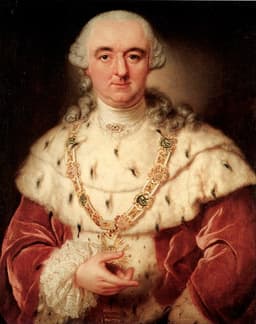
Charles Theodore of Sulzbach
Emperor · Modern
44.8Total

King Ghazi of Iraq
Emperor · Modern
43.3Total
Basic Information
Born
1724
1912
Died
1799
1939
Era
Modern
Modern
Nationality
Sulzbach
Iraq
Occupation
Emperor
Emperor
Civilization
Western
Middle Eastern
Score Comparison
Military (10%)
14.9
50.0
Political (20%)
46.6
36.5
Influence (20%)
48.6
46.3
Legacy (20%)
38.3
35.8
Leadership (15%)
67.0
51.9
Strategy (15%)
45.0
45.0
TOTAL
44.8
43.3
Charles Theodore of Sulzbach — Complete Timeline
1742 AD
Inherited the Electorate of the PalatinatePolitical Action◆ Major
Charles Theodore inherited the Electorate of the Palatinate and the Duchies of J
SuccessionElectorate
Impact: regional
1777 AD
Inherited the Electorate of BavariaPolitical Action
Upon the death of Elector Maximilian III Joseph of Bavaria, Charles Theodore inherited the Electorate of Bavaria. This inheritance united Bavaria with the Palatinate, creating a large Wittelsbach state, but also triggered the War of the Bavarian Succession.
SuccessionBavariaUnification
Impact: regional
1779 AD
Treaty of TeschenPolitical Action◆ Major
Charles Theodore signed the Treaty of Teschen, ending the War of the Bavarian Succession. The treaty confirmed his inheritance of Bavaria but ceded the Innviertel region to Austria, a compromise that preserved the territorial unity of his new domains.
TreatyWar of the Bavarian SuccessionTerritorial Cession
Impact: regional
King Ghazi of Iraq — Complete Timeline
1933 AD
Assumption of the Throne (1933)Political Action◆ Major
King Ghazi ascended to the throne of Iraq following the death of his father, King Faisal I. At age 21, he inherited a newly independent but fragile kingdom. His reign was marked by growing nationalism, anti-British sentiment, and tensions between the monarchy and the military.
SuccessionMonarchyNationalism
Impact: national
1936 AD
Bakr Sidqi Coup and Military Influence (1936)Political Action◆ Major
King Ghazi tacitly supported the military coup led by General Bakr Sidqi, which overthrew the civilian government of Yasin al-Hashimi. This was the first military coup in the Arab world. Ghazi's sympathy with the military reflected his nationalist and anti-British views, but it destabilized Iraqi politics.
Military CoupBakr SidqiPolitical Instability
Impact: nationaldestructive
1939 AD
Death in a Car Accident (1939)Other◆ Major
King Ghazi died in a car accident in Baghdad, crashing his sports car into a utility pole. His death was sudden and unexpected, leading to widespread rumors of assassination by British agents. He was succeeded by his young son, Faisal II, under a regency, which further weakened the monarchy.
DeathCar AccidentConspiracy Theories
Impact: nationaltragic
Expert Analysis
Origins
Charles Theodore of Sulzbach was born on December 11, 1724, in Düsseldorf, into the House of Wittelsbach. His father was Count Palatine John Christian of Sulzbach, and his mother was Marie Henriette de La Tour d'Auvergne. He received a Catholic education and was groomed for rulership within the complex web of German principalities. His early life was marked by the political maneuvering of the Holy Roman Empire, where small states jostled for influence.
King Ghazi of Iraq was born on March 21, 1912, in Mecca, then part of the Ottoman Empire. He was the only son of King Faisal I of Iraq and his wife Huzaima bint Nasser. Ghazi was educated in Iraq and later at the Royal Military Academy Sandhurst in England, reflecting his father's desire to modernize the monarchy. His upbringing was shaped by the Arab Revolt and the establishment of new states after World War I.
Rise to Power
Charles Theodore rose to power through inheritance. In 1742, he succeeded his cousin Charles III Philip as Elector of the Palatinate and Duke of Jülich and Berg. His major breakthrough came in 1777 when Elector Maximilian III Joseph of Bavaria died without issue. Charles Theodore inherited the Electorate of Bavaria, uniting the Palatinate and Bavaria after centuries of separation. This succession triggered the War of the Bavarian Succession (1778–1779), which ended with the Treaty of Teschen, confirming his inheritance but ceding the Innviertel to Austria.
King Ghazi ascended the throne on September 8, 1933, upon the death of his father, King Faisal I. At age 21, he inherited a newly independent but fragile kingdom. His early reign was overshadowed by the influence of his uncle, Prince Abdullah, and the British, who maintained significant control over Iraq. Ghazi's nationalist sentiments led him to support military figures like General Bakr Sidqi, who orchestrated the first military coup in the Arab world in 1936, overthrowing the civilian government of Yasin al-Hashimi. Ghazi tacitly supported this coup, marking a shift toward military influence in Iraqi politics.
Leadership & Governance
Charles Theodore's leadership was characterized by enlightened absolutism with a focus on cultural patronage. He supported the arts, particularly music and theater, and his court in Mannheim became a center for the Mannheim school of composers. Politically, he pursued a policy of neutrality and avoided major conflicts, but his governance was criticized for neglecting administrative reforms. He scored 67.0 in leadership and 46.6 in political acumen. His handling of the Bavarian succession showed diplomatic skill but also a willingness to cede territory to avoid war.
King Ghazi's governance was marked by nationalism and a desire to reduce British influence. He promoted pan-Arab ideas and used radio broadcasts to rally support. However, his reign was chaotic; he had little control over the military and civilian governments. The 1936 coup set a precedent for military intervention in politics. Ghazi's political score of 36.5 reflects his weak governance and reliance on military figures. He scored 51.9 in leadership, but his inexperience and lack of administrative focus undermined his effectiveness.
Triumph & Tragedy
Charles Theodore's greatest triumph was the unification of Bavaria and the Palatinate, creating a larger Wittelsbach state. He also successfully navigated the War of the Bavarian Succession without major destruction. However, his tragedy was the loss of the Innviertel to Austria and his failure to produce a legitimate heir, leading to the extinction of his line. His legacy score of 38.3 reflects limited long-term impact.
King Ghazi's triumph was his role in promoting Iraqi nationalism and reducing British influence, symbolized by the 1936 coup. He also oversaw the development of the Iraqi air force. His tragedy was his sudden death in a car accident on April 4, 1939, at age 27, which left Iraq in a succession crisis and paved the way for the pro-British regency of Prince Abdullah. His legacy score of 35.8 is low due to his short reign and the instability that followed.
Character & Destiny
Charles Theodore was known as a cultured, easygoing ruler who preferred the arts to politics. He was indecisive and often left governance to his ministers. His character shaped his destiny: his lack of assertiveness led to territorial concessions, but his diplomatic approach prevented war. Historians view him as a transitional figure in Bavarian history.
King Ghazi was impulsive, nationalist, and passionate about modern technology like automobiles and radio. His recklessness may have contributed to his fatal car accident. His character—youthful and idealistic—led him to support military coups, but his inexperience prevented him from consolidating power. Historical assessments note his potential unfulfilled due to his early death.
Legacy
Charles Theodore's legacy is mixed. He is remembered for uniting Bavaria and the Palatinate, but his lack of reform and heir meant his successors faced challenges. The Mannheim school of music flourished under his patronage, influencing classical music. Politically, his reign demonstrated the limits of enlightened absolutism in the Holy Roman Empire.
King Ghazi's legacy is that of a nationalist king who died young. His support for the 1936 coup began a pattern of military intervention in Iraqi politics that persisted for decades. His death led to the regency of Prince Abdullah, who aligned Iraq with Britain during World War II. Ghazi is remembered as a symbol of Iraqi nationalism, but his actual impact was limited by his short reign.
Conclusion
While Charles Theodore scored slightly higher overall (44.8 vs 43.3), King Ghazi's impact on Iraq's political trajectory was more significant. Charles Theodore's unification of Bavaria was important but reversible, and his cultural contributions, while notable, did not alter the course of German history. Ghazi's actions, particularly the 1936 coup, set a precedent for military rule in Iraq and the Arab world, with consequences lasting into the 21st century. Thus, despite his lower scores, King Ghazi had a greater long-term impact on political history. The score gap of 1.5 points does not capture the transformative nature of Ghazi's reign.
Rankings
🥇
Charles Theodore of SulzbachLeader
Mil: 14.9Pol: 46.6Inf: 48.6
44.8
🥈
King Ghazi of Iraq
Mil: 50.0Pol: 36.5Inf: 46.3
43.3
+1.5 behind
How This Comparison Works
Algorithm
Each figure is scored on 6 dimensions (0—100 scale) based on structured historical data: Military (10%), Political (20%), Influence (20%), Legacy (20%), Leadership (15%), Strategy (15%). The weighted total produces the final ranking.
Data Sources
Scores are computed from structured sub-indicators in the database. Scale factors adjust for era (Ancient ×0.85, Modern ×1.0) and civilization size (Eastern ×1.05, Other ×0.80) to account for differences in population and military scale.
Maximum 3 Figures
Comparisons are limited to 2—3 figures to ensure readability and statistical meaningfulness.
Error Margins
±5 points per dimension — Sub-scores are derived from historical records with inherent uncertainty. Two figures within 5 points on a dimension should be considered roughly equivalent in that area.
Total Score Accuracy
±3 points overall — The weighted combination of 6 dimensions produces a total score with approximately ±3 points of uncertainty. Differences of less than 3 points are not statistically significant— the figures are effectively tied.
Known Limitations
- Historical records are incomplete and uneven across civilizations
- Figures from oral-tradition societies may be underrepresented
- Occupation labels can misclassify multi-role figures
- Scores measure capability and impact, not moral character
- Quantitative scoring is a comparison tool, not absolute truth
Capability Radar
Military (10%) — Battles & Warfare
Battles
5
0
Win Rate
5
0
Expansion
10
0
Political (20%) — Governance & Reform
Reform
30
25
Diplomacy
40
35
Economy
30
20
Influence (20%) — Cultural & Global Reach
Cultural
20
10
Global
10
5
Legacy (20%) — Historical Impact
Historical
20
10
Longevity
20
5
Leadership (15%) — Power & Stability
Tenure
50
30
Stability
20
15
Strategy (15%) — Tactics & Innovation
Strategy
5
0
Tactics
5
0
Reform
5
5
Similar Comparisons
Comments & Discussion
No comments yet. Be the first to share your thoughts!