Loading...
Charles de Gaulle vs Yoweri Museveni
Charles de Gaulle leads by 4.3 pts · 2 figures compared
…
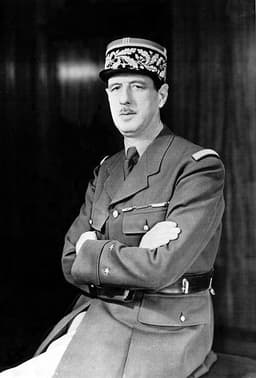
Charles de Gaulle
Politician · Modern
68.2Total
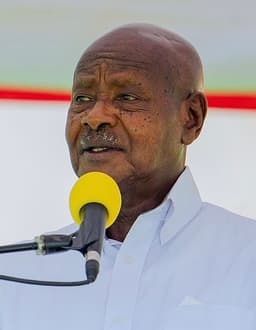
Yoweri Museveni
Politician · Modern
63.9Total
Basic Information
Born
1890
1944
Died
1970
—
Era
Modern
Modern
Nationality
France
Uganda
Occupation
Politician
Politician
Civilization
Western
Other
Score Comparison
Military (10%)
55.0
67.5
Political (20%)
75.0
72.0
Influence (20%)
65.0
61.0
Legacy (20%)
68.0
50.0
Leadership (15%)
78.0
80.0
Strategy (15%)
65.0
66.3
TOTAL
68.2
63.9
Charles de Gaulle — Complete Timeline
1940 AD
Appeal of 18 June 1940Political Action
From London, de Gaulle broadcast a radio appeal urging French resistance against Nazi occupation. He called on French soldiers and citizens to continue the fight, founding the Free French Forces and becoming the symbol of French defiance.
World War IIResistanceLeadership
Impact: nationalconstructive
1958 AD
Founding of the Fifth RepublicPolitical Action
De Gaulle returned to power during the Algerian crisis and oversaw the drafting of a new constitution. The Fifth Republic established a strong executive presidency, replacing the unstable parliamentary system of the Fourth Republic.
ConstitutionGovernment ReformPolitical System
Impact: nationalconstructive
1962 AD
End of the Algerian WarPolitical Action◆ Major
De Gaulle negotiated the
DecolonizationPeace TreatyAlgeria
Impact: regionalconstructive
1968 AD
May 1968 CrisisPolitical Action◆ Major
Mass student protests and general strikes paralyzed France, challenging de Gaulle's government. De Gaulle briefly fled to Germany, then returned to dissolve the National Assembly and call elections, which his party won, but his authority was weakened.
ProtestPolitical CrisisSocial Unrest
Impact: nationaldestructive
1969 AD
Resignation as PresidentPolitical Action
De Gaulle resigned after losing a referendum on regional reform and Senate restructuring. The defeat marked the end of his political career, as he withdrew from public life and died the following year.
ResignationPolitical DefeatReferendum
Impact: nationaltragic
Yoweri Museveni — Complete Timeline
1986 AD
Bush War Victory and Capture of KampalaWar
Museveni's National Resistance Army (NRA) captured Kampala, ending the Ugandan Bush War. He was sworn in as President on January 29, 1986, overthrowing the government of Tito Okello and beginning his long rule.
Ugandan Bush WarSeizure of PowerNRA
Impact: national
Introduction of the Movement SystemPolitical Action◆ Major
Museveni established a 'no-party' Movement system, banning political party activity. This system concentrated power in the National Resistance Movement (NRM) and was justified as necessary to prevent ethnic conflict, but was criticized as authoritarian.
Political SystemNRMAuthoritarianism
Impact: national
1998 AD
Invasion of the Democratic Republic of CongoWar◆ Major
Ugandan forces, allied with Rwanda, invaded the Democratic Republic of Congo (DRC) to overthrow Laurent Kabila. This intervention escalated the Second Congo War, drawing in multiple African nations and causing widespread devastation.
Second Congo WarRegional ConflictIntervention
Impact: regionaldestructive
2005 AD
Constitutional Amendment Removing Term LimitsPolitical Action◆ Major
Museveni's government pushed through a constitutional amendment removing presidential term limits. This allowed him to run for a third term in 2006 and subsequent elections, consolidating his hold on power and drawing domestic and international criticism.
Constitutional ChangeTerm LimitsPower Consolidation
Impact: nationaldestructive
2014 AD
Anti-Homosexuality ActPolitical Action◆ Major
Museveni signed the Anti-Homosexuality Act, which imposed life imprisonment for certain same-sex acts. The law was widely condemned internationally, leading to aid cuts from some Western nations, though it was later annulled by the Constitutional Court on procedural grounds.
LGBTQ RightsLegislationInternational Condemnation
Impact: nationaldestructive
Expert Analysis
Charles de Gaulle vs Yoweri Museveni
# The General and the Guerrilla
In the autumn of 1969, an aging Charles de Gaulle walked away from power after losing a referendum on regional reform—a man who had saved France twice, undone by a vote about Senate restructuring. Half a world away and seventeen years later, Yoweri Museveni marched into Kampala at the head of a guerrilla army, seized the presidency, and would spend the next four decades systematically dismantling every obstacle to his continued rule. Both men called themselves saviors of their nations. Both were military men who became political architects. Yet one chose to leave when the people said no, while the other learned to make the people’s voice irrelevant. The difference tells us something profound about power, legitimacy, and the souls of nations.
Origins
Charles de Gaulle was born into a devoutly Catholic, nationalist family in Lille in 1890. His father taught him that France was a sacred vessel of civilization, and that duty to her was absolute. He entered Saint-Cyr military academy, was wounded at Verdun, and spent the interwar years writing unfashionable books about tank warfare and the need for a strong executive. He was a man formed by defeat—the humiliation of 1940, the collapse of the Third Republic—and he carried that wound for the rest of his life.
Yoweri Museveni was born in 1944 in Ntungamo, then part of the British protectorate of Uganda. He grew up in a world of cattle, colonial schools, and the stirrings of independence. He studied political science in Tanzania, where he absorbed Marxist theory and the writings of Frantz Fanon. While de Gaulle’s world was shaped by the trenches of the Great War and the fall of France, Museveni’s was shaped by the liberation struggles sweeping Africa—the overthrow of colonial regimes, the rise of strongmen, the bitter lesson that in post-colonial politics, power was taken, not granted.
Rise to Power
De Gaulle’s rise was the stuff of radio waves and stubborn principle. On June 18, 1940, a little-known brigadier general broadcast from London, calling on the French people to resist. He had no army, no territory, no legitimacy—only the conviction that he embodied the true France. For four years, he was a voice in exile, a man dismissed by Roosevelt and Churchill as a pretentious prima donna. Yet he endured, and in 1944 he returned to Paris a liberator.
Museveni’s path was wet with blood. After failing to unseat Idi Amin through the ballot box, he took to the bush. For five years, his National Resistance Army fought a guerrilla war in the Luwero Triangle, living off the land and the loyalty of the Baganda peasants. When he captured Kampala in January 1986, he was not a voice from London but a general who had walked through the mud. His legitimacy came not from history or constitution, but from the barrel of a gun and the exhaustion of a war-torn people.
Leadership & Governance
De Gaulle governed with a kind of tragic grandeur. He believed France required a strong president above petty parties, and in 1958 he wrote the Fifth Republic’s constitution to ensure it. He ended the Algerian War in 1962 by the sheer force of his will, defying the army that had brought him to power. He built nuclear weapons, withdrew from NATO’s military command, and pursued an independent foreign policy that irritated allies but restored French pride. His style was aloof, monarchical—he once said, “A man of character finds a special attraction in difficulty, since it is only by coming to grips with difficulty that he can realize his potentialities.”
Museveni governed as a pragmatist who learned to perfect the art of controlled democracy. He introduced a “Movement system” that banned political parties, claiming they fostered tribalism. He stabilized Uganda after the horrors of Amin and Obote, restored economic growth, and won genuine international praise in the 1990s. He invaded the Democratic Republic of Congo in 1998, a disastrous intervention that destabilized the Great Lakes region. And in 2005, he removed presidential term limits, ensuring he could rule indefinitely. Where de Gaulle built institutions that outlasted him, Museveni built institutions that served him.
Triumph & Tragedy
De Gaulle’s greatest moment was the Appeal of June 18, 1940—a speech that gave France a reason to keep fighting when all seemed lost. His greatest tragedy was the May 1968 crisis, when students and workers paralyzed France, and the old general, bewildered by a generation he did not understand, briefly fled to Germany to consult with his generals. He recovered, called an election, and won—but the spell was broken. A year later, he lost a trivial referendum and resigned.
Museveni’s triumph was the capture of Kampala and the restoration of order to a shattered country. His tragedy is that he has become the very thing he fought against—a leader who cannot let go. The Anti-Homosexuality Act of 2014, which imposed life imprisonment for same-sex acts, turned him into a symbol of repression. The long slide from liberator to autocrat is the story of his later years.
Character & Destiny
De Gaulle was a man of immense pride and immense discipline. He believed he had a rendezvous with history, and he was right. But he also believed in the legitimacy of the people’s will—even when it disappointed him. When the 1969 referendum failed, he resigned instantly. He did not change the rules. He did not send the army to the streets. He accepted that the people had spoken, and he walked away.
Museveni, by contrast, has never accepted that the people might wish him gone. He has changed the constitution, arrested opponents, and manipulated elections. Where de Gaulle saw democracy as the ultimate source of his authority, Museveni sees it as an obstacle to be managed. Both men were shaped by war and national crisis, but they drew opposite conclusions: de Gaulle that power must be earned anew each day, Museveni that power once seized must never be surrendered.
Legacy
De Gaulle left behind the Fifth Republic, a constitution that has given France stability for over sixty years. He left behind a France that stood tall in the world, a nuclear power with a seat at the table of the great. He is remembered as the man who saved France twice—once from the Nazis, once from itself. His legacy is institutional, constitutional, and enduring.
Museveni’s legacy is still being written, but the early returns are troubling. He stabilized Uganda, but he also corrupted its politics. He brought peace, but then refused to share it. He may be remembered as a father of the nation, or as a classic African strongman who stayed too long. The difference between him and de Gaulle is not talent or vision—it is the willingness to let go.
Conclusion
In the end, the most important decision a leader makes is whether to leave. De Gaulle walked away from power when the people asked him to. Museveni rewrote the rules to make sure the people could never ask. Both were warriors, both were nation-builders, both believed they were indispensable. But one understood that in a democracy, no one is indispensable—not even the man who saved the country. The other has yet to learn that lesson, and his country is paying the price.
Rankings
🥇
Charles de GaulleLeader
Mil: 55.0Pol: 75.0Inf: 65.0
68.2
🥈
Yoweri Museveni
Mil: 67.5Pol: 72.0Inf: 61.0
63.9
+4.3 behind
How This Comparison Works
Algorithm
Each figure is scored on 6 dimensions (0—100 scale) based on structured historical data: Military (10%), Political (20%), Influence (20%), Legacy (20%), Leadership (15%), Strategy (15%). The weighted total produces the final ranking.
Data Sources
Scores are computed from structured sub-indicators in the database. Scale factors adjust for era (Ancient ×0.85, Modern ×1.0) and civilization size (Eastern ×1.05, Other ×0.80) to account for differences in population and military scale.
Maximum 3 Figures
Comparisons are limited to 2—3 figures to ensure readability and statistical meaningfulness.
Error Margins
±5 points per dimension — Sub-scores are derived from historical records with inherent uncertainty. Two figures within 5 points on a dimension should be considered roughly equivalent in that area.
Total Score Accuracy
±3 points overall — The weighted combination of 6 dimensions produces a total score with approximately ±3 points of uncertainty. Differences of less than 3 points are not statistically significant— the figures are effectively tied.
Known Limitations
- Historical records are incomplete and uneven across civilizations
- Figures from oral-tradition societies may be underrepresented
- Occupation labels can misclassify multi-role figures
- Scores measure capability and impact, not moral character
- Quantitative scoring is a comparison tool, not absolute truth
Capability Radar
Military (10%) — Battles & Warfare
Battles
60
65
Win Rate
55
70
Expansion
20
55
Political (20%) — Governance & Reform
Reform
95
60
Diplomacy
90
70
Economy
70
55
Influence (20%) — Cultural & Global Reach
Cultural
70
45
Global
80
50
Legacy (20%) — Historical Impact
Historical
85
55
Longevity
75
50
Leadership (15%) — Power & Stability
Tenure
85
85
Stability
75
50
Strategy (15%) — Tactics & Innovation
Strategy
85
80
Tactics
70
75
Reform
80
60
Similar Comparisons
Comments & Discussion
Musket and Machete6/16/2026
De Gaulle built his legitimacy on a sacred vision of France; Museveni built his on a gun. The General walked away after losing a referendum on regional reform—a trivial issue that became a matter of principle. Museveni changed Uganda’s constitution to abolish presidential term limits in 2005. One man believed his authority came from the people; the other believes the people exist to validate his authority. That’s the difference between a statesman and a warlord with a suit.
铁幕与丛林6/16/2026
戴高乐在1940年选择流亡,拒绝承认维希政府的合法性;穆塞韦尼在1986年选择武装夺取政权。两人都自称救国者,但戴高乐坚持“合法性源于人民同意”这一西方原则,而穆塞韦尼用宪法修正案、选举操纵和逮捕反对派来确保自己“永远正确”。一个在1969年因全民公投失败而辞职,另一个在位近四十年仍在修改规则。哪个才是真正的领袖?
Tank Commander's Shadow6/16/2026
De Gaulle was a man of the book and the battlefield—he wrote presciently about armored warfare in the 1930s while the French military ignored him. Museveni studied guerrilla tactics in Mozambique and Algeria, then applied them ruthlessly. One was a professional soldier who never fired a shot after 1918 except in anger at his own country's surrender; the other led a bush war that left tens of thousands dead. The romanticism around Museveni’s “liberation” obscures the truth: he won by attrition, n
数据拆解师6/16/2026
比较两人不能忽略硬数据:戴高乐治下的法国在1960年代GDP年均增长约5.5%,失业率低于2%;而穆塞韦尼治理了38年,乌干达人均GDP仍不到800美元,40%以上人口每日生活费不足2美元。更讽刺的是,戴高乐1969年辞职是因一场微不足道的区域改革全民公投,穆塞韦尼却用修改宪法、控制法院和镇压异见来规避任何真正的民意检验。数字不会撒谎,权力与发展的差距如此明显。
The Ghost of Versailles6/16/2026
De Gaulle believed France was a divine mission; Museveni believes Uganda is a personal project. De Gaulle restored democracy after the war and then left when voters rejected him—on a Senate reform, of all things. Museveni abolished presidential term limits in 2005 and has ruled for 38 years, calling it “stability.” The General’s arrogance was about French greatness; Museveni’s is about self-preservation. One built a Fifth Republic; the other built a one-party state with elections as theater.