Loading...
Charles de Gaulle vs Pedro I of Brazil
Charles de Gaulle leads by 13.6 pts · 2 figures compared
…
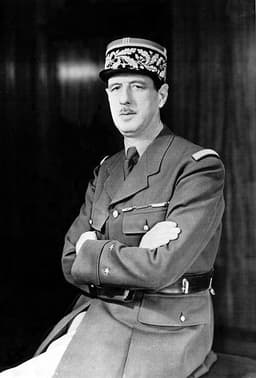
Charles de Gaulle
Politician · Modern
68.2Total
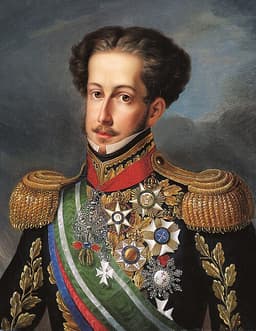
Pedro I of Brazil
Emperor · Modern
54.6Total
Basic Information
Born
1890
1798
Died
1970
1834
Era
Modern
Modern
Nationality
France
Brazil
Occupation
Politician
Emperor
Civilization
Western
Western
Score Comparison
Military (10%)
55.0
55.0
Political (20%)
75.0
62.7
Influence (20%)
65.0
59.0
Legacy (20%)
68.0
50.0
Leadership (15%)
78.0
53.2
Strategy (15%)
65.0
45.0
TOTAL
68.2
54.6
Charles de Gaulle — Complete Timeline
1940 AD
Appeal of 18 June 1940Political Action
From London, de Gaulle broadcast a radio appeal urging French resistance against Nazi occupation. He called on French soldiers and citizens to continue the fight, founding the Free French Forces and becoming the symbol of French defiance.
World War IIResistanceLeadership
Impact: nationalconstructive
1958 AD
Founding of the Fifth RepublicPolitical Action
De Gaulle returned to power during the Algerian crisis and oversaw the drafting of a new constitution. The Fifth Republic established a strong executive presidency, replacing the unstable parliamentary system of the Fourth Republic.
ConstitutionGovernment ReformPolitical System
Impact: nationalconstructive
1962 AD
End of the Algerian WarPolitical Action◆ Major
De Gaulle negotiated the
DecolonizationPeace TreatyAlgeria
Impact: regionalconstructive
1968 AD
May 1968 CrisisPolitical Action◆ Major
Mass student protests and general strikes paralyzed France, challenging de Gaulle's government. De Gaulle briefly fled to Germany, then returned to dissolve the National Assembly and call elections, which his party won, but his authority was weakened.
ProtestPolitical CrisisSocial Unrest
Impact: nationaldestructive
1969 AD
Resignation as PresidentPolitical Action
De Gaulle resigned after losing a referendum on regional reform and Senate restructuring. The defeat marked the end of his political career, as he withdrew from public life and died the following year.
ResignationPolitical DefeatReferendum
Impact: nationaltragic
Pedro I of Brazil — Complete Timeline
1822 AD
Declaration of Independence of BrazilPolitical Action
Pedro I declared Brazil's independence from Portugal on September 7, 1822, at the Ipiranga River in S
Impact: globalprogressive
Coronation as Emperor of BrazilPolitical Action◆ Major
Pedro I was crowned Emperor of Brazil on December 1, 1822, in Rio de Janeiro. The coronation formalized the new imperial government, with Pedro I as constitutional monarch, though he retained significant executive powers.
Impact: nationalconstructive
1823 AD
War of Independence of BrazilWar◆ Major
Pedro I led Brazilian forces against Portuguese loyalists in the War of Independence. Key battles occurred in Bahia, Maranh
Impact: national
Dissolution of the Constituent AssemblyPolitical Action◆ Major
Pedro I dissolved the Constituent Assembly after conflicts over the constitution's limits on imperial power. He then imposed the 1824 Constitution, which granted the emperor extensive powers, including the Moderating Power, centralizing authority.
Impact: nationaldestructive
1831 AD
Abdication of the Brazilian ThronePolitical Action
Pedro I abdicated the Brazilian throne in favor of his five-year-old son Pedro II on April 7, 1831. He returned to Portugal to claim the Portuguese throne, leaving Brazil under a regency until his son came of age.
Impact: national
Expert Analysis
Charles de Gaulle vs Pedro I of Brazil
# The Lonely Path of Power: Charles de Gaulle and Pedro I of Brazil
In the spring of 1969, Charles de Gaulle, the towering figure who had restored France’s honor and reshaped its institutions, quietly left the Élysée Palace after losing a referendum on regional reform. Less than a century and a half earlier, another monarch—Pedro I of Brazil—had abdicated his throne under pressure, sailing back to Portugal in 1831 after a tumultuous nine-year reign. One was a general who became a president; the other, an emperor who became a legend. Both men stood at the crossroads of revolution and tradition, yet their paths diverged in ways that reveal much about the forces that shape history.
Origins
Charles de Gaulle was born in 1890 into a devoutly Catholic, patriotic family in Lille, northern France. His father, a professor, instilled in him a fierce love of country and a sense of destiny. De Gaulle grew up in the shadow of France’s humiliation in the Franco-Prussian War, an experience that forged his conviction that national greatness required strong leadership and independence. He was shaped by the trenches of World War I, where he was wounded and captured, and by the interwar years, when he argued passionately for mechanized warfare against a skeptical military establishment.
Pedro I of Brazil, born in 1798 in Lisbon, was the son of King João VI of Portugal and Carlota Joaquina of Spain. His childhood was marked by chaos: the Napoleonic Wars forced the Portuguese royal family to flee to Brazil in 1807, making Rio de Janeiro the capital of the Portuguese Empire. Pedro grew up in a tropical court, surrounded by intrigue and the ferment of revolutionary ideas. He was impulsive, charismatic, and deeply aware that his destiny lay in the Americas, not Europe. Where de Gaulle’s formation was intellectual and military, Pedro’s was visceral and political—a prince thrust into a world breaking apart.
Rise to Power
De Gaulle’s ascent began in the darkest hour of France. In June 1940, as German forces overran the country and Marshal Pétain prepared to surrender, de Gaulle—then a little-known brigadier general—flew to London. On June 18, he broadcast his famous appeal over BBC radio, calling on the French to resist. “France has lost a battle,” he declared, “but France has not lost the war.” This single act of defiance, at age 49, transformed him from a military officer into the symbolic leader of Free France. His rise was not smooth; he faced indifference from Allies and hostility from Vichy collaborators. But his unwavering belief in France’s destiny carried him through.
Pedro’s path to power was swifter and more dramatic. In 1821, King João VI returned to Portugal, leaving his 23-year-old son as regent in Brazil. The Portuguese parliament, the Cortes, sought to reduce Brazil to colonial status, demanding Pedro’s return. On January 9, 1822, he defied them with the famous phrase “Fico” (“I stay”). Eight months later, at the Ipiranga River, he declared Brazil’s independence and was crowned emperor in December. Unlike de Gaulle, who built legitimacy through exile and sacrifice, Pedro inherited legitimacy and then broke with it—a prince who chose to become a nation’s father.
Leadership & Governance
De Gaulle’s leadership was defined by grandeur and distance. He believed that authority required mystery and that a leader must stand above factions. As president of the Fifth Republic, founded in 1958, he crafted a constitution that concentrated power in the executive, ending the parliamentary instability that had plagued France. He ended the bloody Algerian War in 1962 through the Évian Accords, a decision that provoked assassination attempts but saved France from deeper division. His military strategy was cautious—he was no battlefield commander—but his political strategy was masterful: he used referendums, television addresses, and the threat of resignation to bend the nation to his will.
Pedro I ruled differently. He was a hands-on emperor who led troops in the War of Independence against Portuguese loyalists in 1823, personally directing campaigns in Bahia. But his governance was erratic. He dissolved the Constituent Assembly in 1823 after clashing over limits on his power, then imposed a constitution that was surprisingly liberal—except for the extensive powers it reserved for the emperor. He was passionate, impulsive, and prone to scandal, including a notorious affair with the Marchioness of Santos. His political wisdom was real but inconsistent; he understood the need for national unity but could not master the art of compromise.
Triumph & Tragedy
De Gaulle’s greatest triumph was the survival and renewal of France itself. From the ashes of 1940, he led a nation back to independence, gave it stable institutions, and restored its global standing. His tragedy came in May 1968, when student protests and a general strike paralyzed France. De Gaulle, bewildered by the revolt of a generation he could not understand, briefly fled to Baden-Baden to consult with French generals. He regained control, but the crisis broke his aura of invincibility. His resignation in 1969, after losing a minor referendum, was a quiet end for a man who had once been the voice of France.
Pedro’s triumph was Brazil’s independence—a vast, peaceful transition from colony to empire that avoided the bloody fragmentation of Spanish America. His tragedy was his own failure to govern. By 1831, his authoritarian tendencies, unpopular Portuguese-born advisors, and military defeats in a war with Argentina over Uruguay had eroded his support. On April 7, he abdicated in favor of his five-year-old son, Pedro II, and sailed for Portugal, where he would die three years later at age 35. He left behind a country still fragile, still searching for its identity.
Character & Destiny
De Gaulle was a man of iron self-discipline and cold calculation. He once wrote, “The leader must be a man of character, capable of imposing his will on events.” His personality—reserved, proud, almost priestly in its devotion to France—shaped every decision. He saw himself as the embodiment of the nation, and this conviction gave him the strength to resist both Nazi Germany and American hegemony. But it also isolated him, making him unable to see the legitimacy of the 1968 protests until it was almost too late.
Pedro was the opposite: warm, impulsive, and restless. He loved music, women, and combat. His character made him a natural revolutionary—the prince who shouted “Independence or death!”—but a poor administrator. He could inspire loyalty but not build institutions. His destiny was to be a founder, not a ruler; to break chains, not to forge them.
Legacy
De Gaulle’s legacy is the Fifth Republic, which still governs France today. His vision of an independent foreign policy, a strong presidency, and national grandeur remains a touchstone for French leaders. He is remembered as the man who said no to defeat, no to colonialism, and no to subservience. His legacy score of 75 reflects a figure who reshaped his nation’s institutions and identity.
Pedro I is remembered as the “Liberator” of Brazil, but his legacy is more complex. His son, Pedro II, would reign for nearly half a century, bringing stability and progress. Pedro I’s abdication, while a personal failure, allowed Brazil to avoid a civil war. His legacy score of 70 is tinged with the sense of what might have been—a brilliant beginning that ended too soon.
Conclusion
De Gaulle and Pedro I were both men of destiny who lived in eras of upheaval. De Gaulle’s long life allowed him to refine his craft, learn from defeat, and build something lasting. Pedro’s brief, fiery reign was a burst of light that illuminated a path but could not sustain it. Their stories remind us that leadership is not just about will or charisma—it is about patience, institutions, and the ability to endure. One died in his bed, a revered elder statesman; the other died young, a king without a throne. Both, in their own way, gave their nations the greatest gift a leader can offer: a beginning.
Rankings
🥇
Charles de GaulleLeader
Mil: 55.0Pol: 75.0Inf: 65.0
68.2
🥈
Pedro I of Brazil
Mil: 55.0Pol: 62.7Inf: 59.0
54.6
+13.6 behind
How This Comparison Works
Algorithm
Each figure is scored on 6 dimensions (0—100 scale) based on structured historical data: Military (10%), Political (20%), Influence (20%), Legacy (20%), Leadership (15%), Strategy (15%). The weighted total produces the final ranking.
Data Sources
Scores are computed from structured sub-indicators in the database. Scale factors adjust for era (Ancient ×0.85, Modern ×1.0) and civilization size (Eastern ×1.05, Other ×0.80) to account for differences in population and military scale.
Maximum 3 Figures
Comparisons are limited to 2—3 figures to ensure readability and statistical meaningfulness.
Error Margins
±5 points per dimension — Sub-scores are derived from historical records with inherent uncertainty. Two figures within 5 points on a dimension should be considered roughly equivalent in that area.
Total Score Accuracy
±3 points overall — The weighted combination of 6 dimensions produces a total score with approximately ±3 points of uncertainty. Differences of less than 3 points are not statistically significant— the figures are effectively tied.
Known Limitations
- Historical records are incomplete and uneven across civilizations
- Figures from oral-tradition societies may be underrepresented
- Occupation labels can misclassify multi-role figures
- Scores measure capability and impact, not moral character
- Quantitative scoring is a comparison tool, not absolute truth
Capability Radar
Military (10%) — Battles & Warfare
Battles
60
35
Win Rate
55
40
Expansion
20
30
Political (20%) — Governance & Reform
Reform
95
45
Diplomacy
90
50
Economy
70
30
Influence (20%) — Cultural & Global Reach
Cultural
70
40
Global
80
45
Legacy (20%) — Historical Impact
Historical
85
55
Longevity
75
50
Leadership (15%) — Power & Stability
Tenure
85
55
Stability
75
25
Strategy (15%) — Tactics & Innovation
Strategy
85
35
Tactics
70
30
Reform
80
20
Similar Comparisons
Comments & Discussion
El General Sin Sonrisa6/16/2026
De Gaulle never lost a war but couldn't win a referendum. Pedro I actually built a nation from scratch with his "Fico" declaration. Give me the emperor who shouted "Independence or Death" over the aloof general who sulked in Colombey-les-Deux-Églises. Pedro's legacy is a continent-sized country; de Gaulle's is a constitution he outlived. The data favors the Brazilian gambler over the French perfectionist.
断头台上的哲学家6/16/2026
我看这俩人根本不在一个维度。佩德罗一世活脱是个南美拿破仑,19岁就敢在伊皮兰加河边喊出"不独立毋宁死",把葡萄牙王室抛在脑后。戴高乐呢?61岁才从伦敦发号施令,还靠着英美补给才能反攻。论血性,论速度,巴西皇帝甩他十条街。历史数据很诚实:前者留了个帝国,后者只是个过渡总统。