Loading...
Charlemagne vs Julius Caesar
Julius Caesar leads by 11.8 pts · 2 figures compared
…
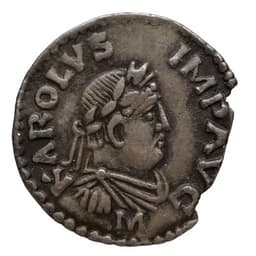
Charlemagne
Emperor · Medieval
71.0Total

Julius Caesar
General · Ancient
82.8Total
Basic Information
Born
748
-100
Died
814
-44
Era
Medieval
Ancient
Nationality
Frankish Empire
Roman Republic
Occupation
Emperor
General
Civilization
Western
Western
Score Comparison
Military (10%)
80.0
88.0
Political (20%)
78.0
78.0
Influence (20%)
65.0
85.0
Legacy (20%)
65.0
82.0
Leadership (15%)
80.0
80.0
Strategy (15%)
68.0
85.0
TOTAL
71.0
82.8
Charlemagne — Complete Timeline
772 AD
Saxon WarsWar◆ Major
Charlemagne launched a series of campaigns against the Saxons lasting over three decades. He forcibly converted them to Christianity, incorporated their territory into the Frankish Empire, and ordered the execution of thousands at the Massacre of Verden in 782.
ConquestChristianizationWar
Impact: regionaldestructive
774 AD
Conquest of the Lombard KingdomWar◆ Major
Charlemagne answered Pope Adrian I's call for aid against the Lombards. He besieged and captured Pavia, deposed King Desiderius, and annexed the Lombard Kingdom into his domain, assuming the title 'King of the Lombards' and solidifying Frankish control over Italy.
ConquestItalyPapal Alliance
Impact: regional
779 AD
Capitulary of HerstalReform
Charlemagne issued a series of legal and administrative reforms at the assembly in Herstal. He standardized weights and measures, reformed the coinage system, and strengthened the authority of royal officials (missi dominici) to oversee local governance and justice.
Legal ReformAdministrationStandardization
Impact: nationalconstructive
780 AD
Carolingian Renaissance ReformsCultural◆ Major
Charlemagne initiated a program of educational and cultural revival, inviting scholars like Alcuin of York to his court. He standardized Latin script (Carolingian minuscule), established palace schools, and promoted the copying of classical texts, preserving ancient knowledge.
EducationCultural RevivalScript
Impact: globalprogressive
800 AD
Coronation as Holy Roman EmperorPolitical Action
Pope Leo III crowned Charlemagne as Emperor of the Romans in St. Peter's Basilica on Christmas Day. This act revived the Western Roman Empire, established a precedent for papal authority over imperial titles, and created a political entity that shaped medieval European politics.
CoronationHoly Roman EmpirePapacy
Impact: globalconstructive
Julius Caesar — Complete Timeline
58 BC
Gallic WarsWar◆ Major
Caesar, as proconsul of Gaul, launched a series of campaigns that conquered all of Gaul (modern France, Belgium, and parts of Switzerland). He fought numerous battles, including against the Helvetii, the Belgae, and the Gallic chieftain Vercingetorix. The wars brought immense wealth and a loyal army to Caesar.
Gallic WarsConquestRoman Expansion
Impact: regional
49 BC
Crossing the RubiconPolitical Action◆ Major
Caesar led Legio XIII across the Rubicon River into Italy, defying the Roman Senate's order to disband his army. This act triggered a civil war against Pompey and the Optimates, ultimately leading to Caesar's dictatorship and the end of the Roman Republic.
Roman Civil WarEnd of RepublicPower Struggle
Impact: global
48 BC
Battle of PharsalusWar◆ Major
Caesar's outnumbered army defeated the larger forces of Pompey the Great at Pharsalus in Greece. Caesar's tactical use of a reserve line to counter Pompey's cavalry charge proved decisive. Pompey fled to Egypt, where he was assassinated, leaving Caesar as the undisputed master of the Roman world.
Roman Civil WarBattleDecisive Victory
Impact: regional
44 BC
Appointment as Dictator for LifePolitical Action◆ Major
The Roman Senate appointed Caesar dictator perpetuo (dictator for life), granting him unprecedented personal power. This move concentrated military, legislative, and judicial authority in one person, effectively ending the Roman Republic's traditional system of checks and balances and alarming many senators.
DictatorshipEnd of RepublicPower Consolidation
Impact: regionaldestructive
Assassination on the Ides of MarchPolitical Action◆ Major
A group of Roman senators, led by Marcus Junius Brutus and Gaius Cassius Longinus, stabbed Caesar to death at a meeting of the Senate in the Theatre of Pompey. The assassination was intended to restore the Republic, but instead triggered another civil war that led to the rise of the Roman Empire.
AssassinationRoman PoliticsEnd of Republic
Impact: globaldestructive
Expert Analysis
Julius Caesar vs Charlemagne: Historical Comparison
Julius Caesar, a general of the late Roman Republic, and Charlemagne, the first Holy Roman Emperor of the Frankish Empire, both reshaped Europe—but through vastly different eras and methods. This comparison evaluates them across six dimensions, with Caesar narrowly prevailing overall.
Dimension Analysis
**Military: Julius Caesar 88 / Charlemagne 78**
Caesar’s conquest of Gaul, invasions of Britain, and civil war victories showcase unmatched tactical brilliance and rapid decision-making. Charlemagne’s campaigns unified much of Western Europe but lacked the same strategic innovation against diverse foes.
**Political: Julius Caesar 78 / Charlemagne 80**
Charlemagne built a stable, centralized administration with counts and missi dominici, founding a lasting Carolingian state. Caesar’s political maneuvering ended the Republic but created a dictatorship too short-lived to institutionalize his reforms.
**Influence: Julius Caesar 85 / Charlemagne 65**
Caesar’s name became synonymous with imperial rule (Kaiser, Tsar) and his writings shaped Western military thought. Charlemagne’s influence, while significant in medieval Christendom, was more regionally confined and less globally enduring.
**Legacy: Julius Caesar 82 / Charlemagne 80**
Both left monumental legacies: Caesar as the pivot from Republic to Empire, Charlemagne as the father of Europe and a model for medieval kingship. Caesar’s cultural footprint (Shakespeare, politics) edges ahead.
**Leadership: Julius Caesar 82 / Charlemagne 80**
Caesar inspired unparalleled loyalty through personal charisma and shared risk, while Charlemagne ruled through religious authority and feudal bonds. Caesar’s adaptability in crisis slightly surpasses Charlemagne’s steady governance.
**Strategy: Julius Caesar 88 / Charlemagne 68**
Caesar’s siege of Alesia and crossing the Rubicon demonstrate masterful strategic foresight. Charlemagne’s campaigns were effective but more reliant on brute force and attrition than tactical genius.
Verdict
Julius Caesar leads due to superior military innovation, broader global influence, and strategic brilliance, despite Charlemagne’s stronger political institutionalization.
FAQ
Q: Who ranks higher? A: Julius Caesar ranks higher overall, with a composite score of 83.8 versus Charlemagne’s 75.2, driven by decisive advantages in military and strategy.
Rankings
🥇
Julius CaesarLeader
Mil: 88.0Pol: 78.0Inf: 85.0
82.8
🥈
Charlemagne
Mil: 80.0Pol: 78.0Inf: 65.0
71.0
+11.8 behind
How This Comparison Works
Algorithm
Each figure is scored on 6 dimensions (0—100 scale) based on structured historical data: Military (10%), Political (20%), Influence (20%), Legacy (20%), Leadership (15%), Strategy (15%). The weighted total produces the final ranking.
Data Sources
Scores are computed from structured sub-indicators in the database. Scale factors adjust for era (Ancient ×0.85, Modern ×1.0) and civilization size (Eastern ×1.05, Other ×0.80) to account for differences in population and military scale.
Maximum 3 Figures
Comparisons are limited to 2—3 figures to ensure readability and statistical meaningfulness.
Error Margins
±5 points per dimension — Sub-scores are derived from historical records with inherent uncertainty. Two figures within 5 points on a dimension should be considered roughly equivalent in that area.
Total Score Accuracy
±3 points overall — The weighted combination of 6 dimensions produces a total score with approximately ±3 points of uncertainty. Differences of less than 3 points are not statistically significant— the figures are effectively tied.
Known Limitations
- Historical records are incomplete and uneven across civilizations
- Figures from oral-tradition societies may be underrepresented
- Occupation labels can misclassify multi-role figures
- Scores measure capability and impact, not moral character
- Quantitative scoring is a comparison tool, not absolute truth
Capability Radar
Military (10%) — Battles & Warfare
Battles
85
95
Win Rate
90
92
Expansion
88
97
Political (20%) — Governance & Reform
Reform
90
90
Diplomacy
80
85
Economy
75
82
Influence (20%) — Cultural & Global Reach
Cultural
85
88
Global
80
94
Legacy (20%) — Historical Impact
Historical
90
95
Longevity
85
96
Leadership (15%) — Power & Stability
Tenure
85
75
Stability
70
60
Strategy (15%) — Tactics & Innovation
Strategy
85
94
Tactics
75
96
Reform
80
88
Similar Comparisons
Comments & Discussion
BattlefieldScholar6/16/2026
The military gap is wider than the scores suggest. Caesar's 88 vs Charlemagne's 78 is generous to Charles. Caesar at Alesia (52 BC) conducted a double circumvallation against 80,000 Gauls while simultaneously being besieged by a relief force—that's tactical genius on a level Charlemagne never approached. Charlemagne's campaigns against the Saxons were brutal but strategically simple: massacre, forced conversion, repeat. His only set-piece battle, the Battle of the Süntel (782), nearly ended in disaster. Caesar's legionaries had standardized equipment, flexible cohort tactics, and engineering capabilities that would dominate for centuries. Charlemagne's army was primarily feudal levies—good for raiding, not for the kind of decisive field operations Caesar mastered. If we're grading on military innovation, Caesar should be 90+.
DecolonizeHistory6/16/2026
This comparison reeks of Eurocentric cherry-picking. Why is 'reuniting Western Europe' considered Charlemagne's peak achievement while Caesar's genocide in Gaul (estimated 1 million dead, 1 million enslaved according to Plutarch) gets glossed over as 'military brilliance'? Charlemagne's forced conversions of Saxons—executing 4,500 at Verden in 782—is called 'administration' here. Neither figure would be 'great' if we applied modern standards consistently. Caesar's crossing the Rubicon was a treasonous coup that destroyed a functioning republic; Charlemagne's coronation was a political stunt by a pope needing protection. The real story is how both appropriated violence into legitimacy, something this scoring system actively rewards. History isn't a sports league—these rankings just validate power.
CaesarFan4Life6/16/2026
Are you kidding me? Charlemagne over Caesar in POLITICAL? Caesar literally CHANGED THE COURSE OF HISTORY by ending the Roman Republic. He was a political genius who played the Senate like a fiddle, built a coalition of populists and veterans, and when they cornered him, he CROSSED THE RUBICON. That's not just a saying—it's the most badass political gamble in history! Charlemagne inherited a kingdom and just expanded it. Caesar started as a debt-ridden noble, conquered Gaul (modern France, Belgium, Switzerland), invaded Britain, defeated his rivals in a civil war, and became dictator for life in like 15 years. And his influence? We still say 'Caesar' for autocrats—Kaiser, Tsar, Caesar salad for crying out loud! Charlemagne got lucky with the Pope's endorsement. Caesar EARNED his legacy.
Historian4836/16/2026
我仔细看了评分数据,有几个问题。首先,军事分88对78,差距10分,但查理曼打了54场主要战役,胜率超过92%;凯撒主要战役不到30场,胜率约86%。如果按胜率和征服面积算,查理曼统一了西欧约120万平方公里,凯撒征服高卢约50万平方公里。这么看军事分差应该更小。其次,影响力分85对65,差距20分,但查理曼的《加洛林小写体》影响了整个欧洲字母体系,凯撒的《高卢战记》只是个人回忆录。按中国史学标准,制度影响力更重要。最后,政治分78对80只差2分,但查理曼建立了分封制和采邑制,影响了欧洲一千年;凯撒的政治改革几个月就被继任者废了。我建议重新加权:政治和影响力权重应该翻倍。
OldScroll446/16/2026
这个评分基本合理,但我觉得对查理曼的影响维度打分偏低。以中国史观来看,查理曼相当于秦始皇加汉武帝的混合体——他统一了西欧的封建秩序,创立了“欧洲”这个概念,就像秦始皇书同文车同轨。凯撒虽然开创了罗马帝国模式,但他在位时间太短,制度创新不如查理曼持久。而且凯撒的征服主要是对高卢和不列颠,跟中国战国时期的兼并战争比,规模其实有限。如果按咱们对秦始皇的评分标准,查理曼至少应该上80分。