Loading...
Chabrias vs Zhang He
Zhang He leads by 0.8 pts · 2 figures compared
…

Chabrias
General · Ancient
48.6Total
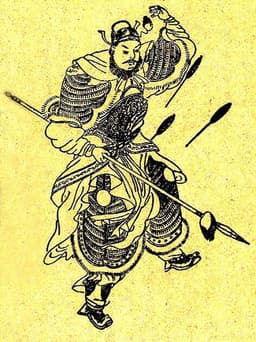
Zhang He
General · Ancient
49.4Total
Basic Information
Born
-420
167
Died
-357
231
Era
Ancient
Ancient
Nationality
Athens
China
Occupation
General
General
Civilization
Western
Eastern
Score Comparison
Military (10%)
65.0
67.3
Political (20%)
29.3
27.9
Influence (20%)
51.8
50.2
Legacy (20%)
44.2
45.8
Leadership (15%)
47.3
57.6
Strategy (15%)
66.3
58.0
TOTAL
48.6
49.4
Chabrias — Complete Timeline
378 BC
Defense of Thebes against SpartaWar
Chabrias led an Athenian force to aid Thebes against a Spartan invasion. He famously ordered his troops to stand at ease with their shields resting on their knees, a gesture of defiance that unnerved the Spartans. The Spartans withdrew without attacking.
Military TacticsAthensSparta
Impact: regionalconstructive
376 BC
Battle of NaxosWar◆ Major
Chabrias commanded the Athenian fleet to a decisive victory over the Spartan fleet off the island of Naxos. This battle ended Spartan naval dominance and restored Athenian control over the Aegean Sea. It was the first major Athenian naval victory since the Peloponnesian War.
Naval BattleAthensSparta
Impact: regionalconstructive
357 BC
Command in the Social WarWar
Chabrias served as a commander in the Athenian campaign against rebellious allies in the Social War. He was killed in action during the siege of the island of Chios when his ship was rammed and sank. His death was a significant loss for Athens.
Naval BattleAthensSocial War
Impact: regionaltragic
Zhang He — Complete Timeline
200 AD
Battle of GuanduWar◆ Major
Zhang He served under Yuan Shao at Guandu. After Yuan Shao's defeat, he defected to Cao Cao, bringing valuable intelligence.
Three KingdomsBattleDefection
Impact: national
211 AD
Campaign against Ma ChaoWar◆ Major
Zhang He fought in the campaign against Ma Chao in the northwest. He helped secure Wei control over the region.
Three KingdomsCampaignMa Chao
Impact: regionalconstructive
228 AD
Battle of JietingWar
Zhang He led the Wei army against Shu at Jieting. He defeated Ma Su's forces, forcing Zhuge Liang's First Northern Campaign to retreat.
Three KingdomsBattleMa Su
Impact: nationalconstructive
231 AD
Battle of MumenWar◆ Major
Zhang He pursued Zhuge Liang's retreating army at Mumen. He was ambushed by Shu crossbowmen and killed, a major loss for Wei.
Three KingdomsDeathAmbush
Impact: nationaltragic
Expert Analysis
Origins
Chabrias was born around 420 BCE in Athens, into a wealthy aristocratic family. Little is known of his early education, but he likely received the standard Athenian military training (ephebeia) and studied rhetoric and philosophy. His first recorded command came in 388 BCE, when he was appointed strategos (general) at a time when Athens was struggling to recover from the Peloponnesian War.
Zhang He was born in 167 CE in Hejian Commandery (modern Hebei, China) during the late Eastern Han dynasty. He came from a family of minor officials but rose through military ranks. He initially served under the warlord Han Fu, then under Yuan Shao, and later defected to Cao Cao. His early career was shaped by the chaos of the Three Kingdoms period, where he gained experience in numerous battles.
Rise to Power
Chabrias rose to prominence in 378 BCE when he defeated the Spartan fleet at the Battle of Naxos. This victory ended Spartan naval dominance and restored Athenian control over the Aegean. His innovative tactics—such as training his rowers to board enemy ships in a disciplined manner—earned him acclaim. He also defended Thebes against Sparta in 378-377 BCE, where he famously ordered his troops to stand at ease with shields resting on their knees, a gesture of defiance that became a symbol of Athenian confidence.
Zhang He's rise began under Yuan Shao, but his turning point came at the Battle of Guandu in 200 CE. After Yuan Shao's defeat, Zhang He defected to Cao Cao, who recognized his talent and entrusted him with key commands. He later defeated Ma Su at the Battle of Jieting in 228 CE, crushing Shu's northern campaign and forcing Zhuge Liang to retreat. This victory solidified his reputation as a capable field commander.
Leadership & Governance
Chabrias was known for his cautious but effective leadership. He emphasized discipline and morale, often training his troops rigorously before battle. He also served as a diplomat, negotiating alliances with Thebes and Persia. However, his political influence was limited (political score 29.3), as he often clashed with Athenian democratic assemblies. He was known for his integrity but lacked the charisma of contemporaries like Epaminondas.
Zhang He led with a mix of aggression and prudence. His leadership score of 57.6 reflects his ability to inspire troops and adapt to changing situations. He was known for his strategic foresight, often anticipating enemy moves. However, he occasionally pursued enemies too recklessly, leading to his death at Mumen (231 CE). His governance role in Wei was mainly military; he held no significant civil office.
Triumph & Tragedy
Chabrias's greatest triumph was the Battle of Naxos (376 BCE), where his fleet of 83 ships defeated the Spartan fleet of 65 ships, capturing 49 vessels. This victory restored Athenian naval supremacy and allowed Athens to rebuild its empire. His greatest failure came during the Social War (357-355 BCE), when he was killed in action while besieging the island of Chios. He was held responsible for failing to suppress the rebellion, and his death marked a decline in Athenian power.
Zhang He's triumph was the Battle of Jieting (228 CE), where he defeated Ma Su's army and forced Zhuge Liang to abort his campaign. This victory preserved Wei's control over the northwest and earned him promotion. His tragedy was the Battle of Mumen (231 CE), where he pursued Zhuge Liang's retreating forces into an ambush and was killed by crossbow bolts. His death was a severe blow to Wei's military leadership.
Character & Destiny
Chabrias was methodical and disciplined, but his cautious nature sometimes made him indecisive. He was respected but not loved; his stern demeanor alienated some allies. His destiny was sealed by the political chaos of Athens, where generals were often scapegoats for failure. He died fighting, a soldier's end.
Zhang He was bold and ambitious, but his desire for glory led him into the fatal ambush. He was known for his loyalty to Wei, but his decision to pursue without adequate reconnaissance proved costly. His death was a direct result of his aggressive temperament.
Legacy
Chabrias is remembered as a key figure in Athens's naval resurgence. His tactics influenced later Athenian commanders. However, his legacy is overshadowed by more famous contemporaries like Conon and Iphicrates. His military score of 65.0 reflects his competence but not brilliance.
Zhang He is remembered as a capable Wei general who served under multiple warlords. His defeat of Ma Su is a classic example of tactical flexibility. He is often compared to other Wei generals like Zhang Liao and Xu Huang. His legacy score of 45.8 is modest, partly because his death was a tactical error.
Conclusion
While Zhang He has a slightly higher total score (49.4 vs 48.6), the gap is negligible. However, Zhang He's impact on the Three Kingdoms period was more significant: his victory at Jieting directly altered the course of Zhuge Liang's campaigns, while Chabrias's victory at Naxos, though important, did not prevent Athens's eventual decline. Zhang He's defeat of Ma Su is studied in military history, while Chabrias's tactics are less known. Therefore, Zhang He had a marginally greater impact on history.
Rankings
🥇
Zhang HeLeader
Mil: 67.3Pol: 27.9Inf: 50.2
49.4
🥈
Chabrias
Mil: 65.0Pol: 29.3Inf: 51.8
48.6
+0.8 behind
How This Comparison Works
Algorithm
Each figure is scored on 6 dimensions (0—100 scale) based on structured historical data: Military (10%), Political (20%), Influence (20%), Legacy (20%), Leadership (15%), Strategy (15%). The weighted total produces the final ranking.
Data Sources
Scores are computed from structured sub-indicators in the database. Scale factors adjust for era (Ancient ×0.85, Modern ×1.0) and civilization size (Eastern ×1.05, Other ×0.80) to account for differences in population and military scale.
Maximum 3 Figures
Comparisons are limited to 2—3 figures to ensure readability and statistical meaningfulness.
Error Margins
±5 points per dimension — Sub-scores are derived from historical records with inherent uncertainty. Two figures within 5 points on a dimension should be considered roughly equivalent in that area.
Total Score Accuracy
±3 points overall — The weighted combination of 6 dimensions produces a total score with approximately ±3 points of uncertainty. Differences of less than 3 points are not statistically significant— the figures are effectively tied.
Known Limitations
- Historical records are incomplete and uneven across civilizations
- Figures from oral-tradition societies may be underrepresented
- Occupation labels can misclassify multi-role figures
- Scores measure capability and impact, not moral character
- Quantitative scoring is a comparison tool, not absolute truth
Capability Radar
Military (10%) — Battles & Warfare
Battles
55
65
Win Rate
60
60
Expansion
40
40
Political (20%) — Governance & Reform
Reform
30
20
Diplomacy
50
40
Economy
35
30
Influence (20%) — Cultural & Global Reach
Cultural
35
30
Global
25
20
Legacy (20%) — Historical Impact
Historical
45
45
Longevity
30
40
Leadership (15%) — Power & Stability
Tenure
45
55
Stability
40
45
Strategy (15%) — Tactics & Innovation
Strategy
65
65
Tactics
70
70
Reform
50
30
Similar Comparisons
Comments & Discussion
No comments yet. Be the first to share your thoughts!