Loading...
Cevdet Sunay vs Takeda Shingen
Takeda Shingen leads by 16.4 pts · 2 figures compared
…
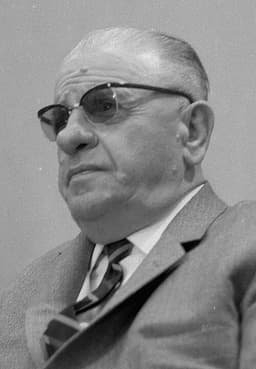
Cevdet Sunay
General · Modern
45.4Total

Takeda Shingen
General · Modern
61.8Total
Basic Information
Born
1899
1521
Died
1982
1573
Era
Modern
Modern
Nationality
Turkey
Japan
Occupation
General
General
Civilization
Middle Eastern
Eastern
Score Comparison
Military (10%)
50.0
74.7
Political (20%)
43.7
59.3
Influence (20%)
53.3
56.7
Legacy (20%)
40.8
55.0
Leadership (15%)
40.0
70.0
Strategy (15%)
43.7
70.0
TOTAL
45.4
61.8
Cevdet Sunay — Complete Timeline
1960 AD
Appointment as Chief of General StaffPolitical Action◆ Major
Cevdet Sunay was appointed Chief of the Turkish General Staff in 1960, following the 1960 coup. He served in this role until 1966, overseeing the military's role in the post-coup political landscape.
Turkish MilitaryChief of StaffPost-Coup
Impact: national
1966 AD
Election as President of TurkeyPolitical Action◆ Major
Cevdet Sunay was elected the fifth President of Turkey by the Grand National Assembly on March 28, 1966, succeeding Cemal G
Turkish PresidencyMilitary PresidentStability
Impact: nationalconstructive
1971 AD
1971 Military MemorandumPolitical Action◆ Major
During Sunay's presidency, the Turkish military issued a memorandum on March 12, 1971, demanding a stronger government to combat political violence and economic crisis. The memorandum led to the resignation of Prime Minister S
1971 MemorandumTurkish MilitaryPolitical Crisis
Impact: nationaldestructive
Takeda Shingen — Complete Timeline
1547 AD
Promulgation of the Kōshū Hatto (Law Code of Kai Province)Reform◆ Major
Takeda Shingen issued the K
Legal CodeGovernanceKai Province
Impact: regionalconstructive
1550 AD
Construction of the Kōfu CastleOther
Takeda Shingen ordered the construction of K
CastleFortificationAdministration
Impact: regionalconstructive
1561 AD
Battle of Kawanakajima (Fourth)War◆ Major
Takeda Shingen fought his most famous battle against Uesugi Kenshin at the fourth Battle of Kawanakajima. The battle was a bloody stalemate with heavy losses on both sides. It cemented the rivalry between the two daimyo and is one of the most celebrated battles of the Sengoku period.
BattleRivalrySengoku Period
Impact: regional
1568 AD
Invasion of Suruga ProvinceWar◆ Major
Takeda Shingen invaded Suruga Province, the domain of his former ally Imagawa Yoshimoto. This expansionist move broke the longstanding alliance between the Takeda and Imagawa clans. It significantly increased Takeda territory and access to the sea, but also created new enemies.
InvasionExpansionAlliance Broken
Impact: regional
1573 AD
Battle of MikatagaharaWar◆ Major
Takeda Shingen defeated Tokugawa Ieyasu's forces at the Battle of Mikatagahara in Totomi Province. Shingen's superior cavalry tactics routed Ieyasu's army, forcing Ieyasu to flee. This victory brought Shingen close to the Tokugawa heartland and threatened the Oda-Tokugawa alliance.
BattleCavalryTokugawa Ieyasu
Impact: regional
Expert Analysis
Origins
Cevdet Sunay was born in 1899 in Trabzon, Ottoman Empire. He graduated from the Ottoman Military Academy and served in World War I. After the war, he joined the Turkish War of Independence under Mustafa Kemal Atatürk. His early career was shaped by the transition from empire to republic.
Takeda Shingen was born in 1521 in Kai Province, Japan, as Harunobu Takeda. He was the son of Takeda Nobutora, a warlord. At age 20, he exiled his father and became daimyo of Kai. His early life was marked by the chaotic Sengoku period, where constant warfare defined his upbringing.
Rise to Power
Sunay rose through the ranks of the Turkish military, becoming a general by 1949. His key turning point came after the 1960 coup, when he was appointed Chief of General Staff in 1960. He served until 1966, overseeing the military's role in politics. His election as President in 1966 solidified his political power, a move supported by the military establishment.
Shingen's rise began with his exile of his father in 1541. He consolidated power in Kai, then formed alliances with the Imagawa and Hojo clans. His military expansion included invasions of Shinano and Suruga provinces. The Battle of Kawanakajima (1561) against Uesugi Kenshin cemented his reputation as a fierce commander, though it ended in stalemate.
Leadership & Governance
Sunay's leadership style was bureaucratic and military. As president, he maintained stability but faced political turmoil. His governance scores 40.0 in leadership and 43.7 in strategy. He supported the 1971 military memorandum, which curtailed civil liberties. His approach was reactive rather than transformative.
Shingen's leadership was proactive and innovative. He scored 70.0 in leadership and 70.0 in strategy. He implemented the Kōshū Hatto, a legal code that regulated land and samurai conduct. His governance focused on centralizing power and improving tax systems. He also built Kōfu Castle as a symbol of authority.
Triumph & Tragedy
Sunay's triumph was his peaceful transition of power after a full seven-year term, rare in Turkish politics. However, his tragedy was the 1971 military memorandum that undermined democratic institutions. His military score of 50.0 reflects his role as a general, but his political score of 43.7 shows limited impact.
Shingen's triumphs include the Battle of Mikatagahara (1572), where he defeated Tokugawa Ieyasu, and his expansion of Takeda territory. His tragedy was his sudden death in 1573 during a campaign, possibly from illness or war wounds. This led to the decline of the Takeda clan. His military score of 74.7 and strategy score of 70.0 highlight his effectiveness.
Character & Destiny
Sunay was a disciplined military officer who valued order. His character shaped his destiny as a caretaker president during a turbulent era. He lacked the charisma of Atatürk but maintained stability. Historical assessments view him as a transitional figure.
Shingen was ambitious and cunning, earning the nickname "Tiger of Kai." His character drove his expansionist policies and military innovations. His destiny was cut short by death, preventing him from achieving national unification. He is remembered as a brilliant strategist.
Legacy
Sunay's legacy is mixed. He is remembered as a president who upheld the military's role in politics, which influenced future coups. His scores: influence 53.3, legacy 40.8. The 1971 memorandum set a precedent for military intervention.
Shingen's legacy is enduring. He influenced samurai culture and military tactics. His Kōshū Hatto impacted Japanese law. Scores: influence 56.7, legacy 55.0. He is a folk hero in Japan, featured in literature and media.
Conclusion
Takeda Shingen had greater impact. His total score of 61.8 surpasses Sunay's 45.4. Shingen's military innovations, legal reforms, and lasting cultural influence outweigh Sunay's role as a transitional president. While Sunay maintained stability, Shingen shaped the course of Japanese history. The data supports Shingen as the more influential figure.
Rankings
🥇
Takeda ShingenLeader
Mil: 74.7Pol: 59.3Inf: 56.7
61.8
🥈
Cevdet Sunay
Mil: 50.0Pol: 43.7Inf: 53.3
45.4
+16.4 behind
How This Comparison Works
Algorithm
Each figure is scored on 6 dimensions (0—100 scale) based on structured historical data: Military (10%), Political (20%), Influence (20%), Legacy (20%), Leadership (15%), Strategy (15%). The weighted total produces the final ranking.
Data Sources
Scores are computed from structured sub-indicators in the database. Scale factors adjust for era (Ancient ×0.85, Modern ×1.0) and civilization size (Eastern ×1.05, Other ×0.80) to account for differences in population and military scale.
Maximum 3 Figures
Comparisons are limited to 2—3 figures to ensure readability and statistical meaningfulness.
Error Margins
±5 points per dimension — Sub-scores are derived from historical records with inherent uncertainty. Two figures within 5 points on a dimension should be considered roughly equivalent in that area.
Total Score Accuracy
±3 points overall — The weighted combination of 6 dimensions produces a total score with approximately ±3 points of uncertainty. Differences of less than 3 points are not statistically significant— the figures are effectively tied.
Known Limitations
- Historical records are incomplete and uneven across civilizations
- Figures from oral-tradition societies may be underrepresented
- Occupation labels can misclassify multi-role figures
- Scores measure capability and impact, not moral character
- Quantitative scoring is a comparison tool, not absolute truth
Capability Radar
Military (10%) — Battles & Warfare
Battles
20
75
Win Rate
20
70
Expansion
10
65
Political (20%) — Governance & Reform
Reform
30
65
Diplomacy
40
70
Economy
20
60
Influence (20%) — Cultural & Global Reach
Cultural
15
65
Global
15
50
Legacy (20%) — Historical Impact
Historical
20
70
Longevity
15
60
Leadership (15%) — Power & Stability
Tenure
55
60
Stability
40
55
Strategy (15%) — Tactics & Innovation
Strategy
20
80
Tactics
20
85
Reform
15
70
Similar Comparisons
Comments & Discussion
No comments yet. Be the first to share your thoughts!