Loading...
This comparison has not been analyzed yet.
One-time AI generation (~1 minute). Scores and timeline are already available below.
Cevdet Sunay vs John Churchill
John Churchill leads by 27.7 pts · 2 figures compared
…
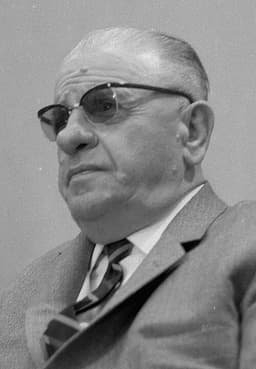
Cevdet Sunay
General · Modern
45.4Total

John Churchill
General · Modern
73.1Total
Basic Information
Born
1899
1650
Died
1982
1722
Era
Modern
Modern
Nationality
Turkey
England
Occupation
General
General
Civilization
Middle Eastern
Western
Score Comparison
Military (10%)
50.0
80.0
Political (20%)
43.7
78.0
Influence (20%)
53.3
68.0
Legacy (20%)
40.8
70.0
Leadership (15%)
40.0
78.0
Strategy (15%)
43.7
72.0
TOTAL
45.4
73.1
Cevdet Sunay — Complete Timeline
1960 AD
Appointment as Chief of General StaffPolitical Action◆ Major
Cevdet Sunay was appointed Chief of the Turkish General Staff in 1960, following the 1960 coup. He served in this role until 1966, overseeing the military's role in the post-coup political landscape.
Turkish MilitaryChief of StaffPost-Coup
Impact: national
1966 AD
Election as President of TurkeyPolitical Action◆ Major
Cevdet Sunay was elected the fifth President of Turkey by the Grand National Assembly on March 28, 1966, succeeding Cemal G
Turkish PresidencyMilitary PresidentStability
Impact: nationalconstructive
1971 AD
1971 Military MemorandumPolitical Action◆ Major
During Sunay's presidency, the Turkish military issued a memorandum on March 12, 1971, demanding a stronger government to combat political violence and economic crisis. The memorandum led to the resignation of Prime Minister S
1971 MemorandumTurkish MilitaryPolitical Crisis
Impact: nationaldestructive
John Churchill — Complete Timeline
1704 AD
Battle of BlenheimWar
Churchill, as Duke of Marlborough, commanded the allied army at the Battle of Blenheim. His forces defeated the French and Bavarian army, preventing the fall of Vienna. The victory was a turning point in the War of the Spanish Succession.
War of Spanish SuccessionBattleGrand Alliance
Impact: global
1706 AD
Battle of RamilliesWar◆ Major
Marlborough led the allied army to victory at the Battle of Ramillies. The French army was routed, leading to the capture of much of the Spanish Netherlands. The victory was achieved with relatively low casualties.
War of Spanish SuccessionBattleNetherlands
Impact: regional
1708 AD
Battle of OudenardeWar◆ Major
Marlborough commanded the allied forces at the Battle of Oudenarde. His army defeated the French under the Duke of Burgundy. The victory led to the capture of Lille and further weakened French control of the Spanish Netherlands.
War of Spanish SuccessionBattleNetherlands
Impact: regional
1709 AD
Battle of MalplaquetWar◆ Major
Marlborough and Prince Eugene won a costly victory at the Battle of Malplaquet. The French army retreated, but allied casualties were very high. The battle was the bloodiest of the war and led to criticism of Marlborough's tactics.
War of Spanish SuccessionBattleHigh Casualties
Impact: regionaltragic
1711 AD
Dismissed from CommandPolitical Action◆ Major
Marlborough was dismissed from all his offices by Queen Anne in 1711. Political intrigue and accusations of embezzlement led to his fall. He went into voluntary exile in Europe until the accession of George I.
Political FallExileEngland
Impact: nationaltragic
This comparison has not been analyzed yet.
One-time AI generation (~1 minute). Scores and timeline are already available below.
Rankings
🥇
John ChurchillLeader
Mil: 80.0Pol: 78.0Inf: 68.0
73.1
🥈
Cevdet Sunay
Mil: 50.0Pol: 43.7Inf: 53.3
45.4
+27.7 behind
How This Comparison Works
Algorithm
Each figure is scored on 6 dimensions (0—100 scale) based on structured historical data: Military (10%), Political (20%), Influence (20%), Legacy (20%), Leadership (15%), Strategy (15%). The weighted total produces the final ranking.
Data Sources
Scores are computed from structured sub-indicators in the database. Scale factors adjust for era (Ancient ×0.85, Modern ×1.0) and civilization size (Eastern ×1.05, Other ×0.80) to account for differences in population and military scale.
Maximum 3 Figures
Comparisons are limited to 2—3 figures to ensure readability and statistical meaningfulness.
Error Margins
±5 points per dimension — Sub-scores are derived from historical records with inherent uncertainty. Two figures within 5 points on a dimension should be considered roughly equivalent in that area.
Total Score Accuracy
±3 points overall — The weighted combination of 6 dimensions produces a total score with approximately ±3 points of uncertainty. Differences of less than 3 points are not statistically significant— the figures are effectively tied.
Known Limitations
- Historical records are incomplete and uneven across civilizations
- Figures from oral-tradition societies may be underrepresented
- Occupation labels can misclassify multi-role figures
- Scores measure capability and impact, not moral character
- Quantitative scoring is a comparison tool, not absolute truth
Capability Radar
Military (10%) — Battles & Warfare
Battles
20
95
Win Rate
20
100
Expansion
10
80
Political (20%) — Governance & Reform
Reform
30
60
Diplomacy
40
90
Economy
20
65
Influence (20%) — Cultural & Global Reach
Cultural
15
70
Global
15
80
Legacy (20%) — Historical Impact
Historical
20
85
Longevity
15
75
Leadership (15%) — Power & Stability
Tenure
55
85
Stability
40
70
Strategy (15%) — Tactics & Innovation
Strategy
20
92
Tactics
20
95
Reform
15
70
Similar Comparisons
Comments & Discussion
No comments yet. Be the first to share your thoughts!