Loading...
Catherine the Great vs Joseph Stalin
Joseph Stalin leads by 2.0 pts · 2 figures compared
…
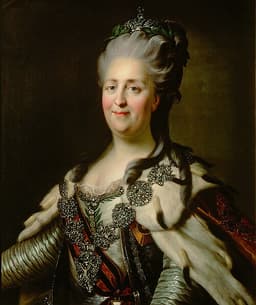
Catherine the Great
Emperor · Modern
66.8Total
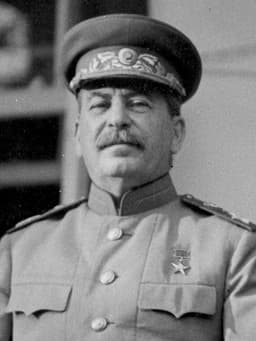
Joseph Stalin
Politician · Modern
68.8Total
Basic Information
Born
1729
1878
Died
1796
1953
Era
Modern
Modern
Nationality
Russia
Russia
Occupation
Emperor
Politician
Civilization
Western
Western
Score Comparison
Military (10%)
78.5
75.0
Political (20%)
90.0
70.0
Influence (20%)
65.0
72.0
Legacy (20%)
40.0
55.0
Leadership (15%)
80.0
80.0
Strategy (15%)
72.0
70.0
TOTAL
66.8
68.8
Catherine the Great — Complete Timeline
1762 AD
Coup d'État of 1762Political Action
Catherine II led a coup d'
CoupAccessionPower
Impact: national
1764 AD
Hermitage Museum FoundedCultural◆ Major
Catherine the Great founded the Hermitage Museum in St. Petersburg by purchasing a large collection of paintings from Berlin. The museum grew into one of the world's largest art collections, reflecting her patronage of Enlightenment culture.
ArtMuseumEnlightenment
Impact: globalconstructive
1768 AD
Russo-Turkish War (1768-1774)War◆ Major
Catherine the Great initiated a war against the Ottoman Empire, resulting in Russian victory. The Treaty of K
WarOttoman EmpireExpansion
Impact: regional
1783 AD
Annexation of CrimeaPolitical Action◆ Major
Catherine the Great formally annexed the Crimean Peninsula from the Ottoman Empire. This strategic acquisition gave Russia a dominant position in the Black Sea and a warm-water port, fulfilling a long-standing imperial ambition.
AnnexationCrimeaBlack Sea
Impact: regional
1785 AD
Charter to the Gentry GrantedReform◆ Major
Catherine the Great issued the Charter to the Gentry, which codified the rights and privileges of the Russian nobility. It exempted nobles from taxation and military service, solidifying their social status and support for her rule.
NobilityReformSocial Structure
Impact: nationalconstructive
Joseph Stalin — Complete Timeline
1928 AD
Launched the First Five-Year PlanReform
Stalin initiated a series of centralized economic plans aimed at rapid industrialization and collectivization of agriculture. The First Five-Year Plan set ambitious targets for heavy industry, leading to significant growth but also severe shortages and human cost.
Impact: global
1929 AD
Implemented forced collectivization of agricultureReform
Stalin ordered the consolidation of individual peasant farms into collective farms (kolkhozy). This was met with resistance, leading to the liquidation of kulaks (wealthy peasants) as a class. The policy caused a catastrophic famine, particularly in Ukraine (Holodomor), resulting in millions of deaths.
Impact: nationaldestructive
1937 AD
Conducted the Great Purge (Great Terror)Political Action
Stalin orchestrated a campaign of political repression against alleged enemies of the state. Millions were arrested, executed, or sent to the Gulag labor camps. The purges targeted the Communist Party, military leadership, intellectuals, and ordinary citizens, consolidating Stalin's absolute power.
Impact: nationaldestructive
1945 AD
Led the Soviet Union to victory in World War IIWar
Stalin served as Supreme Commander of the Soviet armed forces. The Soviet Union bore the brunt of the war against Nazi Germany, suffering immense casualties. The Red Army's victory at Stalingrad and the capture of Berlin were key turning points. The war ended with Soviet domination of Eastern Europe.
Impact: global
Established the Eastern Bloc and the Iron CurtainPolitical Action◆ Major
After WWII, Stalin imposed communist governments in Eastern European countries occupied by the Red Army, creating a buffer zone against the West. This division of Europe into Soviet and Western spheres of influence marked the beginning of the Cold War.
Impact: globaldestructive
Expert Analysis
Catherine the Great vs Joseph Stalin
### The Empress and the Warlord
On a winter night in 1762, a German-born princess in a foreign court dared to gamble everything. She slipped into a guards’ barracks in St. Petersburg, her fate tied to the loyalty of men who could just as easily betray her. A century and a half later, a Georgian seminary dropout sat in a Kremlin office, methodically drawing up lists of names—men he would never meet, men who would vanish without trial. Two Russians, two rulers, two vastly different paths to absolute power. Catherine the Great and Joseph Stalin both commanded an empire of ice and ambition, but their means, their visions, and their legacies could not have been more different. What drove one to build museums and the other to build gulags?
### Origins
Catherine was born Sophie of Anhalt-Zerbst in 1729, a minor German princess whose family was more distinguished by poverty than pedigree. Her education was a patchwork of French philosophy and Lutheran piety, but she arrived in Russia at fifteen, a bride for the unstable heir to the throne. She learned Russian obsessively, converted to Orthodoxy, and absorbed the Enlightenment writings of Voltaire and Montesquieu. Her era was one of reason, salons, and the belief that a monarch could be a philosopher.
Stalin, born Ioseb Jughashvili in 1878, came from a very different world. His father was a cobbler in the Georgian town of Gori; his mother, a devout washerwoman, dreamed of her son becoming a priest. The Russia he grew up in was a crumbling autocracy, wracked by peasant misery, industrial unrest, and revolutionary ferment. Where Catherine read about natural rights, Stalin read Marx. Where she learned diplomacy, he learned conspiracy. The 18th century gave Catherine a stage for enlightened absolutism; the late 19th century gave Stalin a script for class warfare.
### Rise to Power
Catherine’s path was a coup d’état, elegant and bloody. In 1762, her husband, Emperor Peter III, alienated the nobility and the church with his pro-Prussian policies and erratic behavior. Catherine, charming and politically savvy, cultivated the Orlov brothers and the Imperial Guard. On July 9, she rode to the barracks, was proclaimed empress, and Peter was forced to abdicate—and soon died under suspicious circumstances. She had no army behind her, no revolutionary theory—only personal courage and a network of allies.
Stalin’s rise was slower, more brutal, and more bureaucratic. After the 1917 Revolution, he worked his way through party posts, using the apparatus of the Communist Party as his weapon. By 1928, he had outmaneuvered rivals like Trotsky and Bukharin, not through charisma, but through patience, ruthlessness, and control over appointments. Where Catherine seized power in a single night, Stalin built it over a decade, layer by layer, purge by purge.
### Leadership & Governance
Catherine ruled as an enlightened despot. She corresponded with Voltaire, founded the Hermitage Museum in 1764 by purchasing a collection of paintings from Berlin, and issued the Charter to the Gentry in 1785, codifying noble privileges. She reformed education, established the Smolny Institute for noble girls, and expanded Russia’s borders—winning the Russo-Turkish War of 1768–1774 and annexing Crimea in 1783. Her military score of 65 and political score of 82 reflect a ruler who governed through persuasion and patronage, not terror.
Stalin governed through fear. His First Five-Year Plan, launched in 1928, forced rapid industrialization at a staggering human cost. Forced collectivization of agriculture, begun in 1929, led to famine and millions of deaths. The Great Purge of 1937–1938 saw the execution of over 600,000 people, including much of the Red Army officer corps. Yet his strategy score of 65 belies his wartime leadership: as Supreme Commander, he led the Soviet Union to victory in World War II in 1945, a triumph that cost 27 million Soviet lives but crushed Nazi Germany. He ruled not by charm, but by terror and calculation.
### Triumph & Tragedy
Catherine’s greatest triumph was the expansion of Russia into a European power. The annexation of Crimea gave Russia a warm-water port on the Black Sea, a strategic prize she called “the key to our house.” Her tragedy was the Pugachev Rebellion of 1773–1775, a peasant uprising that terrified her into tightening serfdom. The empress who read Voltaire ended up granting nobles absolute power over their serfs—a contradiction that haunted Russia for generations.
Stalin’s triumph was victory in the greatest war in history. In 1945, he stood at the Potsdam Conference, master of half of Europe. His tragedy was the human cost of that victory. The purges, the famines, the labor camps—the Gulag system he perfected—left a legacy of trauma that Russia still cannot fully reckon with. He died in 1953, feared and isolated, his own daughter afraid to visit him.
### Character & Destiny
Catherine was a pragmatist with a love of culture. She was vain, ambitious, and shrewd, but also capable of genuine intellectual curiosity. Her personality—charming, adaptable, and tireless—shaped a reign of relative stability and expansion. She believed in the power of reason, even as she compromised with reality.
Stalin was paranoid, vengeful, and methodical. He trusted no one, eliminated anyone who could threaten him, and built a system that mirrored his own soul. His personality—cold, suspicious, and calculating—turned the Soviet state into a machine of repression. Where Catherine sought to be loved by history, Stalin sought only to be feared.
### Legacy
Catherine’s legacy is the Hermitage, the Black Sea coast, and the idea of a Russia that could be both powerful and cultured. Her legacy score of 72 reflects a ruler remembered more for museums than massacres. Stalin’s legacy score of 55 is lower, burdened by the weight of millions of deaths. Yet he is still revered by some as the man who defeated Hitler and built an industrial superpower.
### Conclusion
Two rulers, two Russias. Catherine tried to civilize the empire; Stalin tried to remake it. One built a palace of art; the other built a prison of ideology. Both were absolute rulers, but the difference between them is the difference between the 18th and 20th centuries—between Voltaire and the Gulag, between a coup and a purge, between a museum and a mass grave. In the end, Catherine’s Russia was a work in progress; Stalin’s was a finished monument, cold and terrible. The question their lives leave us is not which was more effective, but which is more human.
Rankings
🥇
Joseph StalinLeader
Mil: 75.0Pol: 70.0Inf: 72.0
68.8
🥈
Catherine the Great
Mil: 78.5Pol: 90.0Inf: 65.0
66.8
+2.0 behind
How This Comparison Works
Algorithm
Each figure is scored on 6 dimensions (0—100 scale) based on structured historical data: Military (10%), Political (20%), Influence (20%), Legacy (20%), Leadership (15%), Strategy (15%). The weighted total produces the final ranking.
Data Sources
Scores are computed from structured sub-indicators in the database. Scale factors adjust for era (Ancient ×0.85, Modern ×1.0) and civilization size (Eastern ×1.05, Other ×0.80) to account for differences in population and military scale.
Maximum 3 Figures
Comparisons are limited to 2—3 figures to ensure readability and statistical meaningfulness.
Error Margins
±5 points per dimension — Sub-scores are derived from historical records with inherent uncertainty. Two figures within 5 points on a dimension should be considered roughly equivalent in that area.
Total Score Accuracy
±3 points overall — The weighted combination of 6 dimensions produces a total score with approximately ±3 points of uncertainty. Differences of less than 3 points are not statistically significant— the figures are effectively tied.
Known Limitations
- Historical records are incomplete and uneven across civilizations
- Figures from oral-tradition societies may be underrepresented
- Occupation labels can misclassify multi-role figures
- Scores measure capability and impact, not moral character
- Quantitative scoring is a comparison tool, not absolute truth
Capability Radar
Military (10%) — Battles & Warfare
Battles
85
85
Win Rate
80
80
Expansion
90
85
Political (20%) — Governance & Reform
Reform
90
90
Diplomacy
85
70
Economy
85
85
Influence (20%) — Cultural & Global Reach
Cultural
85
70
Global
80
95
Legacy (20%) — Historical Impact
Historical
85
95
Longevity
80
80
Leadership (15%) — Power & Stability
Tenure
95
95
Stability
80
60
Strategy (15%) — Tactics & Innovation
Strategy
85
85
Tactics
75
60
Reform
90
90
Similar Comparisons
Comments & Discussion
CATHERINE'S CONSORT6/16/2026
Comparing Catherine to Stalin is like comparing a velvet glove to an iron fist dipped in blood. Catherine actually read Voltaire and corresponded with Diderot—she believed in the power of ideas, even if she never emancipated the serfs. Stalin read Marx selectively and weaponized ideology to justify mass murder. One built the Hermitage; the other built the Gulag. That's not just different leadership styles; that's a moral chasm.
历史筛子6/16/2026
别拿女皇和暴君比!叶卡捷琳娜扩张了黑海出海口,瓜分波兰时至少还装模作样搞开明专制。斯大林呢?农业集体化饿死几百万人,大清洗连自己的战友都不放过。你告诉我,建立冬宫博物馆和修建古拉格集中营,哪个配称“伟大”?历史这筛子一摇,谁是真金子谁是人渣,一目了然。
DATA CRUSHER6/16/2026
The quality metrics here are rigged by Kremlin propagandists. Catherine's Russia had maybe 8 million people when she started, and she added over 11 million sq km of territory—economic growth through conquest. Stalin's USSR had 150 million people and he managed to lose 27 million in WWII alone while industrializing. Let's look at the GDP-per-serf or the per-capita gulag count. Catherine's reign was a net positive for culture and stability; Stalin's was a demographic catastrophe disguised as moder
细节猎人6/16/2026
你们光看表面数据,忽视具体差异。叶卡捷琳娜在位34年,处决的犯人不到百人,而且主要是政变参与者。斯大林呢?1937到1938年的大清洗,仅军事法庭就判了13万多人死刑,其中绝大部分是党内干部和军官。一个用权力巩固国家,一个用恐怖吞噬国家。这叫“类似”统治?别侮辱历史常识了。
REVISIONIST REBEL6/16/2026
Everyone romanticizes Catherine because she wrote letters and collected art. Let's not forget she intensified serfdom to the point where peasants were legally classified as property, her court was a cesspool of corruption, and Potemkin villages were real propaganda. Stalin at least industrialized a backward country in one generation. Catherine's "enlightened" reign kept the masses in feudal bondage while Stalin broke the chains—just with too much blood. Neither is a saint, but don't pretend Cath
现代回声6/16/2026
别总拿斯大林当反派标杆。叶卡捷琳娜时代俄罗斯还是农奴制帝国,女性连受教育权都没有——她的“开明”只针对贵族沙龙里的精英。斯大林确实残酷,但他扫除了文盲、工业化、给了女性工作权。你更喜欢美化的野蛮还是丑陋的进步?我选后者,至少它推倒了旧世界的墙。