Loading...
Catherine the Great vs Deng Xiaoping
Catherine the Great leads by 0.8 pts · 2 figures compared
…
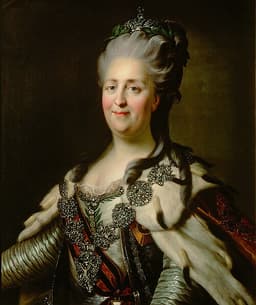
Catherine the Great
Emperor · Modern
66.8Total
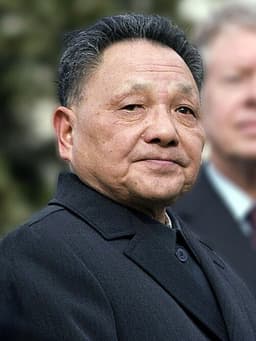
Deng Xiaoping
Politician · Modern
66.0Total
Basic Information
Born
1729
1904
Died
1796
1997
Era
Modern
Modern
Nationality
Russia
China
Occupation
Emperor
Politician
Civilization
Western
Eastern
Score Comparison
Military (10%)
78.5
30.0
Political (20%)
90.0
90.0
Influence (20%)
65.0
68.0
Legacy (20%)
40.0
65.0
Leadership (15%)
80.0
78.0
Strategy (15%)
72.0
45.0
TOTAL
66.8
66.0
Catherine the Great — Complete Timeline
1762 AD
Coup d'État of 1762Political Action
Catherine II led a coup d'
CoupAccessionPower
Impact: national
1764 AD
Hermitage Museum FoundedCultural◆ Major
Catherine the Great founded the Hermitage Museum in St. Petersburg by purchasing a large collection of paintings from Berlin. The museum grew into one of the world's largest art collections, reflecting her patronage of Enlightenment culture.
ArtMuseumEnlightenment
Impact: globalconstructive
1768 AD
Russo-Turkish War (1768-1774)War◆ Major
Catherine the Great initiated a war against the Ottoman Empire, resulting in Russian victory. The Treaty of K
WarOttoman EmpireExpansion
Impact: regional
1783 AD
Annexation of CrimeaPolitical Action◆ Major
Catherine the Great formally annexed the Crimean Peninsula from the Ottoman Empire. This strategic acquisition gave Russia a dominant position in the Black Sea and a warm-water port, fulfilling a long-standing imperial ambition.
AnnexationCrimeaBlack Sea
Impact: regional
1785 AD
Charter to the Gentry GrantedReform◆ Major
Catherine the Great issued the Charter to the Gentry, which codified the rights and privileges of the Russian nobility. It exempted nobles from taxation and military service, solidifying their social status and support for her rule.
NobilityReformSocial Structure
Impact: nationalconstructive
Deng Xiaoping — Complete Timeline
1978 AD
Third Plenum of the 11th Central CommitteePolitical Action
Deng Xiaoping consolidated power and announced the policy of Reform and Opening-Up. This meeting marked the end of Maoist class struggle as the national priority and shifted focus to economic modernization, initiating market-oriented reforms.
Economic ReformOpening-UpChina Modernization
Impact: globalconstructive
1980 AD
Establishment of Special Economic ZonesReform◆ Major
Deng Xiaoping approved the creation of Special Economic Zones in Shenzhen, Zhuhai, Shantou, and Xiamen. These zones offered tax incentives and market freedoms to attract foreign investment and technology, serving as experimental laboratories for capitalist practices within a socialist framework.
Economic ZonesForeign InvestmentMarket Reforms
Impact: nationalconstructive
1984 AD
Sino-British Joint Declaration on Hong KongPolitical Action◆ Major
Deng Xiaoping negotiated with British Prime Minister Margaret Thatcher to agree on the return of Hong Kong to Chinese sovereignty in 1997. The declaration established the 'One Country, Two Systems' principle, allowing Hong Kong to maintain its capitalist system for 50 years.
Hong KongDiplomacyOne Country Two Systems
Impact: globalconstructive
1989 AD
Tiananmen Square Protests CrackdownPolitical Action
Deng Xiaoping authorized the military to suppress pro-democracy protests in Tiananmen Square. The crackdown resulted in hundreds of civilian deaths and injuries, leading to international condemnation and a tightening of political control while economic reforms continued.
TiananmenSuppressionHuman Rights
Impact: globaldestructive
1992 AD
Southern Tour (Nanxun)Political Action◆ Major
Deng Xiaoping traveled to southern China to reaffirm the course of economic reform after conservative backlash. His speeches in Shenzhen and other cities revitalized market-oriented policies, accelerating foreign investment and pushing China toward a socialist market economy.
Economic ReformNanxunMarket Economy
Impact: nationalconstructive
Expert Analysis
Catherine the Great vs Deng Xiaoping
### The Empress and the Pragmatist
In the winter of 1796, as Catherine the Great lay dying in her gilded palace, her vast empire stretched from the Baltic to the Black Sea, its nobility newly empowered and its culture enriched by the treasures of Europe. Two centuries later, in the spring of 1997, Deng Xiaoping’s body was laid to rest, and China—once a starving, isolated giant—had become a workshop for the world, its people lifted from poverty by forces he had unleashed. Both were modernizers, both wielded absolute power, and both left nations transformed. Yet one built a museum; the other built a market. One expanded borders; the other opened doors. What drove these two titans down such different paths?
### Origins
Catherine was not born Russian. She arrived in St. Petersburg in 1744 as Sophia of Anhalt-Zerbst, a minor German princess, to marry the heir to the throne. Her new homeland was a frozen autocracy, where the tsar’s word was law and the serfs were chattel. She devoured the works of Voltaire and Montesquieu, writing to philosophers as if they were pen pals, dreaming of a Russia that could be rational, just, and enlightened. Her upbringing had taught her that survival depended on charm and calculation, and her era—the height of the Enlightenment—offered a blueprint for reform.
Deng Xiaoping was born in 1904 in Sichuan, a province of the crumbling Qing Empire. His father was a minor landowner, but China was in chaos—invaded, humiliated, torn by warlords. Deng left at sixteen to study in France, where he worked in a factory and learned not philosophy but the gritty mechanics of revolution. He joined the Communist Party, fought in the Long March, and survived Mao’s purges by keeping his head down. His era was one of war, famine, and ideological frenzy; his education was in survival, not salon talk.
### Rise to Power
Catherine’s ascent was a palace coup. In 1762, her husband, Emperor Peter III, alienated the nobility and the church. Catherine, with the help of her lover Grigory Orlov and the Imperial Guard, staged a coup d’état. She rode to the barracks in a military uniform, sword in hand, and the troops hailed her as empress. Peter was arrested and soon died—probably murdered. Catherine wept, then took the throne. Her power came from a conspiracy of aristocrats, and she never forgot it.
Deng’s rise was a long, brutal climb. He was purged twice during the Cultural Revolution, sent to work in a tractor factory. His comeback began after Mao’s death in 1976. By 1978, at the Third Plenum of the 11th Central Committee, Deng consolidated power and announced Reform and Opening-Up. Unlike Catherine’s dramatic seizure, his was a quiet, factional victory within the party. He had learned that ideology could destroy; he would use pragmatism to build.
### Leadership & Governance
Catherine ruled as an enlightened despot. She modernized Russia by importing Western ideas—but carefully. She founded the Hermitage Museum in 1764, buying entire collections from Berlin, a signal that Russia was a civilized European power. She reformed education, opening schools for girls and the first state-funded institute for women. But she also crushed a peasant revolt in 1773 and, in 1785, issued the Charter to the Gentry, granting the nobility absolute control over their serfs. Enlightenment had its limits: freedom was for the elite. Her military was aggressive; she won the Russo-Turkish War of 1768–1774 and annexed Crimea in 1783, giving Russia a warm-water port. Her political score of 82 reflects a master of balancing factions, but her military score of 65 shows she relied on generals more than personal command.
Deng governed as a pragmatic revolutionary. He had no interest in culture or philosophy; he wanted results. His 1978 reforms dismantled Mao’s communes and allowed peasants to sell surplus produce. In 1980, he established Special Economic Zones—Shenzhen, Zhuhai, Shantou, Xiamen—where capitalism could experiment. He negotiated the return of Hong Kong in 1984, a diplomatic triumph. But his leadership had a dark edge: in 1989, when pro-democracy protests threatened stability, he authorized the Tiananmen Square crackdown. Political score 88, leadership 78—he was a builder who could also destroy. His Southern Tour in 1992, after conservative backlash, reignited reforms by traveling to factories and declaring, “Development is the absolute principle.”
### Triumph & Tragedy
Catherine’s greatest triumph was the expansion of Russia into a European power. The annexation of Crimea was a strategic masterstroke. Her tragedy was the serfdom she refused to abolish. The Charter to the Gentry locked millions into bondage, and a peasant rebellion in 1773 was drowned in blood. She died knowing her reforms touched only the surface.
Deng’s triumph was lifting hundreds of millions from poverty. His reforms created the modern Chinese economy. His tragedy was the suppression of Tiananmen, which stained his legacy and silenced dissent. He died in 1997, just months before Hong Kong’s return, a symbol of his vision.
### Character & Destiny
Catherine was a woman of immense ambition and intellect, but also vanity. She loved power and display—her court glittered, her lovers were promoted. Her personality drove her to seek approval from Europe’s thinkers while keeping Russia’s chains tight. She was a reformer who feared chaos more than injustice.
Deng was short, blunt, and ruthless. He once said, “It doesn’t matter if a cat is black or white, as long as it catches mice.” His pragmatism was his strength and his weakness. He cared about outcomes, not ideals. His character—shaped by war and purges—made him distrustful of mass movements and devoted to stability.
### Legacy
Catherine the Great left a Russia that was larger, more cultured, but still autocratic and unequal. The Hermitage stands as her monument, but serfdom remained until 1861. Her legacy score of 72 reflects a mixed record: she modernized the state, not the society.
Deng Xiaoping left a China that was richer, more confident, but still one-party. His legacy score of 75 is high, but debated. He created the economic miracle, but also the tools of surveillance and control. Today, China’s rise is his shadow.
### Conclusion
Catherine and Deng both broke with the past, but in opposite directions. One imported art; the other exported goods. One expanded an empire; the other opened a nation. Their differences were not accidents of personality but products of circumstance: Catherine lived in a world of kings and philosophers, Deng in a world of revolutions and markets. Both understood that power requires change—but also that change must be controlled. In the end, they remind us that modernizers are always prisoners of their time, and that the path to the future is paved with compromises.
Rankings
🥇
Catherine the GreatLeader
Mil: 78.5Pol: 90.0Inf: 65.0
66.8
🥈
Deng Xiaoping
Mil: 30.0Pol: 90.0Inf: 68.0
66.0
+0.8 behind
How This Comparison Works
Algorithm
Each figure is scored on 6 dimensions (0—100 scale) based on structured historical data: Military (10%), Political (20%), Influence (20%), Legacy (20%), Leadership (15%), Strategy (15%). The weighted total produces the final ranking.
Data Sources
Scores are computed from structured sub-indicators in the database. Scale factors adjust for era (Ancient ×0.85, Modern ×1.0) and civilization size (Eastern ×1.05, Other ×0.80) to account for differences in population and military scale.
Maximum 3 Figures
Comparisons are limited to 2—3 figures to ensure readability and statistical meaningfulness.
Error Margins
±5 points per dimension — Sub-scores are derived from historical records with inherent uncertainty. Two figures within 5 points on a dimension should be considered roughly equivalent in that area.
Total Score Accuracy
±3 points overall — The weighted combination of 6 dimensions produces a total score with approximately ±3 points of uncertainty. Differences of less than 3 points are not statistically significant— the figures are effectively tied.
Known Limitations
- Historical records are incomplete and uneven across civilizations
- Figures from oral-tradition societies may be underrepresented
- Occupation labels can misclassify multi-role figures
- Scores measure capability and impact, not moral character
- Quantitative scoring is a comparison tool, not absolute truth
Capability Radar
Military (10%) — Battles & Warfare
Battles
85
36
Win Rate
80
37
Expansion
90
41
Political (20%) — Governance & Reform
Reform
90
95
Diplomacy
85
80
Economy
85
95
Influence (20%) — Cultural & Global Reach
Cultural
85
70
Global
80
90
Legacy (20%) — Historical Impact
Historical
85
90
Longevity
80
85
Leadership (15%) — Power & Stability
Tenure
95
85
Stability
80
75
Strategy (15%) — Tactics & Innovation
Strategy
85
47
Tactics
75
48
Reform
90
49
Similar Comparisons
Comments & Discussion
SerfSlayer6/16/2026
Catherine gets romanticized as an enlightened despot, but let's be real: she expanded serfdom to Ukraine and crushed Pugachev's rebellion with extreme brutality. Deng lifted 400 million+ out of poverty. Catherine expanded Russia's borders; Deng expanded human potential. If you're comparing legacies on human suffering, Catherine's bloodstains are far darker. The "Enlightenment" chat with Voltaire didn't feed a single serf.
历史质检员6/16/2026
说凯瑟琳是改革者?她1775年给贵族发了20万农奴当奖励,而邓小平1982年搞的家庭联产承包责任制让7亿农民饿不了肚子。一个用铁链拴住人口,一个用种子解放生产力。凯瑟琳的“开明”不过是镀金锁链,邓的“黑猫白猫”才是真实惠。任何比较都该先看民生账本。
BreadNotBorders6/16/2026
Catherine conquered huge territories, sure—Crimea, part of Poland—but her peasantry was still largely illiterate and destitute. Deng's "one country, two systems" and Special Economic Zones didn't grab land; they grabbed ideas and investment. Catherine was about imperial vanity; Deng was about practical prosperity. I'd rather inherit a factory than a statue.
古典主义冤案6/16/2026
凯瑟琳是真懂文化的——她买下狄德罗的图书馆还留他当馆长,赞助拉吉舍夫写书。但邓呢?1978年恢复高考,让知识不是贵族的玩具。凯瑟琳的启蒙只在她书房里,邓的启蒙在千万间教室中。前者要学欧洲贵族,后者要老百姓自己变强。文明,不在谁藏了多少书,在谁给了人读书的机会。
MarketMarxWrangler6/16/2026
Both faced dying systems—Catherine's overgrown feudalism, Deng's broken command economy. One tried to patch it with 18th-century PR stunts; the other rebooted 1.2 billion lives with market mechanisms. Deng's 1992 Southern Tour said "development is the hard truth." Catherine's 1767 Nakaz said "the monarch is absolute." You tell me which vision had more lasting economic logic. One managed decline; the other engineered a renaissance.