Loading...
This comparison has not been analyzed yet.
One-time AI generation (~1 minute). Scores and timeline are already available below.
Canaan Banana vs Mohammad Najibullah
Mohammad Najibullah leads by 8.8 pts · 2 figures compared
…
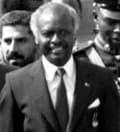
Canaan Banana
Politician · Modern
38.4Total

Mohammad Najibullah
Politician · Modern
47.2Total
Basic Information
Born
1936
1947
Died
—
—
Era
Modern
Modern
Nationality
Zimbabwe
Afghanistan
Occupation
Politician
Politician
Civilization
Other
Middle Eastern
Score Comparison
Military (10%)
48.1
36.6
Political (20%)
30.7
39.4
Influence (20%)
45.5
50.2
Legacy (20%)
35.0
39.2
Leadership (15%)
31.2
65.7
Strategy (15%)
42.2
53.8
TOTAL
38.4
47.2
Canaan Banana — Complete Timeline
1980 AD
Elected President of ZimbabwePolitical Action◆ Major
Canaan Banana was elected as the first President of independent Zimbabwe, a largely ceremonial role. He served as head of state while Robert Mugabe was Prime Minister.
PresidencyIndependence
Impact: national
1999 AD
Convicted of Sodomy and Sexual AssaultOther◆ Major
Banana was convicted on 11 counts of sodomy and sexual assault, committed against his male bodyguards and employees. He was sentenced to 10 years in prison, though he served only 18 months.
ConvictionSexual AssaultScandal
Impact: nationaldestructive
Mohammad Najibullah — Complete Timeline
1987 AD
Presidency of Afghanistan (1987-1992)Political Action◆ Major
Mohammad Najibullah served as President of Afghanistan from 1987 to 1992, leading the Soviet-backed Democratic Republic of Afghanistan. He implemented a policy of National Reconciliation, attempting to broaden his government's base and end the civil war, but ultimately failed to prevent the mujahideen's victory.
Communist GovernmentNational ReconciliationCivil War
Impact: national
1992 AD
Fall of Kabul (1992)War◆ Major
In April 1992, Najibullah's government collapsed as mujahideen forces entered Kabul. He resigned and sought refuge in the UN compound in Kabul, where he remained for four years. This event marked the end of communist rule in Afghanistan and the beginning of a brutal civil war.
CollapseUN CompoundMujahideen
Impact: nationaltragic
1996 AD
Execution by Taliban (1996)War◆ Major
When the Taliban captured Kabul in September 1996, they stormed the UN compound, captured Najibullah, and executed him along with his brother. His body was mutilated and displayed in public. This act signaled the Taliban's brutal consolidation of power.
TalibanExecutionAtrocity
Impact: nationaltragic
This comparison has not been analyzed yet.
One-time AI generation (~1 minute). Scores and timeline are already available below.
Rankings
🥇
Mohammad NajibullahLeader
Mil: 36.6Pol: 39.4Inf: 50.2
47.2
🥈
Canaan Banana
Mil: 48.1Pol: 30.7Inf: 45.5
38.4
+8.8 behind
How This Comparison Works
Algorithm
Each figure is scored on 6 dimensions (0—100 scale) based on structured historical data: Military (10%), Political (20%), Influence (20%), Legacy (20%), Leadership (15%), Strategy (15%). The weighted total produces the final ranking.
Data Sources
Scores are computed from structured sub-indicators in the database. Scale factors adjust for era (Ancient ×0.85, Modern ×1.0) and civilization size (Eastern ×1.05, Other ×0.80) to account for differences in population and military scale.
Maximum 3 Figures
Comparisons are limited to 2—3 figures to ensure readability and statistical meaningfulness.
Error Margins
±5 points per dimension — Sub-scores are derived from historical records with inherent uncertainty. Two figures within 5 points on a dimension should be considered roughly equivalent in that area.
Total Score Accuracy
±3 points overall — The weighted combination of 6 dimensions produces a total score with approximately ±3 points of uncertainty. Differences of less than 3 points are not statistically significant— the figures are effectively tied.
Known Limitations
- Historical records are incomplete and uneven across civilizations
- Figures from oral-tradition societies may be underrepresented
- Occupation labels can misclassify multi-role figures
- Scores measure capability and impact, not moral character
- Quantitative scoring is a comparison tool, not absolute truth
Capability Radar
Military (10%) — Battles & Warfare
Battles
24
5
Win Rate
23
5
Expansion
28
5
Political (20%) — Governance & Reform
Reform
5
40
Diplomacy
10
30
Economy
5
20
Influence (20%) — Cultural & Global Reach
Cultural
5
15
Global
5
15
Legacy (20%) — Historical Impact
Historical
5
25
Longevity
5
10
Leadership (15%) — Power & Stability
Tenure
10
55
Stability
5
10
Strategy (15%) — Tactics & Innovation
Strategy
31
10
Tactics
33
10
Reform
37
15
Similar Comparisons
Comments & Discussion
No comments yet. Be the first to share your thoughts!