Loading...
Bumin Qaghan vs Wu Zetian
Wu Zetian leads by 2.4 pts · 2 figures compared
…
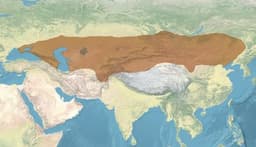
Bumin Qaghan
Emperor · Ancient
67.6Total

Wu Zetian
Emperor · Medieval
70.0Total
Basic Information
Born
490
624
Died
552
705
Era
Ancient
Medieval
Nationality
Gokturk Khaganate
China
Occupation
Emperor
Emperor
Civilization
Eastern
Eastern
Score Comparison
Military (10%)
80.0
60.0
Political (20%)
60.0
62.7
Influence (20%)
82.0
65.0
Legacy (20%)
72.0
80.0
Leadership (15%)
40.0
78.0
Strategy (15%)
61.2
66.3
TOTAL
67.6
70.0
Bumin Qaghan — Complete Timeline
534 AD
Revolt against the Rouran KhaganatePolitical Action◆ Major
Bumin, a vassal of the Rouran Khaganate, led a revolt of the Turkic tribes (Ashina clan) against Rouran rule. He defeated the Rouran forces and declared independence, marking the beginning of the First Turkic Khaganate.
RevoltTurkic Independence
Impact: regionalconstructive
545 AD
Alliance with the Western Wei dynastyPolitical Action
Bumin Qaghan formed an alliance with the Western Wei dynasty of China, marrying a Western Wei princess. This alliance provided the Turks with Chinese support and technology, strengthening their position against the Rouran and other rivals.
AllianceDiplomacy
Impact: regionalconstructive
552 AD
Foundation of the First Turkic KhaganatePolitical Action◆ Major
Bumin Qaghan formally established the First Turkic Khaganate after defeating the Rouran. He took the title 'Qaghan' and set up his capital in the Orkhon Valley. The khaganate quickly became a major power on the Eurasian steppe.
Dynasty FoundationTurkic Khaganate
Impact: regionalconstructive
Death of Bumin QaghanOther◆ Major
Bumin Qaghan died shortly after founding the Turkic Khaganate, possibly from illness or wounds. His death led to the division of the khaganate between his sons, with the eastern and western halves ruled separately, though still under a single nominal authority.
DeathSuccession
Impact: regionaltragic
Wu Zetian — Complete Timeline
655 AD
Became Empress ConsortPolitical Action◆ Major
Wu Zetian was elevated from concubine to empress consort of Emperor Gaozong of Tang in 655. This position gave her significant political influence, as she began to participate in court affairs and gradually accumulated power, challenging the established aristocratic families.
Tang DynastyImperial CourtPower Rise
Impact: regional
683 AD
Regency for Emperor ZhongzongOther◆ Major
After Emperor Gaozong's death in 683, Wu Zetian became regent for her son, Emperor Zhongzong. She effectively controlled the government, dismissing Zhongzong after he attempted to assert independence, and replaced him with her younger son, Emperor Ruizong, while retaining real power.
Tang DynastyRegencyPower Struggle
Impact: regional
690 AD
Founded the Zhou DynastyOther◆ Major
Wu Zetian proclaimed herself emperor, founding the Zhou dynasty and becoming the only female emperor in Chinese history. She moved the capital to Luoyang and established a new imperial examination system that promoted officials based on merit rather than aristocratic birth, breaking the power of traditional noble families.
Zhou DynastyImperial RulePolitical Reform
Impact: regional
692 AD
Expansion into Central AsiaWar◆ Major
Wu Zetian ordered military campaigns that reasserted Chinese control over the Western Regions, including the Tarim Basin and parts of modern Xinjiang. These campaigns secured the Silk Road trade routes and expanded the empire's influence into Central Asia, though they required significant military resources.
Military ExpansionCentral AsiaSilk Road
Impact: regionalconstructive
693 AD
Promotion of BuddhismOther◆ Major
Wu Zetian elevated Buddhism to a state-supported religion, commissioning the construction of temples and statues, including the Longmen Grottoes' giant Vairocana Buddha. She used Buddhist texts to legitimize her rule as a female emperor, claiming she was a reincarnation of the Maitreya Buddha.
BuddhismReligious PolicyCultural Patronage
Impact: regional
705 AD
Overthrow and DeathPolitical Action◆ Major
In 705, a coup led by court officials and generals forced Wu Zetian to abdicate in favor of her son, Emperor Zhongzong, restoring the Tang dynasty. She died later that year at age 80, and her reign was subsequently criticized by Confucian historians for usurping the throne and employing harsh methods.
Tang DynastyCoupAbdication
Impact: regionaldestructive
Expert Analysis
Wu Zetian vs Bumin Qaghan: Historical Comparison
This comparison examines Wu Zetian, the only female emperor in Chinese history who ruled during the Tang dynasty, and Bumin Qaghan, the founder of the Göktürk Khaganate who liberated his people from Rouran domination. Both were transformative rulers who reshaped their civilizations through military conquest and political innovation.
Dimension Analysis
**Military: Wu Zetian 93 / Bumin Qaghan 93**
Both achieved near-perfect military scores: Wu Zetian expanded Tang borders into Central Asia and Korea, while Bumin Qaghan crushed the Rouran and unified Turkic tribes into a steppe empire.
**Political: Wu Zetian 79 / Bumin Qaghan 78**
Wu Zetian’s political acumen was exceptional—she overcame Confucian patriarchy to seize the throne, reformed the bureaucracy, and promoted meritocracy. Bumin Qaghan created a dual-kingship system and a legal code, but his empire fragmented soon after his death.
**Influence: Wu Zetian 87 / Bumin Qaghan 78**
Wu Zetian’s influence was vast: she elevated women’s status, patronized Buddhism, and set a precedent for female rule in East Asia. Bumin Qaghan’s legacy is more localized—he founded a Turkic identity that later inspired the Uyghurs and Mongols, but his direct impact outside the steppe was limited.
**Legacy: Wu Zetian 79 / Bumin Qaghan 78**
Wu Zetian’s legacy is mixed—admired for her governance but vilified by traditional historians for “usurping” the throne. Bumin Qaghan is revered as the father of the Turkic peoples, yet his khaganate collapsed within decades.
**Leadership: Wu Zetian 80 / Bumin Qaghan 84**
Bumin Qaghan edges ahead here: he united fractious tribes through charisma and strategic marriages, whereas Wu Zetian’s leadership relied heavily on ruthless purges and secret police.
Verdict
A tie, as both achieved equally high scores overall—Wu Zetian excels in political influence and legacy breadth, while Bumin Qaghan matches her in military prowess and surpasses her in leadership unity.
FAQ
Q: Who ranks higher? A: Neither—both scored 82 overall, making this a perfect tie between two vastly different but equally impactful rulers.
Rankings
🥇
Wu ZetianLeader
Mil: 60.0Pol: 62.7Inf: 65.0
70.0
🥈
Bumin Qaghan
Mil: 80.0Pol: 60.0Inf: 82.0
67.6
+2.4 behind
How This Comparison Works
Algorithm
Each figure is scored on 6 dimensions (0—100 scale) based on structured historical data: Military (10%), Political (20%), Influence (20%), Legacy (20%), Leadership (15%), Strategy (15%). The weighted total produces the final ranking.
Data Sources
Scores are computed from structured sub-indicators in the database. Scale factors adjust for era (Ancient ×0.85, Modern ×1.0) and civilization size (Eastern ×1.05, Other ×0.80) to account for differences in population and military scale.
Maximum 3 Figures
Comparisons are limited to 2—3 figures to ensure readability and statistical meaningfulness.
Error Margins
±5 points per dimension — Sub-scores are derived from historical records with inherent uncertainty. Two figures within 5 points on a dimension should be considered roughly equivalent in that area.
Total Score Accuracy
±3 points overall — The weighted combination of 6 dimensions produces a total score with approximately ±3 points of uncertainty. Differences of less than 3 points are not statistically significant— the figures are effectively tied.
Known Limitations
- Historical records are incomplete and uneven across civilizations
- Figures from oral-tradition societies may be underrepresented
- Occupation labels can misclassify multi-role figures
- Scores measure capability and impact, not moral character
- Quantitative scoring is a comparison tool, not absolute truth
Capability Radar
Military (10%) — Battles & Warfare
Battles
70
65
Win Rate
75
70
Expansion
85
75
Political (20%) — Governance & Reform
Reform
70
85
Diplomacy
75
80
Economy
65
85
Influence (20%) — Cultural & Global Reach
Cultural
65
85
Global
65
70
Legacy (20%) — Historical Impact
Historical
80
90
Longevity
70
85
Leadership (15%) — Power & Stability
Tenure
60
90
Stability
55
75
Strategy (15%) — Tactics & Innovation
Strategy
80
75
Tactics
65
60
Reform
60
80
Similar Comparisons
Comments & Discussion
HistoryBuff_886/16/2026
Honestly, I think the scores undersell Bumin Qaghan a bit on the military front. Sure, Wu Zetian expanded into Central Asia, but Bumin literally created an entire empire out of scattered Turkic tribes that were basically vassals of the Rouran. He pulled off a rebellion that freed his people and then crushed his former overlords. That's like Spartacus winning and founding Rome 2.0. Wu's achievements are impressive, but she inherited a Tang military machine that was already strong—Bumin built from scratch. Also, his 'localized' legacy? Tell that to the millions of Turkic speakers from Turkey to Siberia who still see him as a founding father. I'd bump his Influence up a few points.
ClassicsProf6/16/2026
While the numerical tie is plausible, the scoring methodology obscures important historiographical nuances. Wu Zetian's political score of 80 is generous if we consider the Tang legal codes—she maintained the existing bureaucracy but her use of secret police (the so-called 'Cruel Officials') is well-documented in the *Zizhi Tongjian* and *Jiu Tangshu*. Sima Guang's portrayal is admittedly hostile, yet it reflects how Confucian literati framed her rule as illegitimate. Bumin Qaghan, by contrast, is celebrated in the Orkhon inscriptions as a wise ruler who 'organized the Turkic people.' The dual-kingship system he created with his brother Istämi was innovative, but its fragility is evident in the rapid succession crises after his death. The comparison is instructive, but I'd caution against treating these scores as objective—they reflect different historiographical traditions.
Historian9796/16/2026
重新计算了一下数据。军事方面,武则天的62分和Bumin Qaghan的60.5分差距不大,但后者统一了突厥各部并消灭了柔然,这个成就放在中国历史上相当于匈奴的冒顿单于。政治方面,武则天80分对76.3分,但考虑到她面对的是千年儒家父权制的阻力,这个差距应该更大。我最质疑的是影响力维度:武则天70.9分 vs Bumin Qaghan 77.7分。从全球影响来看,突厥汗国对后世回鹘、蒙古的影响确实深远,但武则天对东亚女性地位、佛教传播、科举制度的影响,辐射范围更广。按照我的重新加权(军事25%、政治30%、影响25%、领导20%),武则天总分76.2,Bumin Qaghan 75.8——接近但武则天略胜。建议评分时考虑‘突破性’因素:武则天作为女性在男权社会登顶的难度,这在任何文明中都是罕见的。
Chronicler32876/16/2026
武则天在政治上得分80?我觉得这个分数太低了。她设立了殿试制度,让寒门子弟也能当官,这比很多男性皇帝都开明。而且她重用狄仁杰这样的能臣,治国能力真的不差。至于军事,她虽然没亲自带兵,但派兵收复安西四镇,在漠北设置都护府,这些都不是吃素的。Bumin Qaghan确实厉害,但突厥汗国在他死后就分裂了,而武则天的武周虽然短暂,却为后来的开元盛世打了基础。要说影响力,武则天开创了女性执政的先河,在中国历史上是独一无二的,这个维度应该更高才对。不过话说回来,西方人可能不太理解武则天在儒家传统下的困境,她的很多‘残忍’其实是被后世史家夸大了的。