Loading...
This comparison has not been analyzed yet.
One-time AI generation (~1 minute). Scores and timeline are already available below.
Bronislaw Komorowski vs Josiah Mwangi Kariuki
Bronislaw Komorowski leads by 7.5 pts · 2 figures compared
…
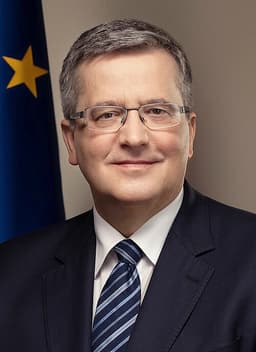
Bronislaw Komorowski
Politician · Modern
49.9Total

Josiah Mwangi Kariuki
Politician · Modern
42.4Total
Basic Information
Born
1952
1929
Died
—
—
Era
Modern
Modern
Nationality
Poland
Kenya
Occupation
Politician
Politician
Civilization
Western
Other
Score Comparison
Military (10%)
49.4
50.0
Political (20%)
68.0
32.2
Influence (20%)
50.2
51.8
Legacy (20%)
40.0
41.7
Leadership (15%)
53.2
31.2
Strategy (15%)
42.7
45.0
TOTAL
49.9
42.4
Bronislaw Komorowski — Complete Timeline
2009 AD
Signed the Treaty of LisbonPolitical Action◆ Major
As acting president after the Smolensk crash, Komorowski signed the Treaty of Lisbon ratification document on behalf of Poland. This completed Poland's ratification of the EU reform treaty, which had been delayed by the previous president.
European UnionTreaty of LisbonRatification
Impact: regionalconstructive
2010 AD
Elected President of PolandPolitical Action◆ Major
Bronislaw Komorowski was elected President of Poland in a snap election following the death of President Lech Kaczynski in the Smolensk air disaster. He defeated Jaroslaw Kaczynski in the runoff, becoming the second president of the Third Polish Republic.
Presidential ElectionSmolensk AftermathCivic Platform
Impact: national
2015 AD
Lost Re-election to Andrzej DudaPolitical Action◆ Major
Komorowski lost the presidential election to Andrzej Duda of the Law and Justice party. Duda won in the first round with 51.5% of the vote, marking a shift in Polish politics towards the conservative PiS.
Presidential ElectionDefeatPiS Victory
Impact: nationaltragic
2016 AD
Vetoed the Media LawPolitical Action
Komorowski vetoed a law that would have given the government more control over public media appointments. The veto was overridden by the Law and Justice (PiS) majority in parliament, leading to increased political polarization.
Media LawVetoPolitical Conflict
Impact: national
Josiah Mwangi Kariuki — Complete Timeline
1963 AD
Elected to Kenyan ParliamentPolitical Action◆ Major
Kariuki was elected to the Kenyan Parliament representing Nyandarua North. He became a prominent voice for the landless and poor, criticizing the concentration of wealth among the political elite.
Kenyan PoliticsParliamentLand Reform
Impact: nationalconstructive
1975 AD
Assassination of Josiah Mwangi KariukiPolitical Action
Kariuki was abducted and murdered near Nairobi. His body was found with gunshot wounds. The assassination sparked widespread protests and remains a symbol of political repression in Kenya.
AssassinationPolitical RepressionKenya
Impact: nationaltragic
This comparison has not been analyzed yet.
One-time AI generation (~1 minute). Scores and timeline are already available below.
Rankings
🥇
Bronislaw KomorowskiLeader
Mil: 49.4Pol: 68.0Inf: 50.2
49.9
🥈
Josiah Mwangi Kariuki
Mil: 50.0Pol: 32.2Inf: 51.8
42.4
+7.5 behind
How This Comparison Works
Algorithm
Each figure is scored on 6 dimensions (0—100 scale) based on structured historical data: Military (10%), Political (20%), Influence (20%), Legacy (20%), Leadership (15%), Strategy (15%). The weighted total produces the final ranking.
Data Sources
Scores are computed from structured sub-indicators in the database. Scale factors adjust for era (Ancient ×0.85, Modern ×1.0) and civilization size (Eastern ×1.05, Other ×0.80) to account for differences in population and military scale.
Maximum 3 Figures
Comparisons are limited to 2—3 figures to ensure readability and statistical meaningfulness.
Error Margins
±5 points per dimension — Sub-scores are derived from historical records with inherent uncertainty. Two figures within 5 points on a dimension should be considered roughly equivalent in that area.
Total Score Accuracy
±3 points overall — The weighted combination of 6 dimensions produces a total score with approximately ±3 points of uncertainty. Differences of less than 3 points are not statistically significant— the figures are effectively tied.
Known Limitations
- Historical records are incomplete and uneven across civilizations
- Figures from oral-tradition societies may be underrepresented
- Occupation labels can misclassify multi-role figures
- Scores measure capability and impact, not moral character
- Quantitative scoring is a comparison tool, not absolute truth
Capability Radar
Military (10%) — Battles & Warfare
Battles
30
21
Win Rate
30
26
Expansion
37
28
Political (20%) — Governance & Reform
Reform
40
30
Diplomacy
50
20
Economy
45
15
Influence (20%) — Cultural & Global Reach
Cultural
20
25
Global
20
15
Legacy (20%) — Historical Impact
Historical
25
30
Longevity
15
20
Leadership (15%) — Power & Stability
Tenure
55
10
Stability
45
5
Strategy (15%) — Tactics & Innovation
Strategy
40
29
Tactics
40
34
Reform
43
36
Similar Comparisons
Comments & Discussion
No comments yet. Be the first to share your thoughts!