Loading...
This comparison has not been analyzed yet.
One-time AI generation (~1 minute). Scores and timeline are already available below.
Boutros Boutros-Ghali vs Maulana Abdul Hamid Khan Bhashani
Maulana Abdul Hamid Khan Bhashani leads by 1.1 pts · 2 figures compared
…
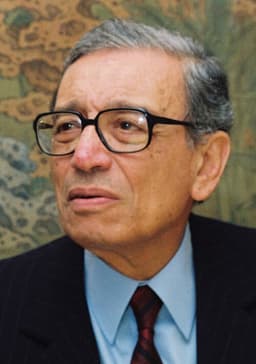
Boutros Boutros-Ghali
Politician · Modern
53.0Total

Maulana Abdul Hamid Khan Bhashani
Politician · Modern
54.1Total
Basic Information
Born
1922
1880
Died
—
1976
Era
Modern
Modern
Nationality
Egypt
Bangladesh
Occupation
Politician
Politician
Civilization
Middle Eastern
Indian
Score Comparison
Military (10%)
50.0
49.3
Political (20%)
45.0
68.0
Influence (20%)
55.0
58.0
Legacy (20%)
49.2
50.0
Leadership (15%)
72.0
40.0
Strategy (15%)
44.4
60.0
TOTAL
53.0
54.1
Boutros Boutros-Ghali — Complete Timeline
1992 AD
Elected Secretary-General of the United NationsPolitical Action◆ Major
Boutros Boutros-Ghali became the sixth Secretary-General of the United Nations, the first from Africa. His election came during a period of post-Cold War transition, and he focused on peacekeeping and conflict resolution.
UN Secretary-GeneralPeacekeepingPost-Cold War
Impact: globalconstructive
Published An Agenda for PeacePolitical Action◆ Major
Boutros-Ghali released An Agenda for Peace, a landmark report outlining preventive diplomacy, peacemaking, and peacekeeping strategies. The report influenced UN operations in conflicts like Somalia, Bosnia, and Rwanda.
PeacekeepingUN ReformDiplomacy
Impact: globalconstructive
1994 AD
Oversaw UN peacekeeping in the Rwandan GenocideWar◆ Major
During the Rwandan Genocide, Boutros-Ghali's UN peacekeeping mission failed to prevent the killing of an estimated 800,000 Tutsis and moderate Hutus. The UN's inaction drew widespread criticism and led to calls for reform.
RwandaGenocideUN Failure
Impact: globaltragic
1996 AD
Vetoed by the United States for a second termPolitical Action◆ Major
The United States vetoed Boutros-Ghali's bid for a second term as UN Secretary-General, citing disagreements over UN reform and peacekeeping operations. He was succeeded by Kofi Annan.
UN PoliticsUS VetoLeadership
Impact: globaldestructive
1997 AD
Served as Secretary-General of the FrancophoniePolitical Action
After leaving the UN, Boutros-Ghali became the first Secretary-General of the International Organisation of the Francophonie, promoting French language and cultural cooperation among member states.
FrancophonieCultural DiplomacyPost-UN
Impact: regionalconstructive
Maulana Abdul Hamid Khan Bhashani — Complete Timeline
1946 AD
Led the Tebhaga movementPolitical Action◆ Major
Bhashani led the Tebhaga movement in Bengal, demanding that sharecroppers receive two-thirds of the crop instead of half. The movement involved mass protests and clashes with landlords, influencing agrarian reforms in East Pakistan.
TebhagaPeasant MovementAgrarian Reform
Impact: regionalconstructive
1957 AD
Founded the National Awami PartyPolitical Action◆ Major
Bhashani founded the National Awami Party (NAP) in East Pakistan, a leftist political party advocating for peasant rights and autonomy. The party became a major force in opposition politics, challenging both the government and mainstream parties.
NAPPolitical PartyLeftist Politics
Impact: regionalconstructive
1969 AD
Led the 1969 mass uprising in East PakistanPolitical Action
Bhashani played a key role in the 1969 mass uprising in East Pakistan, demanding autonomy and democratic reforms. The protests forced the resignation of President Ayub Khan and accelerated the push for Bengali rights.
Mass UprisingAutonomyEast Pakistan
Impact: regionalconstructive
1971 AD
Opposed the creation of BangladeshPolitical Action◆ Major
Bhashani opposed the Bangladesh Liberation War and the creation of an independent Bangladesh, advocating instead for a united Pakistan. His stance isolated him from mainstream Bengali nationalism, though he remained a peasant leader.
Bangladesh Liberation WarOppositionPakistan
Impact: regionaldestructive
This comparison has not been analyzed yet.
One-time AI generation (~1 minute). Scores and timeline are already available below.
Rankings
🥇
Maulana Abdul Hamid Khan BhashaniLeader
Mil: 49.3Pol: 68.0Inf: 58.0
54.1
🥈
Boutros Boutros-Ghali
Mil: 50.0Pol: 45.0Inf: 55.0
53.0
+1.1 behind
How This Comparison Works
Algorithm
Each figure is scored on 6 dimensions (0—100 scale) based on structured historical data: Military (10%), Political (20%), Influence (20%), Legacy (20%), Leadership (15%), Strategy (15%). The weighted total produces the final ranking.
Data Sources
Scores are computed from structured sub-indicators in the database. Scale factors adjust for era (Ancient ×0.85, Modern ×1.0) and civilization size (Eastern ×1.05, Other ×0.80) to account for differences in population and military scale.
Maximum 3 Figures
Comparisons are limited to 2—3 figures to ensure readability and statistical meaningfulness.
Error Margins
±5 points per dimension — Sub-scores are derived from historical records with inherent uncertainty. Two figures within 5 points on a dimension should be considered roughly equivalent in that area.
Total Score Accuracy
±3 points overall — The weighted combination of 6 dimensions produces a total score with approximately ±3 points of uncertainty. Differences of less than 3 points are not statistically significant— the figures are effectively tied.
Known Limitations
- Historical records are incomplete and uneven across civilizations
- Figures from oral-tradition societies may be underrepresented
- Occupation labels can misclassify multi-role figures
- Scores measure capability and impact, not moral character
- Quantitative scoring is a comparison tool, not absolute truth
Capability Radar
Military (10%) — Battles & Warfare
Battles
24
44
Win Rate
24
47
Expansion
28
47
Political (20%) — Governance & Reform
Reform
55
65
Diplomacy
85
55
Economy
40
40
Influence (20%) — Cultural & Global Reach
Cultural
40
50
Global
65
40
Legacy (20%) — Historical Impact
Historical
55
55
Longevity
40
45
Leadership (15%) — Power & Stability
Tenure
60
60
Stability
50
35
Strategy (15%) — Tactics & Innovation
Strategy
31
55
Tactics
32
58
Reform
34
60
Similar Comparisons
Comments & Discussion
No comments yet. Be the first to share your thoughts!