Loading...
This comparison has not been analyzed yet.
One-time AI generation (~1 minute). Scores and timeline are already available below.
Boun Oum vs Jyoti Basu
Jyoti Basu leads by 11.2 pts · 2 figures compared
…
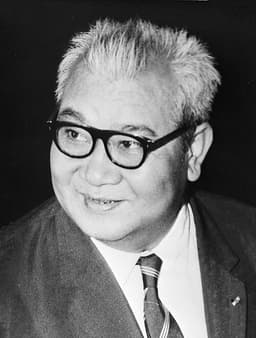
Boun Oum
Politician · Modern
47.3Total

Jyoti Basu
Politician · Modern
58.5Total
Basic Information
Born
1912
1914
Died
1980
2010
Era
Modern
Modern
Nationality
Laos
India
Occupation
Politician
Politician
Civilization
Eastern
Indian
Score Comparison
Military (10%)
36.6
46.0
Political (20%)
40.8
60.0
Influence (20%)
49.4
59.0
Legacy (20%)
40.0
50.0
Leadership (15%)
65.7
78.0
Strategy (15%)
52.8
60.0
TOTAL
47.3
58.5
Boun Oum — Complete Timeline
1960 AD
Role in the Battle of VientianeWar◆ Major
Boun Oum allied with General Phoumi Nosavan to retake Vientiane from neutralist forces led by Kong Le. The battle resulted in heavy casualties and destruction in the capital, and Boun Oum's forces emerged victorious, installing a right-wing government.
BattleCivil WarVientiane
Impact: nationaldestructive
Formation of the Right-Wing Government in ChampasakPolitical Action◆ Major
Boun Oum, as prince of Champasak, formed a right-wing government in southern Laos with support from the United States and Thailand. His government opposed the neutralist coalition of Souvanna Phouma and the communist Pathet Lao, deepening the Laotian Civil War.
Civil WarRight-WingUS Support
Impact: nationaldestructive
1975 AD
Exile to ThailandPolitical Action◆ Major
Following the communist takeover of Laos, Boun Oum fled to Thailand, where he lived in exile. He continued to oppose the Pathet Lao government but never returned to Laos. His exile marked the end of the traditional Lao aristocracy's political influence.
ExileCommunist TakeoverAristocracy
Impact: nationaltragic
Jyoti Basu — Complete Timeline
1977 AD
Became Chief Minister of West BengalPolitical Action◆ Major
Jyoti Basu became Chief Minister of West Bengal, leading the Left Front government. He served for 23 consecutive years, the longest tenure of any Indian chief minister, implementing land reforms, panchayat decentralization, and industrial policies.
Chief MinisterLeft FrontWest Bengal
Impact: regionalconstructive
Led the Left Front to Victory in West BengalPolitical Action◆ Major
Basu led the Left Front coalition to a landslide victory in the West Bengal assembly elections, defeating the Congress party. This marked the beginning of the longest-serving democratically elected communist government in the world.
Election VictoryLeft FrontCommunist Government
Impact: regionalconstructive
1978 AD
Implemented Operation BargaReform◆ Major
Basu's government implemented Operation Barga, a land reform program that registered the rights of sharecroppers (bargadars) in West Bengal. The program provided tenancy security and improved agricultural productivity, benefiting millions of rural poor.
Land ReformsOperation BargaAgriculture
Impact: regionalconstructive
1996 AD
Declined the Prime MinistershipPolitical Action◆ Major
After the 1996 general elections, Basu was offered the position of Prime Minister of India by the United Front coalition, but he declined due to opposition from his party's central committee. This decision remains a subject of debate.
Prime Minister OfferDeclinedUnited Front
Impact: national
This comparison has not been analyzed yet.
One-time AI generation (~1 minute). Scores and timeline are already available below.
Rankings
🥇
Jyoti BasuLeader
Mil: 46.0Pol: 60.0Inf: 59.0
58.5
🥈
Boun Oum
Mil: 36.6Pol: 40.8Inf: 49.4
47.3
+11.2 behind
How This Comparison Works
Algorithm
Each figure is scored on 6 dimensions (0—100 scale) based on structured historical data: Military (10%), Political (20%), Influence (20%), Legacy (20%), Leadership (15%), Strategy (15%). The weighted total produces the final ranking.
Data Sources
Scores are computed from structured sub-indicators in the database. Scale factors adjust for era (Ancient ×0.85, Modern ×1.0) and civilization size (Eastern ×1.05, Other ×0.80) to account for differences in population and military scale.
Maximum 3 Figures
Comparisons are limited to 2—3 figures to ensure readability and statistical meaningfulness.
Error Margins
±5 points per dimension — Sub-scores are derived from historical records with inherent uncertainty. Two figures within 5 points on a dimension should be considered roughly equivalent in that area.
Total Score Accuracy
±3 points overall — The weighted combination of 6 dimensions produces a total score with approximately ±3 points of uncertainty. Differences of less than 3 points are not statistically significant— the figures are effectively tied.
Known Limitations
- Historical records are incomplete and uneven across civilizations
- Figures from oral-tradition societies may be underrepresented
- Occupation labels can misclassify multi-role figures
- Scores measure capability and impact, not moral character
- Quantitative scoring is a comparison tool, not absolute truth
Capability Radar
Military (10%) — Battles & Warfare
Battles
5
43
Win Rate
5
46
Expansion
5
50
Political (20%) — Governance & Reform
Reform
30
70
Diplomacy
40
65
Economy
25
60
Influence (20%) — Cultural & Global Reach
Cultural
20
50
Global
15
45
Legacy (20%) — Historical Impact
Historical
25
55
Longevity
15
50
Leadership (15%) — Power & Stability
Tenure
45
85
Stability
20
55
Strategy (15%) — Tactics & Innovation
Strategy
5
51
Tactics
5
54
Reform
5
61
Similar Comparisons
Comments & Discussion
No comments yet. Be the first to share your thoughts!