Loading...
Bertrand du Guesclin vs Gang Gam-chan
Bertrand du Guesclin leads by 4.6 pts · 2 figures compared
…
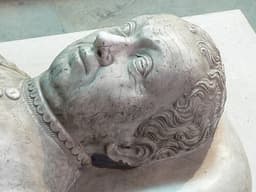
Bertrand du Guesclin
General · Medieval
60.0Total

Gang Gam-chan
General · Medieval
55.4Total
Basic Information
Born
1320
948
Died
1380
1031
Era
Medieval
Medieval
Nationality
France
Korea
Occupation
General
General
Civilization
Western
Eastern
Score Comparison
Military (10%)
67.3
82.0
Political (20%)
54.7
36.5
Influence (20%)
56.4
54.1
Legacy (20%)
48.3
47.5
Leadership (15%)
80.0
65.0
Strategy (15%)
69.1
65.9
TOTAL
60.0
55.4
Bertrand du Guesclin — Complete Timeline
1364 AD
Battle of CocherelWar◆ Major
Bertrand du Guesclin led French forces to victory at the Battle of Cocherel against the forces of Charles II of Navarre. The victory secured the French throne for Charles V and established du Guesclin as a leading commander.
Hundred Years' WarBattle
Impact: regional
Battle of AurayWar◆ Major
Du Guesclin was defeated and captured at the Battle of Auray while fighting for the French in the Breton War of Succession. The defeat was a setback for French ambitions in Brittany.
Hundred Years' WarBattleDefeat
Impact: regionaltragic
1370 AD
Campaign in AquitaineWar◆ Major
Du Guesclin led a successful campaign in Aquitaine, using Fabian tactics to avoid pitched battles and recapture castles and towns from the English. His strategy weakened English control in the region.
Hundred Years' WarCampaign
Impact: regional
Appointment as Constable of FrancePolitical Action◆ Major
King Charles V appointed Bertrand du Guesclin as Constable of France, the highest military office. Du Guesclin was tasked with leading the French campaign to recover territory from the English.
FranceAppointment
Impact: nationalconstructive
1380 AD
Death at the Siege of Châteauneuf-de-RandonWar◆ Major
Bertrand du Guesclin died during the siege of Ch
Hundred Years' WarSiegeDeath
Impact: nationaltragic
Gang Gam-chan — Complete Timeline
1010 AD
Siege of HeunghwajinWar◆ Major
Gang Gam-chan defended the fortress of Heunghwajin against Khitan forces during the Second Goryeo-Khitan War. The siege ended with a Goryeo victory, delaying the Khitan advance.
Goryeo-Khitan WarSiegeDefense
Impact: regionalconstructive
1019 AD
Battle of KwijuWar
Gang Gam-chan commanded Goryeo forces at the Battle of Kwiju against the Khitan Liao dynasty. His army decisively defeated the Khitan invaders, ending the Third Goryeo-Khitan War and securing Goryeo's independence.
Goryeo-Khitan WarBattleVictory
Impact: regionalconstructive
Expert Analysis
Origins
Bertrand du Guesclin was born around 1320 in the Duchy of Brittany, France, into a minor noble family. His early life was marked by a lack of formal education—he was reportedly illiterate—but he excelled in physical training and martial skills. His family's modest status limited his initial opportunities, but his prowess in tournaments and local conflicts earned him a reputation.
Gang Gam-chan was born in 948 in Goryeo (modern Korea) into a scholarly family; his father was a high-ranking official. He passed the civil service examination at age 23 and began his career as a bureaucrat. Unlike du Guesclin, Gang's early path was academic, but he later transitioned to military command during a period of national crisis.
Rise to Power
Du Guesclin's rise began during the Breton War of Succession (1341–1364). He fought for Charles of Blois against John of Montfort, who was backed by the English. His first major victory came at the Battle of Cocherel in 1364, where he defeated the forces of Charles II of Navarre. However, he was captured at the Battle of Auray later that year. After his release, he served King Charles V of France, who appointed him Constable of France in 1370, making him the supreme military commander.
Gang Gam-chan rose to prominence during the Second Goryeo-Khitan War (1010–1011). In 1010, the Khitan Liao dynasty invaded Goryeo. Gang, then a civil official, was appointed as the commander of the northwestern border. His strategic defense of the fortress Heunghwajin in 1010 held off the Khitan, buying time for Goryeo to regroup. His greatest achievement followed at the Battle of Kwiju in 1011, where he decisively defeated the Khitan army, ending the invasion.
Leadership & Governance
Du Guesclin's leadership style was characterized by Fabian tactics: avoiding open battles and instead using sieges, raids, and attrition to wear down the English. He recaptured numerous castles and towns in Aquitaine without major pitched battles. His governance as Constable focused on restoring French morale and reclaiming territory. He was known for his discipline and ability to inspire loyalty among his troops.
Gang Gam-chan led by example, personally overseeing defenses and encouraging his soldiers. At Kwiju, he employed a combination of fortified positions and aggressive counterattacks. He also implemented a scorched-earth policy to deprive the Khitan of supplies. His leadership was more direct and decisive than du Guesclin's, relying on a single decisive battle rather than a protracted campaign.
Triumph & Tragedy
Du Guesclin's greatest triumph was his successful campaign in Aquitaine (1370–1374), where he recaptured territory from the English without a single major defeat. His greatest failure was his defeat at Auray in 1364, where he was captured and imprisoned. This setback highlighted the risk of his preferred Fabian approach when forced into open battle. He died in 1380 during the siege of Châteauneuf-de-Randon, a loss that was mourned by France.
Gang Gam-chan's triumph was the Battle of Kwiju, where his army of about 200,000 annihilated a Khitan force of similar size, securing Goryeo's independence. His failure was less prominent, but his initial defense of Heunghwajin was a near-run thing; had the fortress fallen, the war might have ended differently. After the war, he retired from military life and returned to civil service, dying in 1031.
Character & Destiny
Du Guesclin was pragmatic, patient, and resilient. His Fabian tactics reflected a cautious but persistent character. He was also chivalrous, often treating prisoners well. His destiny was to restore French fortunes in the Hundred Years' War, but his death before the final victory meant he did not see the full fruits of his work.
Gang Gam-chan was brave, decisive, and strategic. His willingness to stake everything on a single battle at Kwiju showed his confidence. He was also modest, refusing rewards after his victory. His destiny was to be the savior of Goryeo, but his later career was overshadowed by his military success; he never held high office again.
Legacy
Du Guesclin's legacy is as the architect of French recovery in the Hundred Years' War. His tactics influenced later commanders, and he is remembered as a national hero. He scored 67.3 in military, 54.7 in political, 56.4 in influence, and 48.3 in legacy, for a total of 60.0. His Fabian approach is still studied.
Gang Gam-chan's legacy is as the defender of Korean independence. He is revered in Korea, with statues and shrines dedicated to him. He scored 82.0 in military, 36.5 in political, 54.1 in influence, and 47.5 in legacy, for a total of 55.4. His victory at Kwiju is a turning point in Korean history.
Conclusion
While du Guesclin has a higher total score (60.0 vs 55.4), Gang Gam-chan's military score is significantly higher (82.0 vs 67.3). However, du Guesclin's broader impact on the Hundred Years' War and his innovative use of Fabian tactics give him a greater historical impact. Gang Gam-chan's victory was decisive but confined to a single campaign, whereas du Guesclin's strategy reshaped a long war. Therefore, Bertrand du Guesclin had the greater overall impact.
Rankings
🥇
Bertrand du GuesclinLeader
Mil: 67.3Pol: 54.7Inf: 56.4
60.0
🥈
Gang Gam-chan
Mil: 82.0Pol: 36.5Inf: 54.1
55.4
+4.6 behind
How This Comparison Works
Algorithm
Each figure is scored on 6 dimensions (0—100 scale) based on structured historical data: Military (10%), Political (20%), Influence (20%), Legacy (20%), Leadership (15%), Strategy (15%). The weighted total produces the final ranking.
Data Sources
Scores are computed from structured sub-indicators in the database. Scale factors adjust for era (Ancient ×0.85, Modern ×1.0) and civilization size (Eastern ×1.05, Other ×0.80) to account for differences in population and military scale.
Maximum 3 Figures
Comparisons are limited to 2—3 figures to ensure readability and statistical meaningfulness.
Error Margins
±5 points per dimension — Sub-scores are derived from historical records with inherent uncertainty. Two figures within 5 points on a dimension should be considered roughly equivalent in that area.
Total Score Accuracy
±3 points overall — The weighted combination of 6 dimensions produces a total score with approximately ±3 points of uncertainty. Differences of less than 3 points are not statistically significant— the figures are effectively tied.
Known Limitations
- Historical records are incomplete and uneven across civilizations
- Figures from oral-tradition societies may be underrepresented
- Occupation labels can misclassify multi-role figures
- Scores measure capability and impact, not moral character
- Quantitative scoring is a comparison tool, not absolute truth
Capability Radar
Military (10%) — Battles & Warfare
Battles
65
75
Win Rate
60
80
Expansion
60
40
Political (20%) — Governance & Reform
Reform
45
30
Diplomacy
70
45
Economy
40
35
Influence (20%) — Cultural & Global Reach
Cultural
55
55
Global
45
40
Legacy (20%) — Historical Impact
Historical
60
60
Longevity
50
55
Leadership (15%) — Power & Stability
Tenure
60
50
Stability
55
50
Strategy (15%) — Tactics & Innovation
Strategy
75
75
Tactics
70
78
Reform
55
30
Similar Comparisons
Comments & Discussion
No comments yet. Be the first to share your thoughts!