Loading...
Benjamin Disraeli vs Lalith Athulathmudali
Benjamin Disraeli leads by 3.1 pts · 2 figures compared
…
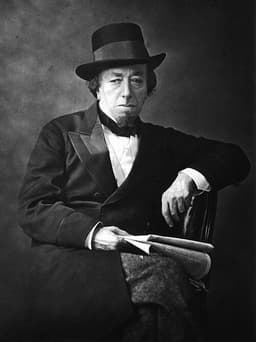
Benjamin Disraeli
Politician · Modern
57.5Total

Lalith Athulathmudali
Politician · Modern
54.4Total
Basic Information
Born
1804
1936
Died
1881
—
Era
Modern
Modern
Nationality
United Kingdom
Sri Lanka
Occupation
Politician
Politician
Civilization
Western
Indian
Score Comparison
Military (10%)
47.4
44.5
Political (20%)
62.7
68.0
Influence (20%)
55.0
52.5
Legacy (20%)
55.0
42.5
Leadership (15%)
78.0
67.0
Strategy (15%)
41.7
60.0
TOTAL
57.5
54.4
Benjamin Disraeli — Complete Timeline
1867 AD
Reform Act 1867Reform
As Chancellor of the Exchequer, Disraeli steered the Reform Act 1867 through Parliament, which doubled the electorate by extending the vote to many urban working-class men. This 'leap in the dark' was a major political reform that reshaped British democracy.
Electoral ReformDemocracyWorking Class
Impact: nationalprogressive
1868 AD
Became Prime MinisterPolitical Action
Disraeli became Prime Minister for the first time on February 27, 1868, after the resignation of Lord Derby. His first ministry lasted only 10 months, but he passed the Reform Act 1867 during his time as Chancellor of the Exchequer, which expanded the electorate.
Prime MinisterConservative PartyReform
Impact: national
1875 AD
Purchase of Suez Canal SharesPolitical Action◆ Major
Disraeli arranged the purchase of a 44% stake in the Suez Canal Company from the Khedive of Egypt for
Suez CanalImperialismFinance
Impact: globalconstructive
1876 AD
Royal Titles Act 1876Political Action
Disraeli's government passed the Royal Titles Act 1876, which added 'Empress of India' to Queen Victoria's titles. This formalized British imperial rule in India and was a symbolic assertion of British power, though it was criticized as flattery of the monarch.
MonarchyIndiaImperial Title
Impact: global
1878 AD
Congress of BerlinPolitical Action◆ Major
Disraeli attended the Congress of Berlin in June-July 1878, representing Britain. He secured revisions to the Treaty of San Stefano, limiting Russian influence in the Balkans and gaining Cyprus for Britain. He returned claiming 'peace with honour', boosting his popularity.
Foreign PolicyBalkansDiplomacy
Impact: global
Lalith Athulathmudali — Complete Timeline
1977 AD
Served as Minister of EducationPolitical Action◆ Major
Athulathmudali was appointed Minister of Education in the UNP government under President Jayewardene. He implemented education reforms, including the introduction of the national school system and the expansion of university access, though his policies also faced criticism for centralization.
Minister of EducationEducation ReformNational Schools
Impact: nationalconstructive
1980 AD
Served as Minister of Trade and CommercePolitical Action◆ Major
Athulathmudali was appointed Minister of Trade and Commerce, where he oversaw the liberalization of Sri Lanka's economy. He promoted export-oriented industries and foreign investment, playing a key role in the economic transformation of the country during the 1980s.
Minister of TradeEconomic LiberalizationExport Promotion
Impact: nationalprogressive
1991 AD
Expelled from the UNP and Formed the Democratic United National FrontPolitical Action◆ Major
Athulathmudali was expelled from the UNP after challenging President Premadasa's leadership. He then formed the Democratic United National Front (DUNF), a breakaway party, and became a leading opposition figure, advocating for constitutional reforms and devolution.
ExpulsionNew PartyOpposition
Impact: national
1993 AD
Assassinated by a GunmanPolitical Action◆ Major
Athulathmudali was shot and killed by a gunman at a political rally in Colombo. The assassination was widely attributed to the LTTE, though some theories suggested involvement of other groups. His death occurred during a period of intense political violence in Sri Lanka.
AssassinationPolitical RallyLTTE
Impact: nationaltragic
Expert Analysis
Origins
Benjamin Disraeli (1804–1881) was born in London to a Jewish literary family. His father, Isaac D'Israeli, was a noted author. Disraeli was baptized Anglican at age 13, which allowed him to enter politics. He attended a private school in Walthamstow but did not go to university. Instead, he trained as a solicitor's clerk and later pursued a literary career, writing novels such as 'Vivian Grey' (1826). His early life was marked by financial troubles and debt.
Lalith Athulathmudali (1936–1993) was born in Colombo, Ceylon (now Sri Lanka), to a wealthy family. He studied at Royal College Colombo and then at the University of Ceylon, before winning a Rhodes Scholarship to Oxford University, where he read law. He was called to the bar at Lincoln's Inn. His upbringing was privileged, and he was heavily influenced by Western liberal thought.
Rise to Power
Disraeli entered Parliament in 1837 as a Conservative MP for Maidstone. He quickly became a leading figure in the Young England group, which sought to revive Tory paternalism. His rise was accelerated by his eloquent speeches and his role in the Corn Law debates. In 1852, he served as Chancellor of the Exchequer under Lord Derby. His first premiership came in 1868 but lasted only 10 months. His second, more substantial term began in 1874.
Athulathmudali entered politics in the 1970s, joining the United National Party (UNP). He was elected to Parliament in 1977 from the Colombo district. His rise was swift due to his education and oratory skills. He was appointed Minister of Education in 1977 and later Minister of Trade and Commerce. He became a key figure in economic liberalization under President J.R. Jayewardene.
Leadership & Governance
Disraeli's leadership style was charismatic and pragmatic. He championed social reforms, such as the Public Health Act 1875 and the Artisans' and Labourers' Dwellings Improvement Act 1875. He also expanded the British Empire, notably through the purchase of Suez Canal shares (1875) and the Congress of Berlin (1878), where he limited Russian influence. His political score is 62.7, reflecting his ability to navigate party politics.
Athulathmudali promoted free-market policies as Trade Minister, reducing tariffs and encouraging foreign investment. As Education Minister, he reformed the university system and introduced free textbooks. His leadership score is 67.0, indicating effective governance but within a smaller sphere. He was known for his intellectual approach, but his expulsion from the UNP in 1991 showed a failure in party management.
Triumph & Tragedy
Disraeli's greatest triumph was the Reform Act 1867, which doubled the electorate and strengthened the Conservative Party. He also secured peace with Russia at the Congress of Berlin, gaining Cyprus. His purchase of Suez Canal shares gave Britain control of the waterway. His failures include his first brief premiership and the economic depression of the late 1870s. He was also criticized for imperial overreach.
Athulathmudali's triumph was his role in Sri Lanka's economic liberalization, which boosted growth. He was a respected minister. His tragedy was his assassination in 1993, likely by the LTTE, which cut short his career. He also failed to secure the presidency after challenging Premadasa.
Character & Destiny
Disraeli was witty, ambitious, and resilient. He overcame anti-Semitism and financial setbacks. His character drove him to become a dominant figure, but his arrogance alienated some. He died in 1881, leaving a mixed legacy.
Athulathmudali was intelligent, principled, but politically rigid. His Oxford education shaped his liberal views, but his inability to compromise led to his expulsion from the UNP. His assassination made him a martyr, but his destiny was unfulfilled.
Legacy
Disraeli's legacy endures through the modern Conservative Party and British imperialism. He is remembered for social reform and empire. His total score is 57.5, with leadership at 78.0 and strategy at 41.7.
Athulathmudali's legacy is limited to Sri Lanka. He is remembered as a reformer and a victim of political violence. His total score is 54.4, with political at 68.0 and influence at 52.5.
Conclusion
Disraeli had greater impact due to his role in shaping British democracy and empire. His political score (62.7) and leadership (78.0) outweigh Athulathmudali's (68.0 and 67.0). Disraeli's reforms and imperial vision affected millions globally, while Athulathmudali's influence was confined to Sri Lanka. Thus, Disraeli is the more significant figure.
Rankings
🥇
Benjamin DisraeliLeader
Mil: 47.4Pol: 62.7Inf: 55.0
57.5
🥈
Lalith Athulathmudali
Mil: 44.5Pol: 68.0Inf: 52.5
54.4
+3.1 behind
How This Comparison Works
Algorithm
Each figure is scored on 6 dimensions (0—100 scale) based on structured historical data: Military (10%), Political (20%), Influence (20%), Legacy (20%), Leadership (15%), Strategy (15%). The weighted total produces the final ranking.
Data Sources
Scores are computed from structured sub-indicators in the database. Scale factors adjust for era (Ancient ×0.85, Modern ×1.0) and civilization size (Eastern ×1.05, Other ×0.80) to account for differences in population and military scale.
Maximum 3 Figures
Comparisons are limited to 2—3 figures to ensure readability and statistical meaningfulness.
Error Margins
±5 points per dimension — Sub-scores are derived from historical records with inherent uncertainty. Two figures within 5 points on a dimension should be considered roughly equivalent in that area.
Total Score Accuracy
±3 points overall — The weighted combination of 6 dimensions produces a total score with approximately ±3 points of uncertainty. Differences of less than 3 points are not statistically significant— the figures are effectively tied.
Known Limitations
- Historical records are incomplete and uneven across civilizations
- Figures from oral-tradition societies may be underrepresented
- Occupation labels can misclassify multi-role figures
- Scores measure capability and impact, not moral character
- Quantitative scoring is a comparison tool, not absolute truth
Capability Radar
Military (10%) — Battles & Warfare
Battles
31
43
Win Rate
34
46
Expansion
36
50
Political (20%) — Governance & Reform
Reform
80
45
Diplomacy
85
50
Economy
70
45
Influence (20%) — Cultural & Global Reach
Cultural
65
30
Global
65
25
Legacy (20%) — Historical Impact
Historical
75
35
Longevity
70
20
Leadership (15%) — Power & Stability
Tenure
75
40
Stability
70
30
Strategy (15%) — Tactics & Innovation
Strategy
39
55
Tactics
38
54
Reform
42
57
Similar Comparisons
Comments & Discussion
No comments yet. Be the first to share your thoughts!