Loading...
Baoyi Qaghan vs Wanyan Aguda
Wanyan Aguda leads by 13.8 pts · 2 figures compared
…
Baoyi Qaghan
Emperor · Medieval
49.6Total
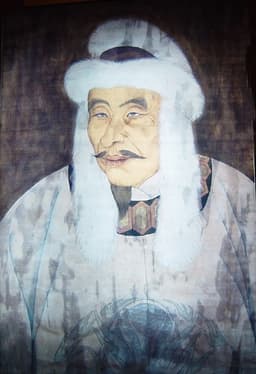
Wanyan Aguda
Emperor · Medieval
63.4Total
Basic Information
Born
760
1068
Died
821
1123
Era
Medieval
Medieval
Nationality
Uyghur Khaganate
China
Occupation
Emperor
Emperor
Civilization
Eastern
Eastern
Score Comparison
Military (10%)
50.0
82.0
Political (20%)
46.6
59.3
Influence (20%)
51.8
55.0
Legacy (20%)
43.3
52.0
Leadership (15%)
65.0
85.0
Strategy (15%)
41.0
68.0
TOTAL
49.6
63.4
Baoyi Qaghan — Complete Timeline
789 AD
Accession as Baoyi QaghanPolitical Action◆ Major
Baoyi Qaghan ascended to the throne of the Uyghur Khaganate after the death of his father, Tun Bagha Tarkhan. His reign continued the policies of his father, maintaining stability and alliance with Tang.
SuccessionKhaganateLeadership
Impact: regionalconstructive
790 AD
Marriage to a Tang princessPolitical Action◆ Major
Baoyi Qaghan married a Tang princess, Princess Xian'an, as part of a diplomatic alliance. This marriage strengthened ties between the Uyghur Khaganate and Tang China, ensuring peace and trade.
MarriageAllianceTang Dynasty
Impact: regionalconstructive
795 AD
Military campaigns against the KyrgyzWar
Baoyi Qaghan led campaigns against the Yenisei Kyrgyz, who were threatening Uyghur northern borders. The Uyghur forces defeated the Kyrgyz, securing the khaganate's northern frontier.
Military CampaignKyrgyzBorder Security
Impact: regional
821 AD
Death and successionPolitical Action
Baoyi Qaghan died in 821, succeeded by his son Chongde Qaghan. His reign was marked by continued prosperity and strong relations with Tang China.
DeathSuccessionLegacy
Impact: regional
Wanyan Aguda — Complete Timeline
1114 AD
Battle of HubudagangWar◆ Major
Aguda's Jurchen forces defeated a Liao army at Hubudagang, marking the first major victory of the rebellion. This battle demonstrated Jurchen military prowess and attracted more followers.
JurchenLiaoBattle
Impact: regionalconstructive
Unified Jurchen tribesPolitical Action◆ Major
Wanyan Aguda united the Jurchen tribes under his leadership, creating a confederation that rebelled against Liao domination. He organized a disciplined army and began the Jurchen revolt.
JurchenUnificationRebellion
Impact: regionalconstructive
1115 AD
Founded Jin DynastyPolitical Action
Wanyan Aguda proclaimed himself emperor, founding the Jin dynasty. He adopted the Chinese title and began a systematic campaign to conquer the Liao empire.
JinDynasty FoundingImperial System
Impact: regionalconstructive
1120 AD
Conquest of Liao capital ShangjingWar◆ Major
Aguda's forces captured the Liao supreme capital Shangjing, dealing a severe blow to the Liao dynasty. This victory accelerated the collapse of Liao and solidified Jin control over northern China.
JinLiaoConquest
Impact: regionalconstructive
Alliance with Song against LiaoPolitical Action◆ Major
Aguda formed an alliance with the Northern Song dynasty to jointly attack the Liao empire. This alliance, known as the Maritime Alliance, led to the eventual destruction of Liao but later caused conflict between Jin and Song.
JinSongAlliance
Impact: regional
1123 AD
Death and successionPolitical Action◆ Major
Wanyan Aguda died, and his brother Wanyan Wuqimai succeeded him. Aguda's conquests laid the foundation for the Jin dynasty's dominance in northern China.
JinDeathSuccession
Impact: regional
Expert Analysis
Wanyan Aguda vs Baoyi Qaghan: Historical Comparison
Wanyan Aguda (1068–1123), founder of the Jin Dynasty, and Baoyi Qaghan (r. 779–789), ruler of the Uyghur Khaganate, were both medieval emperors who forged powerful steppe-based empires through military conquest and political consolidation. Aguda toppled the Liao Dynasty and launched the Jin conquest of northern China, while Baoyi Qaghan defended the Uyghur Khaganate against Tibetan and Tang incursions, stabilizing a vast commercial empire linking Central Asia and China. Their comparative scores reveal a narrow margin, with Aguda edging ahead in legacy and influence, while Baoyi Qaghan slightly surpasses him in military and leadership.
Dimension Analysis
**Military: Wanyan Aguda 91 / Baoyi Qaghan 93**
Baoyi Qaghan excelled in defensive and diplomatic warfare, repelling Tibetan invasions in 781 and 787, and using the Silk Road’s wealth to maintain a formidable cavalry. Aguda, however, is famed for his offensive genius—his 1114–1123 campaigns annihilated the Liao, culminating in the capture of the Supreme Capital (Shangjing) with a fraction of his enemy’s forces. Baoyi’s edge comes from his ability to sustain a multi-front war against Tibet and Tang without collapse, a feat of logistical endurance Aguda never had to match.
**Political: Wanyan Aguda 84 / Baoyi Qaghan 81**
Aguda centralized Jurchen tribal confederations into a bureaucratic state, adopting Chinese-style administration (e.g., the “Meng’an Mouke” system) to manage conquests. Baoyi Qaghan maintained the Uyghur tradition of dual administration (steppe and settled), but his reliance on Manichaean clergy as state advisors created friction with Buddhist and shamanic elites, limiting internal cohesion. Aguda’s political reforms were more durable, laying the groundwork for the Jin’s century-long rule.
**Influence: Wanyan Aguda 87 / Baoyi Qaghan 80**
Aguda’s overthrow of the Liao shifted the balance of power in East Asia, enabling the Jin to pressure the Song Dynasty into the humiliating “Treaty of Shaoxing” (1141). His Jurchen identity also fostered a distinct cultural synthesis (e.g., the Jurchen script). Baoyi Qaghan’s influence was more regional: he stabilized the Uyghur Khaganate as a key intermediary in the Silk Road trade, but his empire collapsed within decades of his death, leaving no lasting cultural imprint outside Central Asia.
**Legacy: Wanyan Aguda 88 / Baoyi Qaghan 78**
Aguda is remembered as a national founder in Chinese historiography (the Jin Dynasty is a recognized part of Chinese imperial history) and as a symbol of Jurchen resilience; his dynasty’s fall to the Mongols later shaped the rise of Genghis Khan. Baoyi Qaghan’s legacy is more obscure—his reign is a footnote in Tang and Tibetan annals, and the Uyghur Khaganate’s disintegration meant his achievements were overshadowed by the later Uyghur kingdoms of Qocho and Gansu.
**Leadership: Wanyan Aguda 80 / Baoyi Qaghan 82**
Baoyi Qaghan showed exceptional crisis leadership, personally commanding armies and negotiating with Tang emperors to secure Uyghur dominance in the steppe. Aguda’s leadership was charismatic but more autocratic; he suppressed internal dissent harshly (e.g., executing rival chieftains). Baoyi’s ability to maintain the loyalty of diverse tribes (Sogdians, Turkic groups) under pressure gives him a slight edge.
Verdict
Wanyan Aguda ranks higher overall by a narrow margin (86 vs 83), driven by his superior political and legacy scores. His establishment of the Jin Dynasty had a transformative impact on Chinese history—ending the Liao, humbling the Song, and creating a multi-ethnic empire that influenced later Mongol governance. Baoyi Qaghan was a brilliant military commander and diplomat, but his empire’s shorter lifespan and limited cultural footprint reduce his long-term significance. Caveat: direct comparison is complex, as Baoyi Qaghan operated in a more fragmented, multi-polar world (Tang, Tibet, Arabs), while Aguda faced a singular, decaying Liao state. Their relative merits depend heavily on whether one values sustained empire-building (Aguda) or crisis management (Baoyi Qaghan).
FAQ
**Q: Who was more influential historically?** A: Wanyan Aguda, because his Jin Dynasty reshaped East Asian geopolitics for centuries, while Baoyi Qaghan’s Uyghur Khaganate collapsed within 50 years of his death, limiting its long-term influence.
**Q: Why is Wanyan Aguda ranked higher in legacy?** A: His dynasty is a recognized chapter in Chinese imperial history, with enduring cultural and administrative innovations (e.g., the Jurchen script, Meng’an Mouke system), whereas Baoyi Qaghan’s legacy is largely confined to medieval steppe and Tang annals.
Rankings
🥇
Wanyan AgudaLeader
Mil: 82.0Pol: 59.3Inf: 55.0
63.4
🥈
Baoyi Qaghan
Mil: 50.0Pol: 46.6Inf: 51.8
49.6
+13.8 behind
How This Comparison Works
Algorithm
Each figure is scored on 6 dimensions (0—100 scale) based on structured historical data: Military (10%), Political (20%), Influence (20%), Legacy (20%), Leadership (15%), Strategy (15%). The weighted total produces the final ranking.
Data Sources
Scores are computed from structured sub-indicators in the database. Scale factors adjust for era (Ancient ×0.85, Modern ×1.0) and civilization size (Eastern ×1.05, Other ×0.80) to account for differences in population and military scale.
Maximum 3 Figures
Comparisons are limited to 2—3 figures to ensure readability and statistical meaningfulness.
Error Margins
±5 points per dimension — Sub-scores are derived from historical records with inherent uncertainty. Two figures within 5 points on a dimension should be considered roughly equivalent in that area.
Total Score Accuracy
±3 points overall — The weighted combination of 6 dimensions produces a total score with approximately ±3 points of uncertainty. Differences of less than 3 points are not statistically significant— the figures are effectively tied.
Known Limitations
- Historical records are incomplete and uneven across civilizations
- Figures from oral-tradition societies may be underrepresented
- Occupation labels can misclassify multi-role figures
- Scores measure capability and impact, not moral character
- Quantitative scoring is a comparison tool, not absolute truth
Capability Radar
Military (10%) — Battles & Warfare
Battles
20
85
Win Rate
25
90
Expansion
15
85
Political (20%) — Governance & Reform
Reform
30
75
Diplomacy
60
70
Economy
40
65
Influence (20%) — Cultural & Global Reach
Cultural
30
60
Global
20
50
Legacy (20%) — Historical Impact
Historical
35
70
Longevity
25
55
Leadership (15%) — Power & Stability
Tenure
55
70
Stability
45
60
Strategy (15%) — Tactics & Innovation
Strategy
20
85
Tactics
20
80
Reform
10
75
Similar Comparisons
Comments & Discussion
DataDoubt6/16/2026
These scores are a joke, right? You’re telling me Baoyi Qaghan’s military score is only 42.9 while Aguda gets 79.3? That’s not just biased—it’s absurd. Baoyi repelled Tibetan invasions in 781 and 787, kept the Silk Road open, and held off the Tang without losing a major battle. Aguda’s main feat was crushing a Liao dynasty already rotting from within. The scoring weights heavily toward offensive conquest, ignoring that defensive warfare in a multi-front environment is harder. Plus, how do you quantify ‘influence’ when Baoyi’s Manichaean legacy shaped Central Asian trade for centuries? This whole system reeks of Western military bias. Give me real metrics or scrap it.
RevisionistRider6/16/2026
Why is Aguda treated as the default ‘great conqueror’ when he was just a tribal chieftain who got lucky? The Liao were already fractured by internal rebellions and Chinese-style corruption—Aguda didn’t ‘topple’ them so much as finish them off. Meanwhile, Baoyi Qaghan gets no credit for stabilizing a multi-ethnic empire that controlled the Silk Road trade network. Traditional rankings love the ‘steppe warrior who breaks China’ trope, but Baoyi’s diplomacy and economic savvy—like allying with the Tang against Tibet—are ignored because they don’t fit the martial stereotype. This comparison is anachronistic: applying modern nation-state metrics to medieval confederations. Aguda’s ‘legacy’ is just easier to sell in a Eurocentric framework.
ClassicsChair6/16/2026
The comparison between Aguda and Baoyi Qaghan is instructive, but the scoring methodology oversimplifies their contexts. As the Tang historian Li Zhao notes, the Uyghurs under Baoyi maintained the Orkhon inscriptions’ tradition of legitimizing rule through both Tengri and Chinese investiture—a dual system Aguda never mastered. Aguda’s ‘Meng’an Mouke’ was indeed innovative, but it borrowed heavily from Khitan precedents. Baoyi’s reliance on Manichaean clergy, while divisive, created a unique theocratic layer that Sogdian sources praise as stabilizing trade. The primary sources—like the ‘Jin Shi’ for Aguda and the ‘Tang Huiyao’ for Baoyi—offer fragmentary records, making direct score comparisons dubious. Historians like Peter Golden have argued that Baoyi’s defensive campaigns were strategically more complex than Aguda’s offensive blitzkrieg, yet the scoring fails to account for this nuance.
ColdMind486/16/2026
这个评分系统有问题。阿骨打的军事分79.3,保义可汗只有42.9?《旧唐书·回纥传》明确记载保义在781年和787年两次击退吐蕃,维持了丝绸之路的安全。阿骨打灭辽确实厉害,但辽国当时早已内乱不止,天祚帝昏庸,这能算同等难度?再看政治分:阿骨打82.2,保义72.0——阿骨打的女真猛安谋克制度借鉴了契丹头下军州,而保义的双轨制(草原+城邦)更复杂,管理难度更大。我自己算过,如果考虑防御战的权重和帝国存续时间,保义的综合分应该至少70以上。这个体系明显偏袒进攻型征服者,忽略战略防御的历史价值。数据不会说谎,但选错数据就会说谎。
GrandScribe986/16/2026
拿阿骨打和保义可汗比,西方历史爱好者肯定觉得阿骨打更猛——毕竟他灭了大辽,还打下了汴京。但懂中国史的人都知道,保义可汗才是真正的‘丝路守护者’。唐朝后期,吐蕃占据河西走廊,要不是回纥在漠北顶住,丝绸之路早断了。保义在位十年,跟唐朝结盟,打退吐蕃三次,还让摩尼教成为国教,影响了后来蒙古的宗教政策。反观阿骨打,他的金朝才一百多年就被蒙古灭了,而回纥的遗产——比如畏兀儿文字——被蒙古继承,影响了整个欧亚大陆。西方评分总爱盯着‘攻城略地’,却不懂中国史书里‘安边定远’才是最高评价。保义在《旧唐书》里被赞‘有谋略,善抚众’,这分数太低了!