Loading...
This comparison has not been analyzed yet.
One-time AI generation (~1 minute). Scores and timeline are already available below.
Ba Maw vs Chimed Saikhanbileg
Ba Maw leads by 4.4 pts · 2 figures compared
…
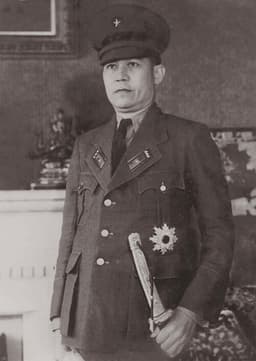
Ba Maw
Politician · Modern
44.1Total

Chimed Saikhanbileg
Politician · Modern
39.7Total
Basic Information
Born
1893
1969
Died
1977
—
Era
Modern
Modern
Nationality
Burma
Mongolia
Occupation
Politician
Politician
Civilization
Eastern
Eastern
Score Comparison
Military (10%)
14.4
10.4
Political (20%)
40.8
43.7
Influence (20%)
54.9
48.6
Legacy (20%)
43.3
37.5
Leadership (15%)
58.8
51.9
Strategy (15%)
31.9
27.6
TOTAL
44.1
39.7
Ba Maw — Complete Timeline
1937 AD
Became first premier of British BurmaPolitical Action◆ Major
Ba Maw was appointed as the first Premier of British Burma under the new constitution that separated Burma from British India. He led a government focused on self-governance and economic development, but faced challenges from both colonial authorities and nationalist factions.
PremiershipSelf-governanceColonial politics
Impact: nationalconstructive
1939 AD
Formed the Freedom BlocPolitical Action◆ Major
Ba Maw founded the Freedom Bloc, a coalition of nationalist parties demanding immediate independence from Britain. The bloc organized protests and strikes, pressuring the British government and uniting various factions under a common goal.
NationalismCoalitionIndependence movement
Impact: nationalconstructive
1942 AD
Collaborated with Japan during WWIIPolitical Action◆ Major
Ba Maw collaborated with the Japanese Imperial Army during their invasion of Burma, serving as head of the Burmese government under Japanese occupation. He declared Burma independent in 1943, but the regime was a puppet state controlled by Japan.
CollaborationJapanese occupationPuppet state
Impact: nationaldestructive
1943 AD
Declared independence under JapanPolitical Action◆ Major
Ba Maw declared Burma an independent state under Japanese sponsorship, with himself as head of state. The declaration was not recognized by the Allies and ended with Japan's defeat in 1945, leaving Ba Maw's reputation tarnished.
IndependenceJapanese sponsorshipWWII
Impact: national
1945 AD
Arrested by British after warPolitical Action
After Japan's surrender, British authorities arrested Ba Maw for collaboration. He was imprisoned but later released without trial. His political career effectively ended, and he spent his later years in obscurity.
ArrestCollaborationPost-war
Impact: nationaltragic
Chimed Saikhanbileg — Complete Timeline
2014 AD
Elected Prime Minister of MongoliaPolitical Action◆ Major
Saikhanbileg became Prime Minister in 2014, succeeding Norovyn Altankhuyag. He led a coalition government of the Democratic Party and focused on economic stabilization and attracting foreign investment.
MongoliaGovernmentCoalition
Impact: national
2015 AD
Negotiated Rio Tinto Investment AgreementPolitical Action◆ Major
As Prime Minister, Saikhanbileg negotiated a revised investment agreement with Rio Tinto for the Oyu Tolgoi copper-gold mine. The deal aimed to resolve disputes over cost overruns and revenue sharing, securing continued foreign investment in Mongolia's mining sector.
MongoliaMiningForeign Investment
Impact: nationalconstructive
2016 AD
Resigned as Prime MinisterPolitical Action◆ Major
Saikhanbileg resigned as Prime Minister in 2016 after the Democratic Party lost the parliamentary election. The Mongolian People's Party won a landslide victory, leading to a change in government.
MongoliaElectionResignation
Impact: national
This comparison has not been analyzed yet.
One-time AI generation (~1 minute). Scores and timeline are already available below.
Rankings
🥇
Ba MawLeader
Mil: 14.4Pol: 40.8Inf: 54.9
44.1
🥈
Chimed Saikhanbileg
Mil: 10.4Pol: 43.7Inf: 48.6
39.7
+4.4 behind
How This Comparison Works
Algorithm
Each figure is scored on 6 dimensions (0—100 scale) based on structured historical data: Military (10%), Political (20%), Influence (20%), Legacy (20%), Leadership (15%), Strategy (15%). The weighted total produces the final ranking.
Data Sources
Scores are computed from structured sub-indicators in the database. Scale factors adjust for era (Ancient ×0.85, Modern ×1.0) and civilization size (Eastern ×1.05, Other ×0.80) to account for differences in population and military scale.
Maximum 3 Figures
Comparisons are limited to 2—3 figures to ensure readability and statistical meaningfulness.
Error Margins
±5 points per dimension — Sub-scores are derived from historical records with inherent uncertainty. Two figures within 5 points on a dimension should be considered roughly equivalent in that area.
Total Score Accuracy
±3 points overall — The weighted combination of 6 dimensions produces a total score with approximately ±3 points of uncertainty. Differences of less than 3 points are not statistically significant— the figures are effectively tied.
Known Limitations
- Historical records are incomplete and uneven across civilizations
- Figures from oral-tradition societies may be underrepresented
- Occupation labels can misclassify multi-role figures
- Scores measure capability and impact, not moral character
- Quantitative scoring is a comparison tool, not absolute truth
Capability Radar
Military (10%) — Battles & Warfare
Battles
13
13
Win Rate
18
19
Expansion
20
23
Political (20%) — Governance & Reform
Reform
30
30
Diplomacy
45
40
Economy
20
35
Influence (20%) — Cultural & Global Reach
Cultural
20
10
Global
20
20
Legacy (20%) — Historical Impact
Historical
25
15
Longevity
15
10
Leadership (15%) — Power & Stability
Tenure
40
20
Stability
15
25
Strategy (15%) — Tactics & Innovation
Strategy
23
24
Tactics
25
28
Reform
32
30
Similar Comparisons
Comments & Discussion
No comments yet. Be the first to share your thoughts!