Loading...
Aung San Suu Kyi vs Buddhadeb Bhattacharjee
Aung San Suu Kyi leads by 4.8 pts · 2 figures compared
…
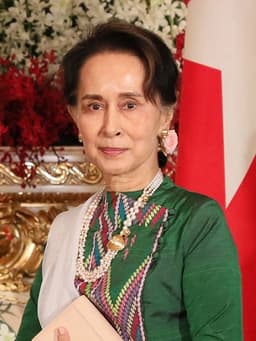
Aung San Suu Kyi
Politician · Modern
48.4Total

Buddhadeb Bhattacharjee
Politician · Modern
43.6Total
Basic Information
Born
1945
1944
Died
—
—
Era
Modern
Modern
Nationality
Myanmar
India
Occupation
Politician
Politician
Civilization
Eastern
Indian
Score Comparison
Military (10%)
15.3
15.3
Political (20%)
46.6
43.7
Influence (20%)
55.0
49.4
Legacy (20%)
54.0
40.0
Leadership (15%)
64.0
58.8
Strategy (15%)
30.6
43.0
TOTAL
48.4
43.6
Aung San Suu Kyi — Complete Timeline
1989 AD
House arrest under SLORCPolitical Action◆ Major
Aung San Suu Kyi was placed under house arrest by the State Law and Order Restoration Council (SLORC) after leading pro-democracy protests. She was offered release if she left Myanmar but refused, remaining under detention for nearly 15 years total.
House arrestPro-democracySLORC
Impact: nationaldestructive
1991 AD
Nobel Peace Prize awardCultural◆ Major
Aung San Suu Kyi was awarded the Nobel Peace Prize for her non-violent struggle for democracy and human rights in Myanmar. Her sons accepted on her behalf as she remained under house arrest.
Nobel PrizePeaceDemocracy
Impact: globalconstructive
2010 AD
Release from house arrestPolitical Action◆ Major
Aung San Suu Kyi was released from house arrest six days after Myanmar's general election. Her release followed years of international pressure and marked a turning point in Myanmar's political transition.
ReleasePolitical transitionDemocracy
Impact: nationalprogressive
2012 AD
Elected to parliamentPolitical Action◆ Major
Aung San Suu Kyi won a seat in Myanmar's parliament in by-elections, becoming an opposition MP. Her National League for Democracy party won 43 of 45 contested seats, marking her entry into formal politics.
ElectionParliamentNLD
Impact: nationalprogressive
2016 AD
Appointed State CounsellorPolitical Action◆ Major
Aung San Suu Kyi was appointed State Counsellor of Myanmar, a position created for her, effectively making her the de facto leader. The constitution barred her from the presidency due to her foreign spouse and children.
State CounsellorLeadershipConstitution
Impact: nationalconstructive
2017 AD
Rohingya genocide defensePolitical Action◆ Major
Aung San Suu Kyi defended Myanmar's military actions against the Rohingya minority at the International Court of Justice, denying genocide allegations. This stance severely damaged her international reputation as a human rights icon.
RohingyaGenocideICJHuman rights
Impact: globaldestructive
2021 AD
Detained in 2021 coupPolitical Action◆ Major
Aung San Suu Kyi was detained by Myanmar's military in a coup that overturned the 2020 election results. She was charged with multiple offenses including corruption and violating the Official Secrets Act, leading to long prison sentences.
CoupDetentionMilitaryElection
Impact: nationaltragic
Buddhadeb Bhattacharjee — Complete Timeline
2000 AD
Became Chief Minister of West BengalPolitical Action◆ Major
Buddhadeb Bhattacharjee was sworn in as the Chief Minister of West Bengal, succeeding Jyoti Basu. He led the Communist Party of India (Marxist) government and focused on industrialization and economic reforms.
Chief MinisterWest BengalCPI(M)
Impact: regionalconstructive
2006 AD
Singur and Nandigram land acquisition controversiesPolitical Action
Bhattacharjee's government attempted to acquire agricultural land for industrial projects in Singur and Nandigram, leading to violent protests. The controversies resulted in deaths, political backlash, and the eventual withdrawal of the Tata Nano project from Singur.
Land AcquisitionIndustrializationProtests
Impact: regionaldestructive
2011 AD
Defeat in the 2011 West Bengal electionsPolitical Action
Bhattacharjee's CPI(M) suffered a historic defeat in the 2011 West Bengal assembly elections, ending 34 years of Left Front rule. The Trinamool Congress under Mamata Banerjee won a landslide victory, marking a major political shift.
Election DefeatWest BengalLeft Front
Impact: regionaltragic
2014 AD
Retirement from active politicsPolitical Action
After the 2014 general elections, Bhattacharjee retired from active politics, citing health reasons. He remained a respected figure within the CPI(M) but did not hold any further public office.
RetirementCPI(M)Politics
Impact: regional
Expert Analysis
Origins
Aung San Suu Kyi was born on June 19, 1945, in Rangoon, British Burma, the daughter of General Aung San, the architect of Burmese independence, who was assassinated when she was two. Her mother, Khin Kyi, served as a diplomat. Suu Kyi studied at the University of Delhi and at St Hugh's College, Oxford, earning a degree in philosophy, politics, and economics. She later worked at the United Nations in New York. Her early life was shaped by her father's legacy and exposure to democratic ideals abroad.
Buddhadeb Bhattacharjee was born on March 1, 1944, in North Calcutta, British India, into a middle-class Bengali family. His father, Nirmal Kumar Bhattacharjee, was a journalist. He studied at the University of Calcutta, earning a bachelor's degree in Bengali literature. He joined the Communist Party of India (Marxist) in 1966, influenced by Marxist ideology and the Naxalite movement. His early years were marked by political activism and party work.
Rise to Power
Aung San Suu Kyi rose to prominence in 1988 during the 8888 Uprising, when she gave speeches calling for democracy. She co-founded the National League for Democracy (NLD) and became its general secretary. In the 1990 general election, the NLD won 82% of seats, but the military junta (SLORC) refused to hand over power and placed her under house arrest. Her detention turned her into an international symbol of peaceful resistance. She was awarded the Nobel Peace Prize in 1991, accepted by her sons. After years of negotiations and international pressure, she was released in 2010. In 2012, she won a by-election and entered parliament. In 2016, after the NLD's landslide victory, she became State Counsellor, the de facto leader, despite being barred from the presidency by the constitution.
Buddhadeb Bhattacharjee rose through the ranks of the CPI(M) in West Bengal. He served as a minister in Jyoti Basu's cabinet, holding portfolios like Information and Culture. In 2000, he succeeded Basu as Chief Minister of West Bengal. He was known for his intellectual bent and efforts to reform the state's economy, promoting industrialization and foreign investment. His rise was marked by his role in the Left Front's long rule, which lasted 34 years from 1977.
Leadership & Governance
Aung San Suu Kyi's leadership was defined by her commitment to non-violence and democracy. She advocated for dialogue with the military, but her governance was criticized for its slow pace of reform and failure to address human rights abuses, particularly against the Rohingya minority. Her political score is 46.6, reflecting her moral authority but limited administrative impact. She faced international backlash for defending the military's actions in Rakhine State, damaging her legacy.
Buddhadeb Bhattacharjee pursued a pragmatic communist approach, seeking to attract industry while maintaining socialist policies. His government's land acquisition for the Tata Nano plant in Singur and chemical hub in Nandigram led to violent protests, culminating in the 2007 Nandigram massacre, where police fired on demonstrators, killing 14. This tarnished his image and contributed to his party's defeat in 2011. His leadership score is 58.8, reflecting his administrative skills but flawed execution.
Triumph & Tragedy
Aung San Suu Kyi's greatest triumph was her non-violent struggle for democracy, winning the Nobel Peace Prize and becoming a global icon. She successfully transitioned Myanmar from military rule to a quasi-civilian government. However, her failure to defend the Rohingya during the 2017 genocide, when over 700,000 fled to Bangladesh, is her greatest tragedy. Her influence score is 55.0, but her legacy has been severely damaged.
Buddhadeb Bhattacharjee's triumph was his effort to modernize West Bengal's economy, bringing IT companies and industrial investment. He also maintained the Left Front's social welfare programs. His tragedy was the land acquisition crises, which sparked violence and led to the end of 34 years of communist rule. His legacy score is 40.0, reflecting his mixed record.
Character & Destiny
Aung San Suu Kyi is characterized by her stoicism and moral certainty, but also by a stubbornness that isolated her from critics. Her destiny was shaped by her father's legacy and the military's opposition. She scored 64.0 in leadership, indicating her ability to inspire, but her strategy score of 30.6 shows her failure to navigate complex political realities.
Buddhadeb Bhattacharjee was an introspective, bookish leader, admired for his integrity but criticized for his aloofness. His decision to push industrialization without adequate consultation led to his downfall. His strategy score of 43.0 reflects his miscalculations.
Legacy
Aung San Suu Kyi's legacy is deeply contested: she remains a symbol of resistance for many, but her complicity in the Rohingya crisis has led to calls to revoke her Nobel Prize. Her total score of 48.4 reflects her high influence but tarnished reputation.
Buddhadeb Bhattacharjee is remembered as the last communist chief minister of West Bengal, who oversaw the decline of the Left Front. His legacy is one of economic ambition undone by political violence. His total score is 43.6.
Conclusion
Aung San Suu Kyi had greater global impact and a higher total score (48.4 vs 43.6), but her legacy is marred by the Rohingya tragedy. Bhattacharjee's impact was limited to West Bengal. Suu Kyi's influence on democracy movements worldwide outweighs Bhattacharjee's regional significance, making her the more consequential figure despite her failures.
Rankings
🥇
Aung San Suu KyiLeader
Mil: 15.3Pol: 46.6Inf: 55.0
48.4
🥈
Buddhadeb Bhattacharjee
Mil: 15.3Pol: 43.7Inf: 49.4
43.6
+4.8 behind
How This Comparison Works
Algorithm
Each figure is scored on 6 dimensions (0—100 scale) based on structured historical data: Military (10%), Political (20%), Influence (20%), Legacy (20%), Leadership (15%), Strategy (15%). The weighted total produces the final ranking.
Data Sources
Scores are computed from structured sub-indicators in the database. Scale factors adjust for era (Ancient ×0.85, Modern ×1.0) and civilization size (Eastern ×1.05, Other ×0.80) to account for differences in population and military scale.
Maximum 3 Figures
Comparisons are limited to 2—3 figures to ensure readability and statistical meaningfulness.
Error Margins
±5 points per dimension — Sub-scores are derived from historical records with inherent uncertainty. Two figures within 5 points on a dimension should be considered roughly equivalent in that area.
Total Score Accuracy
±3 points overall — The weighted combination of 6 dimensions produces a total score with approximately ±3 points of uncertainty. Differences of less than 3 points are not statistically significant— the figures are effectively tied.
Known Limitations
- Historical records are incomplete and uneven across civilizations
- Figures from oral-tradition societies may be underrepresented
- Occupation labels can misclassify multi-role figures
- Scores measure capability and impact, not moral character
- Quantitative scoring is a comparison tool, not absolute truth
Capability Radar
Military (10%) — Battles & Warfare
Battles
13
24
Win Rate
19
27
Expansion
18
27
Political (20%) — Governance & Reform
Reform
40
40
Diplomacy
55
35
Economy
20
30
Influence (20%) — Cultural & Global Reach
Cultural
65
20
Global
65
15
Legacy (20%) — Historical Impact
Historical
60
25
Longevity
55
15
Leadership (15%) — Power & Stability
Tenure
60
30
Stability
15
25
Strategy (15%) — Tactics & Innovation
Strategy
21
35
Tactics
26
37
Reform
32
39
Similar Comparisons
Comments & Discussion
No comments yet. Be the first to share your thoughts!