Loading...
Ashurbanipal vs Euric
Ashurbanipal leads by 12.5 pts · 2 figures compared
…

Ashurbanipal
Emperor · Ancient
65.4Total
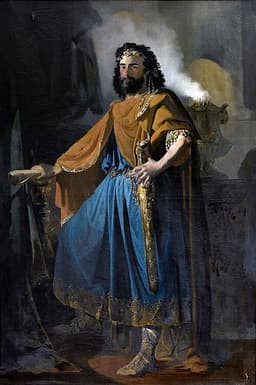
Euric
Emperor · Ancient
52.9Total
Basic Information
Born
-685
415
Died
-627
484
Era
Ancient
Ancient
Nationality
Assyria
Visigothic Kingdom
Occupation
Emperor
Emperor
Civilization
Middle Eastern
Western
Score Comparison
Military (10%)
78.0
47.5
Political (20%)
60.0
68.0
Influence (20%)
82.0
56.4
Legacy (20%)
40.0
48.3
Leadership (15%)
80.0
40.0
Strategy (15%)
61.2
57.5
TOTAL
65.4
52.9
Ashurbanipal — Complete Timeline
652 BC
Suppression of the Babylonian revolt (652-648 BC)War◆ Major
Ashurbanipal suppressed a major revolt in Babylon led by his brother Shamash-shum-ukin. The rebellion lasted four years and ended with the siege and capture of Babylon. Shamash-shum-ukin died in the palace fire. This victory solidified Ashurbanipal's control over Babylonia.
BabylonRevoltCivil War
Impact: regionaldestructive
650 BC
Construction of the Library of NinevehCultural◆ Major
Ashurbanipal assembled a vast library at Nineveh containing over 30,000 cuneiform tablets. The library included literary, religious, scientific, and administrative texts from across Mesopotamia. This collection preserved much of ancient Mesopotamian literature, including the Epic of Gilgamesh.
LibraryLiteraturePreservation
Impact: globalconstructive
Patronage of arts and scholarshipCultural◆ Major
Ashurbanipal was a patron of the arts and scholarship, and he personally collected and studied cuneiform tablets. He boasted of his ability to read and write in multiple languages. His library and patronage made Nineveh a center of learning in the ancient Near East.
ScholarshipPatronageLearning
Impact: regionalconstructive
647 BC
Conquest of ElamWar◆ Major
Ashurbanipal launched a devastating campaign against Elam, destroying the capital Susa and other cities. The Elamite kingdom was effectively annihilated, and its territory was incorporated into the Assyrian Empire. This conquest removed a major rival and secured Assyrian dominance in the region.
ElamConquestDestruction
Impact: regionaldestructive
640 BC
Campaign against the ArabsWar
Ashurbanipal conducted a military campaign against Arab tribes in the Syrian desert. The campaign aimed to secure trade routes and suppress raids. Several Arab leaders were captured and brought to Nineveh. This campaign extended Assyrian influence into the Arabian Peninsula.
ArabsCampaignTrade
Impact: regional
Euric — Complete Timeline
466 AD
Accession as Visigothic KingPolitical Action◆ Major
Euric became king of the Visigoths after assassinating his brother Theodoric II. His reign marked the beginning of Visigothic expansion and independence from the Western Roman Empire, as he consolidated power in Gaul and Hispania.
Visigothic KingdomSuccessionExpansion
Impact: regional
475 AD
Conquest of AuvergneWar◆ Major
Euric's forces besieged and captured the city of Clermont in Auvergne, a key stronghold of the Gallo-Roman aristocracy. This conquest extended Visigothic control over much of southern Gaul, weakening the remaining Roman authority in the region.
Visigothic KingdomConquestGaul
Impact: regional
Codification of the Code of EuricReform
Euric issued the Code of Euric, the first written law code of the Germanic peoples. It compiled Roman and Germanic legal traditions, governing both Visigoths and Romans in his kingdom. This code influenced later Visigothic legislation and legal development in early medieval Europe.
Visigothic KingdomLaw CodeLegal History
Impact: regionalconstructive
476 AD
Treaty with the Eastern Roman EmpirePolitical Action◆ Major
Euric negotiated a treaty with the Eastern Roman Emperor Zeno, which recognized Visigothic control over most of Gaul and Hispania. This formalized the Visigothic Kingdom as an independent state, ending any nominal allegiance to the Roman Empire.
Visigothic KingdomDiplomacyIndependence
Impact: regionalconstructive
Expert Analysis
Origins
Ashurbanipal (born c. 685 BC) was the last great king of the Neo-Assyrian Empire, inheriting a vast realm from his father Esarhaddon. He was educated in the royal court of Nineveh, where he learned to read and write cuneiform, a rare skill among rulers. His family background was steeped in military and administrative tradition, with his father having conquered Egypt. Euric (c. 420–484 AD) was a Visigothic king, born into the royal line of the Thervingi Goths. He grew up during the period of Visigothic settlement in Gaul, after the collapse of the Western Roman Empire. Little is known of his early education, but he was likely trained in warfare and diplomacy. His brother Theodoric II preceded him as king.
Rise to Power
Ashurbanipal ascended the throne in 669 BC after his father's death, but faced immediate challenges. His brother Shamash-shum-ukin was appointed king of Babylon, leading to tension. Ashurbanipal's rise was secured through a series of military campaigns, including a brutal suppression of a revolt in Egypt. He solidified his power by crushing a rebellion in Babylon (652-648 BC) led by his brother, which ended with the siege and destruction of Babylon. Euric rose to power in 466 AD by assassinating his brother Theodoric II, an act that marked the beginning of his independent rule. He then expanded Visigothic territory through a series of conquests, notably capturing the city of Clermont in Auvergne in 475 AD. His rise was less about internal consolidation and more about external expansion, exploiting the weakness of the Roman Empire.
Leadership & Governance
Ashurbanipal's leadership was characterized by military might and cultural patronage. He personally led campaigns, such as the conquest of Elam (c. 647 BC), where he destroyed Susa. His governance relied on a centralized bureaucracy and terror tactics, such as deporting rebellious populations. He also promoted arts and scholarship, assembling a library of over 30,000 cuneiform tablets at Nineveh. Euric's leadership focused on legal and political consolidation. He issued the Code of Euric, the first written law code of the Germanic peoples, blending Roman and Germanic traditions. This code governed both Visigoths and Romans, stabilizing his realm. Euric also negotiated a treaty with Eastern Roman Emperor Zeno in 475 AD, gaining recognition of Visigothic control over most of Gaul and Hispania. While Ashurbanipal ruled through fear and cultural prestige, Euric used law and diplomacy to integrate diverse populations.
Triumph & Tragedy
Ashurbanipal's greatest triumph was the creation of the Library of Nineveh, which preserved Mesopotamian literature, including the Epic of Gilgamesh. His military campaigns, especially the annihilation of Elam, extended Assyrian dominance. However, his greatest failure was the inability to prevent the empire's collapse after his death. The Assyrian Empire fell within decades due to internal strife and external attacks. Euric's triumph was the codification of the Code of Euric, which influenced later Germanic law and provided a model for governance. His conquests expanded Visigothic territory to its greatest extent. Yet, his failure was the lack of a stable succession; after his death, the Visigothic kingdom faced internal divisions and eventually fell to the Franks. Both leaders succeeded in their immediate goals but failed to create lasting institutions.
Character & Destiny
Ashurbanipal was known for his intellectual curiosity and cruelty. He boasted of his ability to read and write, but also of the brutal punishments he inflicted on rebels. His character combined a scholar's mind with a ruthless warrior's spirit. This duality shaped his destiny: his patronage of learning ensured his legacy, but his harshness sowed resentment that weakened the empire. Euric was pragmatic and ambitious, willing to kill his brother to gain power. He was a skilled diplomat, securing recognition from the Eastern Roman Empire. His character was more that of a lawgiver than a conqueror, focused on building a stable state. However, his reliance on personal authority rather than institutional structures meant his achievements were fragile. Historians assess Ashurbanipal as the last great Assyrian king, while Euric is seen as a founder of Visigothic legal identity.
Legacy
Ashurbanipal's legacy is most visible in the Library of Nineveh, whose tablets provide invaluable insights into ancient Mesopotamian culture. His military campaigns, however, did not prevent the empire's collapse, and his name is less known than that of earlier Assyrian kings. His influence score of 82.0 reflects the library's impact, but his legacy score of 40.0 indicates the ephemeral nature of his empire. Euric's Code of Euric had a lasting impact on Germanic law, influencing later codes like the Visigothic Code. His conquests established the Visigothic kingdom as a major power in post-Roman Europe. His legacy score of 48.3 is modest but solid, as his legal reforms outlasted his dynasty. The Eastern Roman recognition of his rule set a precedent for barbarian kingdoms.
Conclusion
Ashurbanipal scored 65.4 overall, with high military (78.0) and influence (82.0) scores, while Euric scored 52.9, with his highest in political (68.0) and legacy (48.3). The 12.5-point gap reflects Ashurbanipal's greater immediate impact, but his legacy is more tied to cultural preservation than political continuity. Euric's legal code had a more direct and enduring influence on European legal traditions. However, taking a clear stance: Ashurbanipal had greater impact because his library preserved knowledge that shaped modern understanding of ancient civilizations, while Euric's code, though important, was eventually superseded. Ashurbanipal's influence transcends his empire's fall, making him the more significant figure.
Rankings
🥇
AshurbanipalLeader
Mil: 78.0Pol: 60.0Inf: 82.0
65.4
🥈
Euric
Mil: 47.5Pol: 68.0Inf: 56.4
52.9
+12.5 behind
How This Comparison Works
Algorithm
Each figure is scored on 6 dimensions (0—100 scale) based on structured historical data: Military (10%), Political (20%), Influence (20%), Legacy (20%), Leadership (15%), Strategy (15%). The weighted total produces the final ranking.
Data Sources
Scores are computed from structured sub-indicators in the database. Scale factors adjust for era (Ancient ×0.85, Modern ×1.0) and civilization size (Eastern ×1.05, Other ×0.80) to account for differences in population and military scale.
Maximum 3 Figures
Comparisons are limited to 2—3 figures to ensure readability and statistical meaningfulness.
Error Margins
±5 points per dimension — Sub-scores are derived from historical records with inherent uncertainty. Two figures within 5 points on a dimension should be considered roughly equivalent in that area.
Total Score Accuracy
±3 points overall — The weighted combination of 6 dimensions produces a total score with approximately ±3 points of uncertainty. Differences of less than 3 points are not statistically significant— the figures are effectively tied.
Known Limitations
- Historical records are incomplete and uneven across civilizations
- Figures from oral-tradition societies may be underrepresented
- Occupation labels can misclassify multi-role figures
- Scores measure capability and impact, not moral character
- Quantitative scoring is a comparison tool, not absolute truth
Capability Radar
Military (10%) — Battles & Warfare
Battles
75
45
Win Rate
80
50
Expansion
70
50
Political (20%) — Governance & Reform
Reform
65
75
Diplomacy
70
55
Economy
75
50
Influence (20%) — Cultural & Global Reach
Cultural
85
55
Global
75
45
Legacy (20%) — Historical Impact
Historical
90
60
Longevity
85
50
Leadership (15%) — Power & Stability
Tenure
85
60
Stability
70
55
Strategy (15%) — Tactics & Innovation
Strategy
75
50
Tactics
70
40
Reform
60
55
Similar Comparisons
Comments & Discussion
No comments yet. Be the first to share your thoughts!