Loading...
Aristotle vs Augustine of Hippo
Aristotle leads by 2.7 pts · 2 figures compared
…
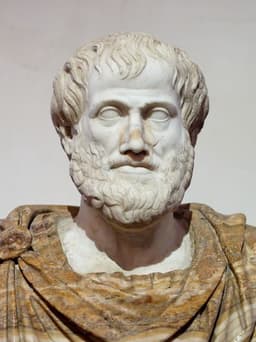
Aristotle
Philosopher · Ancient
59.3Total

Augustine of Hippo
Philosopher · Ancient
56.6Total
Basic Information
Born
-384
354
Died
-322
430
Era
Ancient
Ancient
Nationality
Greece
Roman Empire
Occupation
Philosopher
Philosopher
Civilization
Western
Western
Score Comparison
Military (10%)
8.8
9.0
Political (20%)
35.0
32.9
Influence (20%)
92.0
80.0
Legacy (20%)
87.0
87.0
Leadership (15%)
27.2
31.8
Strategy (15%)
43.6
42.2
TOTAL
59.3
56.6
Aristotle — Complete Timeline
350 BC
Development of Formal LogicInvention
Aristotle developed the first formal system of logic, including syllogistic logic, in his work 'Organon'. He identified the rules of valid reasoning, such as the syllogism, which became the foundation of Western logic for over two millennia.
LogicPhilosophyScience
Impact: globalprogressive
343 BC
Tutoring Alexander the GreatCultural◆ Major
Philip II of Macedon invited Aristotle to tutor his son Alexander. Aristotle taught Alexander for several years, instilling in him an interest in Greek culture, science, and philosophy. This relationship influenced Alexander's later policies of Hellenization in his conquered territories.
EducationMentorshipHellenization
Impact: globalconstructive
340 BC
Publication of 'Nicomachean Ethics'Cultural◆ Major
Aristotle wrote the 'Nicomachean Ethics', a treatise on virtue ethics. He argued that the highest good is eudaimonia (flourishing) achieved through virtuous activity and practical wisdom. This work became a cornerstone of Western moral philosophy.
EthicsPhilosophyVirtue
Impact: globalconstructive
335 BC
Founding of the LyceumCultural◆ Major
Aristotle founded the Lyceum, a school in Athens dedicated to philosophical and scientific research. He established a library and organized systematic studies across disciplines. The Lyceum became a major center of learning, rivaling Plato's Academy.
SchoolPhilosophyResearch
Impact: globalconstructive
323 BC
Departure from AthensPolitical Action
After Alexander's death, anti-Macedonian sentiment rose in Athens. Aristotle, associated with Macedon, left the city to avoid persecution, saying he would not allow Athens to 'sin twice against philosophy' (referring to Socrates' execution). He died in exile in Chalcis.
ExilePoliticsPhilosophy
Augustine of Hippo — Complete Timeline
386 AD
Conversion to ChristianityCultural
Augustine of Hippo converted to Christianity in Milan, influenced by Bishop Ambrose and his mother Monica. This conversion, described in his *Confessions*, ended his earlier Manichaean beliefs and set him on a path to becoming a leading Church Father.
ConversionChristianityChurch Father
Impact: globalconstructive
393 AD
Council of HippoCultural◆ Major
Augustine of Hippo participated in the Council of Hippo, which helped define the biblical canon for the Western Church. His influence contributed to the acceptance of certain books and the rejection of others, standardizing Christian scripture.
CouncilBibleCanon
Impact: globalconstructive
398 AD
Confessions PublishedCultural◆ Major
Augustine of Hippo published *Confessions*, an autobiographical work detailing his spiritual journey and conversion. The book explored themes of sin, grace, and divine providence, becoming a foundational text in Western Christian theology and literature.
BookTheologyAutobiography
Impact: globalconstructive
426 AD
City of God PublishedCultural
Augustine of Hippo completed *City of God*, a major theological work written in response to the sack of Rome in 410. It contrasted the earthly city with the heavenly city, shaping Christian views on history, politics, and the relationship between church and state.
BookTheologyPhilosophy of History
Impact: globalconstructive
430 AD
Siege of Hippo RegiusWar◆ Major
Augustine of Hippo died during the Siege of Hippo Regius by the Vandals under King Genseric. The siege marked the decline of Roman North Africa, and Augustine's death occurred as his city was under attack, symbolizing the end of an era.
SiegeVandalsDeath
Impact: regionaltragic
Expert Analysis
Origins
Aristotle was born in 384 BCE in Stagira, a Greek colony in Macedonia. His father, Nicomachus, was court physician to King Amyntas of Macedon, providing Aristotle with early exposure to biology and medicine. At age 17, he moved to Athens to study at Plato's Academy, where he remained for 20 years until Plato's death. Aristotle's departure from the Academy in 347 BCE marked a shift from Platonic idealism toward empirical investigation.
Augustine of Hippo was born in 354 CE in Thagaste, Roman North Africa (modern Algeria). His father, Patricius, was a pagan minor official; his mother, Monica, was a devout Christian. Augustine received a classical Latin education in rhetoric, studying in Carthage. He lived with a concubine for 15 years, fathering a son, Adeodatus. His early intellectual journey included Manichaeism, skepticism, and Neoplatonism before his conversion to Christianity in 386 CE.
Rise to Power
Aristotle rose to prominence through his association with the Macedonian court. In 343 BCE, Philip II invited him to tutor his son Alexander, then 13. This position gave Aristotle access to resources and political connections. After Alexander's accession, Aristotle returned to Athens in 335 BCE and founded the Lyceum, a school that rivaled Plato's Academy. The Lyceum's systematic approach to research attracted students and established Aristotle as the leading philosopher of his time.
Augustine rose to prominence through his intellectual and ecclesiastical career. He became a professor of rhetoric in Milan, where he encountered Bishop Ambrose. His conversion in 386 CE led to his baptism and return to North Africa. Ordained a priest in 391 CE, he became Bishop of Hippo in 395 CE. His prolific writings and defense of orthodox Christianity against heresies like Donatism and Pelagianism made him the most influential theologian in the Latin West.
Leadership & Governance
Aristotle's leadership was intellectual and institutional. At the Lyceum, he organized research across disciplines: logic, physics, biology, ethics, politics, and poetics. He compiled a vast library and supervised systematic investigations, such as the classification of animals. His governance philosophy, outlined in *Politics*, advocated for a mixed constitution balancing monarchy, aristocracy, and democracy. He believed the middle class should rule to avoid extremes of oligarchy and democracy.
Augustine's leadership was pastoral and theological. As Bishop of Hippo, he managed church affairs, preached regularly, and adjudicated disputes. His governance style was authoritative but pastoral, emphasizing unity and orthodoxy. In *City of God*, he developed a political theology that distinguished the earthly city (focused on self-love) from the heavenly city (focused on love of God). This framework influenced medieval church-state relations, though Augustine did not advocate for direct church rule.
Triumph & Tragedy
Aristotle's greatest triumph was the creation of a comprehensive philosophical system that dominated Western thought for over two millennia. His logic, especially syllogistic logic, remained the standard until the 19th century. His ethics of virtue and the golden mean influenced moral philosophy. His biological works were unsurpassed until the Renaissance. However, his tragedy was the loss of most of his writings after his death; only about one-third of his works survived, preserved by Arab scholars and later rediscovered in the West.
Augustine's greatest triumph was the articulation of Christian theology that shaped Western Christianity. His *Confessions* pioneered the introspective autobiography, and *City of God* provided a Christian philosophy of history. His doctrines of original sin, divine grace, and predestination were foundational for later theologians like Aquinas and Calvin. His tragedy was witnessing the collapse of Roman North Africa. He died in 430 CE as the Vandals besieged Hippo, symbolizing the end of an era.
Character & Destiny
Aristotle was systematic, empirical, and rational. He trusted observation and logical analysis over mystical insight. His personality was methodical; he collected data, categorized phenomena, and sought causes. This character led him to found multiple sciences and create a comprehensive worldview. His destiny was to become "the Philosopher" in medieval Europe, whose authority was nearly unquestioned.
Augustine was introspective, passionate, and dialectical. His *Confessions* reveals a man tormented by sin and driven by a search for truth. He combined Neoplatonic philosophy with Christian faith, creating a synthesis that emphasized inner experience and divine grace. His destiny was to become the most influential theologian in the Latin Church, whose ideas on sin and grace sparked debates for centuries.
Legacy
Aristotle's legacy is immense in philosophy, science, and logic. His influence score of 92.0 reflects his impact on fields from biology to political theory. His logic was unchallenged until the 19th century. His ethical framework remains a cornerstone of virtue ethics. His political theory influenced thinkers from Aquinas to the Founding Fathers. The Lyceum model of research institutions presaged modern universities.
Augustine's legacy is equally profound in theology and philosophy. His influence score of 80.0 reflects his shaping of Western Christianity. His *City of God* provided a template for Christian engagement with secular society. His doctrines of original sin and grace became central to Protestant and Catholic traditions. His *Confessions* influenced the genre of autobiography and psychological introspection.
Conclusion
While both figures left indelible marks, Aristotle's overall impact is greater. His total score of 59.3 versus Augustine's 56.6 reflects his broader range of contributions across multiple disciplines. Aristotle founded logic as a formal system, pioneered empirical biology, and established ethical and political frameworks that remain relevant. Augustine's contributions, though transformative for Christianity, are more confined to theology and religious psychology. Aristotle's work is essential for understanding Western thought, science, and philosophy; Augustine's is essential for understanding Western Christianity. On balance, Aristotle's intellectual empire encompasses more of human knowledge, making him the more impactful figure.
Rankings
🥇
AristotleLeader
Mil: 8.8Pol: 35.0Inf: 92.0
59.3
🥈
Augustine of Hippo
Mil: 9.0Pol: 32.9Inf: 80.0
56.6
+2.7 behind
How This Comparison Works
Algorithm
Each figure is scored on 6 dimensions (0—100 scale) based on structured historical data: Military (10%), Political (20%), Influence (20%), Legacy (20%), Leadership (15%), Strategy (15%). The weighted total produces the final ranking.
Data Sources
Scores are computed from structured sub-indicators in the database. Scale factors adjust for era (Ancient ×0.85, Modern ×1.0) and civilization size (Eastern ×1.05, Other ×0.80) to account for differences in population and military scale.
Maximum 3 Figures
Comparisons are limited to 2—3 figures to ensure readability and statistical meaningfulness.
Error Margins
±5 points per dimension — Sub-scores are derived from historical records with inherent uncertainty. Two figures within 5 points on a dimension should be considered roughly equivalent in that area.
Total Score Accuracy
±3 points overall — The weighted combination of 6 dimensions produces a total score with approximately ±3 points of uncertainty. Differences of less than 3 points are not statistically significant— the figures are effectively tied.
Known Limitations
- Historical records are incomplete and uneven across civilizations
- Figures from oral-tradition societies may be underrepresented
- Occupation labels can misclassify multi-role figures
- Scores measure capability and impact, not moral character
- Quantitative scoring is a comparison tool, not absolute truth
Capability Radar
Military (10%) — Battles & Warfare
Battles
17
14
Win Rate
16
20
Expansion
18
22
Political (20%) — Governance & Reform
Reform
30
20
Diplomacy
20
25
Economy
20
10
Influence (20%) — Cultural & Global Reach
Cultural
95
95
Global
95
90
Legacy (20%) — Historical Impact
Historical
95
95
Longevity
95
95
Leadership (15%) — Power & Stability
Tenure
10
30
Stability
10
15
Strategy (15%) — Tactics & Innovation
Strategy
21
22
Tactics
28
26
Reform
30
27
Similar Comparisons
Comments & Discussion
No comments yet. Be the first to share your thoughts!