Loading...
Ariel Sharon vs Miguel Primo de Rivera
Ariel Sharon leads by 2.4 pts · 2 figures compared
…
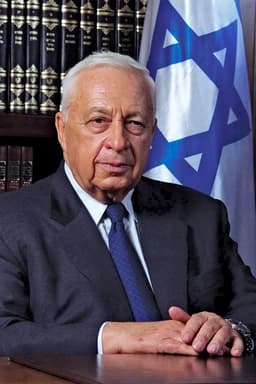
Ariel Sharon
General · Modern
58.3Total

Miguel Primo de Rivera
General · Modern
55.9Total
Basic Information
Born
1928
1870
Died
—
1930
Era
Modern
Modern
Nationality
Israel
Spain
Occupation
General
General
Civilization
Middle Eastern
Western
Score Comparison
Military (10%)
67.3
50.0
Political (20%)
45.0
68.0
Influence (20%)
56.7
59.0
Legacy (20%)
54.0
49.2
Leadership (15%)
68.0
62.0
Strategy (15%)
69.1
43.3
TOTAL
58.3
55.9
Ariel Sharon — Complete Timeline
1982 AD
Command of the 1982 Lebanon WarWar◆ Major
As Minister of Defense, Sharon directed the Israeli invasion of Lebanon to expel the PLO. The war led to the Sabra and Shatila massacre, for which an Israeli commission found Sharon indirectly responsible, forcing his resignation as defense minister.
Lebanon WarSabra and ShatilaMilitary Campaign
Impact: regionaldestructive
2001 AD
Election as Prime MinisterPolitical Action◆ Major
Sharon was elected prime minister of Israel in a special election, defeating Ehud Barak. His victory came during the Second Intifada, and he adopted a hardline security policy, including military operations in Palestinian areas.
ElectionSecond IntifadaSecurity Policy
Impact: national
2005 AD
Disengagement from GazaPolitical Action◆ Major
Sharon implemented the unilateral disengagement plan, withdrawing all Israeli settlers and military forces from the Gaza Strip and dismantling four settlements in the West Bank. The move was controversial within Israel but internationally supported.
Gaza WithdrawalSettlementsUnilateral Action
Impact: regionalconstructive
Miguel Primo de Rivera — Complete Timeline
1923 AD
Led the 1923 Coup d'ÉtatPolitical Action
Primo de Rivera, as Captain General of Catalonia, led a military coup on September 13, 1923, with the support of King Alfonso XIII. He suspended the 1876 Constitution, dissolved parliament, and established a military dictatorship, ending the Restoration system.
CoupDictatorshipEnd of Restoration
Impact: nationaldestructive
1924 AD
Created the Patriotic Union PartyPolitical Action
Primo de Rivera founded the Uni
Political PartyDictatorshipMobilization
Impact: national
1925 AD
Ended the Rif War with the Alhucemas LandingWar◆ Major
Primo de Rivera personally commanded the Alhucemas landing, a joint Spanish-French amphibious operation in Morocco. This decisive victory broke the back of the Rifian rebellion led by Abd el-Krim, ending the costly Rif War and securing Spanish colonial interests.
Rif WarMilitary CampaignMorocco
Impact: regionalconstructive
1930 AD
Resigned Under PressurePolitical Action◆ Major
Facing growing opposition from the military, intellectuals, and republicans, Primo de Rivera resigned on January 28, 1930. He went into exile in Paris, where he died shortly after, leaving Spain in political crisis that led to the fall of the monarchy.
ResignationExilePolitical Crisis
Impact: nationaltragic
Expert Analysis
Origins
Ariel Sharon was born on February 26, 1928, in Kfar Malal, a moshav in British Mandatory Palestine. His parents, Shmuel and Vera Scheinerman, were immigrants from Russia. Sharon grew up in a farming community, learning agricultural skills and developing a strong connection to the land. He joined the Haganah, the Jewish paramilitary organization, at age 14 and later studied at the Hebrew University of Jerusalem.
Miguel Primo de Rivera was born on January 8, 1870, in Jerez de la Frontera, Spain, into a military family. His father was a colonel, and his uncle was a general. He attended the General Military Academy in Toledo and later served in the Spanish army in Morocco, Cuba, and the Philippines. His early career was marked by rapid promotion due to family connections and his own competence.
Rise to Power
Sharon's rise came through military excellence. He commanded Unit 101, a special forces unit, in the 1950s, and led the paratroopers in the 1956 Suez Crisis. He became a major general in 1969, commanding the Southern Command during the War of Attrition. His political career began after the Yom Kippur War, when he criticized the government's preparedness. He joined the Likud party and held ministerial positions under Menachem Begin. His key turning point was his election as prime minister in 2001, defeating Ehud Barak during the Second Intifada.
Primo de Rivera rose through military ranks, becoming Captain General of Catalonia in 1922. On September 13, 1923, he led a coup d'état with the support of King Alfonso XIII, suspending the constitution and establishing a dictatorship. His political score of 68.0 reflects his ability to seize and consolidate power, but his military score of 50.0 indicates less combat command than Sharon's 67.3.
Leadership & Governance
Sharon's leadership style was aggressive and decisive. As prime minister, he shifted from supporting settlements to implementing the unilateral disengagement from Gaza in 2005, withdrawing all Israeli forces and settlers. This decision split his Likud party and led to his departure to form Kadima. His governance focused on security, responding to the Second Intifada with military operations and the construction of the West Bank barrier.
Primo de Rivera ruled as a dictator, suspending parliament and banning political parties. He created the Patriotic Union Party to mobilize support. His regime implemented public works and infrastructure projects, but suppressed dissent. He ended the Rif War in Morocco with the Alhucemas landing in 1925, a joint operation with France. However, his economic policies failed, and he faced growing opposition from intellectuals, military, and republicans, leading to his resignation in 1930.
Triumph & Tragedy
Sharon's greatest triumph was the Gaza disengagement, a bold move that reshaped Israeli politics and removed settlements from Gaza. However, his tragedy was the 1982 Lebanon War, where as defense minister he oversaw the invasion that led to the Sabra and Shatila massacre. An Israeli commission found him indirectly responsible, forcing his resignation as defense minister.
Primo de Rivera's triumph was ending the Rif War with the Alhucemas landing, a decisive victory that secured Spanish interests in Morocco. His tragedy was his failed economic management and increasing unpopularity, leading to his resignation and exile in Paris, where he died shortly after.
Character & Destiny
Sharon was known for his ruthlessness and strategic thinking. His leadership score of 68.0 reflects his ability to make tough decisions, but his political score of 45.0 indicates his divisiveness. He was a controversial figure, admired for his security policies but criticized for his role in Lebanon. His destiny was to leave a complex legacy of both war and peace.
Primo de Rivera was authoritarian but paternalistic. His strategy score of 43.3 is low, indicating poor long-term planning. He relied on military support but alienated key groups. His destiny was to be a transitional dictator whose regime paved the way for the Second Spanish Republic and eventually the Spanish Civil War.
Legacy
Sharon's legacy is mixed. He is remembered for the Gaza disengagement, which set a precedent for unilateral withdrawal, but also for the Lebanon war and Sabra and Shatila. His influence score of 56.7 reflects his impact on Israeli policy. He reshaped the Israeli right and changed the political landscape.
Primo de Rivera's legacy is also contested. His dictatorship undermined democratic institutions in Spain. His son, Jose Antonio Primo de Rivera, founded the Falange, which influenced Franco's regime. His legacy score of 49.2 is lower than Sharon's 54.0.
Conclusion
Ariel Sharon had greater impact than Miguel Primo de Rivera. Sharon's military score of 67.3 and leadership score of 68.0 exceed Primo de Rivera's 50.0 and 62.0. Sharon's Gaza disengagement had lasting consequences for the Israeli-Palestinian conflict, while Primo de Rivera's dictatorship was a temporary interruption in Spanish democracy. Sharon's total score of 58.3 is higher than Primo de Rivera's 55.9. While both were military leaders who turned to politics, Sharon's actions continue to shape the Middle East, whereas Primo de Rivera's impact is largely historical.
Rankings
🥇
Ariel SharonLeader
Mil: 67.3Pol: 45.0Inf: 56.7
58.3
🥈
Miguel Primo de Rivera
Mil: 50.0Pol: 68.0Inf: 59.0
55.9
+2.4 behind
How This Comparison Works
Algorithm
Each figure is scored on 6 dimensions (0—100 scale) based on structured historical data: Military (10%), Political (20%), Influence (20%), Legacy (20%), Leadership (15%), Strategy (15%). The weighted total produces the final ranking.
Data Sources
Scores are computed from structured sub-indicators in the database. Scale factors adjust for era (Ancient ×0.85, Modern ×1.0) and civilization size (Eastern ×1.05, Other ×0.80) to account for differences in population and military scale.
Maximum 3 Figures
Comparisons are limited to 2—3 figures to ensure readability and statistical meaningfulness.
Error Margins
±5 points per dimension — Sub-scores are derived from historical records with inherent uncertainty. Two figures within 5 points on a dimension should be considered roughly equivalent in that area.
Total Score Accuracy
±3 points overall — The weighted combination of 6 dimensions produces a total score with approximately ±3 points of uncertainty. Differences of less than 3 points are not statistically significant— the figures are effectively tied.
Known Limitations
- Historical records are incomplete and uneven across civilizations
- Figures from oral-tradition societies may be underrepresented
- Occupation labels can misclassify multi-role figures
- Scores measure capability and impact, not moral character
- Quantitative scoring is a comparison tool, not absolute truth
Capability Radar
Military (10%) — Battles & Warfare
Battles
75
20
Win Rate
70
25
Expansion
60
10
Political (20%) — Governance & Reform
Reform
55
60
Diplomacy
50
45
Economy
45
40
Influence (20%) — Cultural & Global Reach
Cultural
55
35
Global
60
30
Legacy (20%) — Historical Impact
Historical
65
45
Longevity
50
30
Leadership (15%) — Power & Stability
Tenure
60
55
Stability
40
30
Strategy (15%) — Tactics & Innovation
Strategy
80
35
Tactics
85
30
Reform
65
40
Similar Comparisons
Comments & Discussion
No comments yet. Be the first to share your thoughts!