Loading...
Ariel Sharon vs Georgy Zhukov
Georgy Zhukov leads by 7.7 pts · 2 figures compared
…
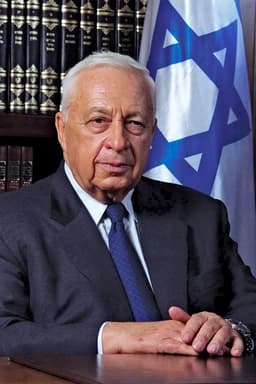
Ariel Sharon
General · Modern
58.3Total

Georgy Zhukov
General · Modern
66.0Total
Basic Information
Born
1928
1896
Died
—
1974
Era
Modern
Modern
Nationality
Israel
Russia
Occupation
General
General
Civilization
Middle Eastern
Western
Score Comparison
Military (10%)
67.3
80.0
Political (20%)
45.0
68.0
Influence (20%)
56.7
40.0
Legacy (20%)
54.0
90.0
Leadership (15%)
68.0
48.8
Strategy (15%)
69.1
80.1
TOTAL
58.3
66.0
Ariel Sharon — Complete Timeline
1982 AD
Command of the 1982 Lebanon WarWar◆ Major
As Minister of Defense, Sharon directed the Israeli invasion of Lebanon to expel the PLO. The war led to the Sabra and Shatila massacre, for which an Israeli commission found Sharon indirectly responsible, forcing his resignation as defense minister.
Lebanon WarSabra and ShatilaMilitary Campaign
Impact: regionaldestructive
2001 AD
Election as Prime MinisterPolitical Action◆ Major
Sharon was elected prime minister of Israel in a special election, defeating Ehud Barak. His victory came during the Second Intifada, and he adopted a hardline security policy, including military operations in Palestinian areas.
ElectionSecond IntifadaSecurity Policy
Impact: national
2005 AD
Disengagement from GazaPolitical Action◆ Major
Sharon implemented the unilateral disengagement plan, withdrawing all Israeli settlers and military forces from the Gaza Strip and dismantling four settlements in the West Bank. The move was controversial within Israel but internationally supported.
Gaza WithdrawalSettlementsUnilateral Action
Impact: regionalconstructive
Georgy Zhukov — Complete Timeline
1939 AD
Battle of Khalkhin GolWar
Zhukov commanded Soviet and Mongolian forces against the Japanese Kwantung Army at Khalkhin Gol. His use of combined arms tactics, including encirclement and artillery, resulted in a decisive Soviet victory that secured the Soviet eastern border.
Soviet-Japanese Border ConflictsCombined ArmsDecisive Victory
Impact: regional
1941 AD
Battle of MoscowWar
Zhukov took command of the defense of Moscow in October 1941. He organized a counteroffensive in December, pushing German forces back 100-250 miles from the capital. The victory was the first major defeat of the German army in World War II.
World War IIEastern FrontFirst German Defeat
Impact: global
1942 AD
Battle of StalingradWar
Zhukov planned and coordinated Operation Uranus, the Soviet counteroffensive that encircled the German 6th Army at Stalingrad. The operation led to the surrender of German forces in February 1943, a turning point in the war.
World War IIEastern FrontTurning Point
Impact: global
1943 AD
Battle of KurskWar◆ Major
Zhukov coordinated the Soviet defense at Kursk, the largest tank battle in history. The Soviet victory halted the German offensive and allowed the Red Army to launch a counteroffensive that pushed German forces back to the Dnieper River.
World War IIEastern FrontTank Battle
Impact: global
1945 AD
Battle of BerlinWar
Zhukov commanded the 1st Belorussian Front in the assault on Berlin. His forces captured the Reichstag and accepted the German surrender on May 8, 1945. The victory ended World War II in Europe and made Zhukov a national hero.
World War IIEastern FrontFall of Berlin
Impact: global
Expert Analysis
Origins
Ariel Sharon was born in 1928 in Kfar Malal, British Mandate of Palestine, to Shmuel and Vera Scheinerman, Jewish immigrants from Russia. He joined the Haganah at age 14 and later studied at the Hebrew University of Jerusalem. Georgy Zhukov was born in 1896 in Strelkovka, Russia, to a peasant family. He worked as a furrier before being conscripted into the Imperial Russian Army in 1915. He joined the Red Army in 1918 and joined the Communist Party in 1919.
Rise to Power
Sharon rose through the ranks of the Israel Defense Forces, commanding Unit 101 and leading reprisal raids in the 1950s. He became a major general after the 1967 Six-Day War. His political career began in 1973 as a member of the Knesset. He served as Minister of Defense in 1981 and was elected Prime Minister in 2001, defeating Ehud Barak. Zhukov rose to prominence after commanding Soviet forces at the Battle of Khalkhin Gol in 1939, where he defeated the Japanese. He became Chief of the General Staff in 1941 and was appointed to the Stavka, the Soviet high command. His successful defense of Moscow in 1941 and planning of Operation Uranus at Stalingrad in 1942 solidified his reputation.
Leadership & Governance
Sharon's leadership was characterized by aggressive military action and unilateral political decisions. As Prime Minister, he initiated the construction of the West Bank barrier and withdrew from Gaza in 2005, a move that split his Likud party. He scored 68.0 in leadership. Zhukov's leadership was harsh and demanding; he was known for his willingness to accept high casualties. He scored 48.8 in leadership, reflecting a more brutal style. His governance of East Germany after WWII was strict but effective in rebuilding.
Triumph & Tragedy
Sharon's greatest success was the disengagement from Gaza, which reduced Israeli casualties. His greatest failure was the 1982 Lebanon War, particularly the Sabra and Shatila massacre, which led to his resignation as Defense Minister. He scored 67.3 in military and 45.0 in political. Zhukov's triumphs include major victories at Moscow, Stalingrad, Kursk, and Berlin. He scored 80.0 in military and 80.1 in strategy. His failure includes the Rzhev meat grinder, where his offensives cost hundreds of thousands of lives. He also fell from political favor after Stalin's death, being demoted by Khrushchev.
Character & Destiny
Sharon was pragmatic and determined, often acting unilaterally. His career was marked by controversy but also bold decisions. He fell into a coma in 2006 and died in 2014. Zhukov was blunt and ruthless, with a strong sense of duty. His popularity with troops made Stalin suspicious, leading to his post-war decline. He died in 1974 in obscurity.
Legacy
Sharon's legacy is mixed: he is remembered for both the Lebanon war and the Gaza withdrawal. His influence on Israeli security policy endures. He scored 54.0 in legacy. Zhukov is celebrated as the greatest Soviet commander of WWII, with monuments and military honors. His legacy is central to Russian national pride, scoring 90.0.
Conclusion
Georgy Zhukov had a greater impact due to his decisive role in defeating Nazi Germany, saving millions of lives. His total score of 66.0 surpasses Sharon's 58.3. While Sharon influenced Israeli policy, Zhukov's contributions to global history are more profound.
Rankings
🥇
Georgy ZhukovLeader
Mil: 80.0Pol: 68.0Inf: 40.0
66.0
🥈
Ariel Sharon
Mil: 67.3Pol: 45.0Inf: 56.7
58.3
+7.7 behind
How This Comparison Works
Algorithm
Each figure is scored on 6 dimensions (0—100 scale) based on structured historical data: Military (10%), Political (20%), Influence (20%), Legacy (20%), Leadership (15%), Strategy (15%). The weighted total produces the final ranking.
Data Sources
Scores are computed from structured sub-indicators in the database. Scale factors adjust for era (Ancient ×0.85, Modern ×1.0) and civilization size (Eastern ×1.05, Other ×0.80) to account for differences in population and military scale.
Maximum 3 Figures
Comparisons are limited to 2—3 figures to ensure readability and statistical meaningfulness.
Error Margins
±5 points per dimension — Sub-scores are derived from historical records with inherent uncertainty. Two figures within 5 points on a dimension should be considered roughly equivalent in that area.
Total Score Accuracy
±3 points overall — The weighted combination of 6 dimensions produces a total score with approximately ±3 points of uncertainty. Differences of less than 3 points are not statistically significant— the figures are effectively tied.
Known Limitations
- Historical records are incomplete and uneven across civilizations
- Figures from oral-tradition societies may be underrepresented
- Occupation labels can misclassify multi-role figures
- Scores measure capability and impact, not moral character
- Quantitative scoring is a comparison tool, not absolute truth
Capability Radar
Military (10%) — Battles & Warfare
Battles
75
95
Win Rate
70
90
Expansion
60
90
Political (20%) — Governance & Reform
Reform
55
40
Diplomacy
50
55
Economy
45
30
Influence (20%) — Cultural & Global Reach
Cultural
55
65
Global
60
80
Legacy (20%) — Historical Impact
Historical
65
85
Longevity
50
75
Leadership (15%) — Power & Stability
Tenure
60
60
Stability
40
45
Strategy (15%) — Tactics & Innovation
Strategy
80
95
Tactics
85
92
Reform
65
85
Similar Comparisons
Comments & Discussion
No comments yet. Be the first to share your thoughts!