Loading...
Antonio Guterres vs Xi Jinping
Xi Jinping leads by 5.7 pts · 2 figures compared
…

Antonio Guterres
Politician · Modern
52.3Total
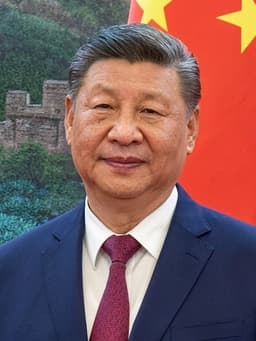
Xi Jinping
Politician · Modern
58.0Total
Basic Information
Born
1949
1953
Died
—
—
Era
Modern
Modern
Nationality
Portugal
China
Occupation
Politician
Politician
Civilization
Western
Eastern
Score Comparison
Military (10%)
10.1
10.0
Political (20%)
72.0
70.3
Influence (20%)
58.3
65.0
Legacy (20%)
50.0
52.0
Leadership (15%)
72.0
75.0
Strategy (15%)
26.5
60.0
TOTAL
52.3
58.0
Antonio Guterres — Complete Timeline
1995 AD
Prime Minister of PortugalPolitical Action◆ Major
Guterres became Prime Minister of Portugal on October 28, 1995, after his Socialist Party won the general election. He led a center-left government focused on economic growth and social welfare.
GovernmentSocialist
Impact: nationalconstructive
1998 AD
Expo 98 in LisbonCultural◆ Major
Guterres oversaw the successful hosting of Expo 98 in Lisbon, a world's fair themed around the oceans. The event revitalized the city's eastern waterfront and boosted Portugal's international image.
World ExpoUrban Development
Impact: nationalconstructive
2002 AD
Resignation as Prime MinisterPolitical Action◆ Major
Guterres resigned as Prime Minister on December 17, 2002, after his party suffered heavy losses in local elections. His government had faced economic slowdown and criticism over handling of the economy.
ResignationPolitical
Impact: national
2017 AD
United Nations Secretary-GeneralPolitical Action◆ Major
Guterres became the ninth UN Secretary-General on January 1, 2017, succeeding Ban Ki-moon. He prioritized climate action, conflict resolution, and reform of the UN system, including addressing the Rohingya crisis and Syrian civil war.
United NationsDiplomacy
Impact: globalconstructive
Xi Jinping — Complete Timeline
2012 AD
Launched the Anti-Corruption CampaignReform◆ Major
Xi initiated a sweeping anti-corruption campaign targeting officials at all levels. The campaign led to the investigation and punishment of millions of party members, including high-ranking figures like Zhou Yongkang and Bo Xilai. It consolidated Xi's authority and reshaped the party's internal discipline.
Anti-CorruptionPolitical Purge
Impact: nationalconstructive
Elected General Secretary of the Communist Party of ChinaPolitical Action
Xi Jinping was elected General Secretary of the CPC Central Committee at the 18th National Congress. This positioned him as the paramount leader of China, succeeding Hu Jintao. The event marked the beginning of his consolidation of power and the launch of major policy initiatives.
Leadership TransitionCPC Congress
Impact: global
2013 AD
Announced the Belt and Road InitiativePolitical Action◆ Major
Xi unveiled the Belt and Road Initiative (BRI) during visits to Kazakhstan and Indonesia. The BRI is a massive infrastructure and economic development project spanning Asia, Europe, and Africa. It aims to enhance connectivity and trade, but has also drawn criticism for debt-trap diplomacy and geopolitical expansion.
InfrastructureForeign PolicyEconomic Strategy
Impact: global
2018 AD
Abolished Presidential Term LimitsPolitical Action
The National People's Congress approved a constitutional amendment removing the two-term limit for the presidency. This allowed Xi to remain in office indefinitely. Critics viewed it as a consolidation of authoritarian rule, while supporters argued it ensured stability and continuity.
Constitutional AmendmentPower Consolidation
Impact: nationaldestructive
2020 AD
Implemented the Hong Kong National Security LawPolitical Action◆ Major
In response to the 2019 Hong Kong protests, Beijing imposed a national security law on Hong Kong. The law criminalized secession, subversion, terrorism, and collusion with foreign forces. It led to the arrest of pro-democracy activists and the dissolution of opposition groups, significantly curtailing Hong Kong's autonomy.
Hong KongNational SecurityAutonomy
Impact: regionaldestructive
Launched the COVID-19 Zero-COVID PolicyPolitical Action◆ Major
Xi's government implemented a strict zero-COVID strategy involving mass testing, lockdowns, and quarantine. The policy initially controlled the virus but later caused economic disruption and public discontent. It was abruptly abandoned in late 2022 after widespread protests.
Public HealthPandemic Response
Impact: national
2022 AD
Met with President Joe Biden at the G20 SummitPolitical Action
Xi held his first in-person meeting with U.S. President Joe Biden on the sidelines of the G20 summit in Bali. The meeting aimed to manage tensions over Taiwan, trade, and human rights. Both sides agreed to resume cooperation on climate change and other issues.
DiplomacyUS-China Relations
Impact: global
Expert Analysis
Origins
Antonio Guterres was born on April 30, 1949, in Lisbon, Portugal, to Virgílio Dias Guterres, an electrical engineer, and Ilda Cândida de Oliveira. He studied electrical engineering at the Instituto Superior Técnico, graduating in 1971. Guterres entered politics as a member of the Socialist Party in 1974, following the Carnation Revolution that ended the Estado Novo dictatorship. He served as a deputy in the Assembly of the Republic from 1976.
Xi Jinping was born on June 15, 1953, in Beijing, China, to Xi Zhongxun, a high-ranking Communist Party official who was purged during the Cultural Revolution. Xi spent time in rural Yanchuan County as a "sent-down youth" during the Cultural Revolution. He studied chemical engineering at Tsinghua University, graduating in 1979 with a degree in Marxist theory and ideological education. Xi joined the Communist Party in 1974.
Rise to Power
Guterres rose through the Socialist Party ranks, becoming its secretary-general in 1992. He led the party to victory in the 1995 legislative election, becoming Prime Minister of Portugal on October 28, 1995. His government focused on welfare reforms and hosted Expo '98 in Lisbon, which revitalized the city's waterfront. However, economic stagnation and local election losses led to his resignation on December 17, 2002. After leaving office, he served as UN High Commissioner for Refugees from 2005 to 2015, managing humanitarian crises in Syria, Iraq, and Afghanistan. On January 1, 2017, he became the ninth UN Secretary-General.
Xi Jinping's rise began in the provinces: he served as governor of Fujian (1999-2002), then Zhejiang (2002-2007), and later Shanghai (2007). He was appointed Vice President of China in 2008. At the 18th National Congress of the Communist Party in 2012, Xi was elected General Secretary, becoming the paramount leader. He consolidated power by leading the anti-corruption campaign that removed rivals like Zhou Yongkang. In 2018, he abolished presidential term limits, allowing indefinite rule.
Leadership & Governance
Guterres leads the UN with a consensus-based, multilateral approach. He prioritizes climate action (scored 72.0 in political, 72.0 in leadership) and conflict resolution, such as the Yemen ceasefire efforts. However, his strategy score of 26.5 reflects limited effectiveness given UN constraints. As PM, he increased social spending but failed to address economic weaknesses.
Xi Jinping governs with centralized, top-down authority. His "Chinese Dream" emphasizes national rejuvenation, state-led capitalism, and global influence via the Belt and Road Initiative (BRI). He scores 75.0 in leadership and 60.0 in strategy, but his military score is 10.0 due to non-combat focus. Xi's zero-COVID policy (2020-2022) initially controlled the virus but caused economic disruption and public backlash.
Triumph & Tragedy
Guterres's triumphs include successful humanitarian leadership at UNHCR, aiding millions of refugees, and overseeing Expo '98. His tragedies: resigning as PM after electoral defeat and struggling to reform the UN Security Council. His legacy score of 50.0 reflects modest long-term impact.
Xi's triumphs: launching the BRI, which has invested over $1 trillion in infrastructure across 140+ countries, and abolishing term limits to secure power. His tragedies: the Tiananmen Square crackdown (1989, though not directly involved), the Uyghur repression in Xinjiang, and the Hong Kong national security law (2020) that eroded freedoms. Xi's legacy score is 52.0, slightly above Guterres.
Character & Destiny
Guterres is pragmatic and diplomatic, often described as a consensus-builder. His personality shaped a career in international cooperation, but his lack of strategic ruthlessness limited his impact at the UN. Xi is authoritarian and ambitious, prioritizing control and national power. His character led to a systematic consolidation of power, but also to international criticism and isolation.
Legacy
Guterres's legacy is tied to the UN's relevance in a multipolar world. He advanced climate goals (e.g., COP26) and refugee protection but failed to resolve major conflicts. Xi's legacy is more tangible: the BRI reshapes global trade, and his anti-corruption campaign purged millions. However, his authoritarian turn and human rights abuses may tarnish his reputation. Xi's total score of 58.0 exceeds Guterres's 52.3.
Conclusion
Xi Jinping has had a greater impact on global affairs. While Guterres scored higher in political (72.0 vs 70.3) and leadership (72.0 vs 75.0, actually Xi higher), Xi's strategy (60.0 vs 26.5) and influence (65.0 vs 58.3) are superior. Xi's initiatives like the BRI and his consolidation of power have reshaped China and the world, whereas Guterres operates within the constraints of a weakening UN. Taking a clear stance: Xi Jinping's impact is more profound and lasting.
Rankings
🥇
Xi JinpingLeader
Mil: 10.0Pol: 70.3Inf: 65.0
58.0
🥈
Antonio Guterres
Mil: 10.1Pol: 72.0Inf: 58.3
52.3
+5.7 behind
How This Comparison Works
Algorithm
Each figure is scored on 6 dimensions (0—100 scale) based on structured historical data: Military (10%), Political (20%), Influence (20%), Legacy (20%), Leadership (15%), Strategy (15%). The weighted total produces the final ranking.
Data Sources
Scores are computed from structured sub-indicators in the database. Scale factors adjust for era (Ancient ×0.85, Modern ×1.0) and civilization size (Eastern ×1.05, Other ×0.80) to account for differences in population and military scale.
Maximum 3 Figures
Comparisons are limited to 2—3 figures to ensure readability and statistical meaningfulness.
Error Margins
±5 points per dimension — Sub-scores are derived from historical records with inherent uncertainty. Two figures within 5 points on a dimension should be considered roughly equivalent in that area.
Total Score Accuracy
±3 points overall — The weighted combination of 6 dimensions produces a total score with approximately ±3 points of uncertainty. Differences of less than 3 points are not statistically significant— the figures are effectively tied.
Known Limitations
- Historical records are incomplete and uneven across civilizations
- Figures from oral-tradition societies may be underrepresented
- Occupation labels can misclassify multi-role figures
- Scores measure capability and impact, not moral character
- Quantitative scoring is a comparison tool, not absolute truth
Capability Radar
Military (10%) — Battles & Warfare
Battles
11
0
Win Rate
16
0
Expansion
19
60
Political (20%) — Governance & Reform
Reform
55
80
Diplomacy
85
75
Economy
50
85
Influence (20%) — Cultural & Global Reach
Cultural
40
65
Global
70
75
Legacy (20%) — Historical Impact
Historical
55
70
Longevity
45
60
Leadership (15%) — Power & Stability
Tenure
60
85
Stability
60
80
Strategy (15%) — Tactics & Innovation
Strategy
19
0
Tactics
23
0
Reform
25
75
Similar Comparisons
Comments & Discussion
No comments yet. Be the first to share your thoughts!