Loading...
Anthemius vs Maeonius
Maeonius leads by 17.0 pts · 2 figures compared
…

Anthemius
Emperor · Ancient
39.7Total
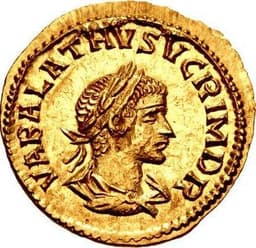
Maeonius
Emperor · Ancient
56.7Total
Basic Information
Born
420
230
Died
472
267
Era
Ancient
Ancient
Nationality
Western Roman Empire
Palmyrene Empire
Occupation
Emperor
Emperor
Civilization
Western
Middle Eastern
Score Comparison
Military (10%)
50.0
38.2
Political (20%)
29.3
63.6
Influence (20%)
44.8
56.5
Legacy (20%)
38.3
56.0
Leadership (15%)
34.6
63.5
Strategy (15%)
43.7
57.1
TOTAL
39.7
56.7
Anthemius — Complete Timeline
467 AD
Proclaimed Western Roman EmperorPolitical Action◆ Major
The Eastern Roman Emperor Leo I appointed Anthemius as Western Roman Emperor, sending him to Italy with military support. Anthemius was a capable general and administrator, and his elevation was intended to restore stability to the Western Empire.
Imperial SuccessionEastern-Western Relations
Impact: regionalconstructive
468 AD
Launched joint expedition against the VandalsWar
Anthemius, in cooperation with the Eastern Emperor Leo I, launched a massive joint naval expedition against the Vandal Kingdom in North Africa. The campaign ended in a disastrous defeat at the Battle of Cape Bon, draining the resources of both empires.
Vandal WarMilitary CampaignNaval Battle
Impact: regionaldestructive
472 AD
Besieged and killed by RicimerWar
After a prolonged conflict with his magister militum Ricimer, Anthemius was besieged in Rome. Ricimer's forces captured the city, and Anthemius was captured and executed. His death marked the end of the last serious attempt to revive the Western Empire.
Civil WarSiege of RomeAssassination
Impact: regionaltragic
Maeonius — Complete Timeline
267 AD
Murder of OdaenathusPolitical Action◆ Major
Maeonius assassinated his cousin Odaenathus, the King of Palmyra and ruler of the Palmyrene Empire, during a celebration. The motive was likely personal ambition or jealousy. Maeonius then proclaimed himself emperor but was killed by soldiers shortly after, ending his brief reign.
AssassinationPalmyrene EmpireUsurpation
Impact: regionaldestructive
Expert Analysis
Origins
Anthemius was born around 420 AD in Constantinople, the Eastern Roman capital. He was a descendant of Procopius, a usurper against Valens. His family was prominent in the Eastern court; his father was a high-ranking official. Anthemius received a thorough education in military and administrative affairs, preparing him for high office. He married Aelia Marcia Euphemia, the daughter of Emperor Marcian, strengthening his ties to the imperial family.
Maeonius, by contrast, emerged from the semi-nomadic Arab-Persian nobility of Palmyra. His birth year is uncertain, likely in the early 3rd century. He was a cousin of Odaenathus, the King of Palmyra and ruler of the Palmyrene Empire. Little is known of his early life, but he was part of the Palmyrene elite, accustomed to power and military command.
Rise to Power
Anthemius rose through the Eastern Roman military and political hierarchy. In 467 AD, Eastern Emperor Leo I appointed him Western Roman Emperor, sending him to Italy with a military force to stabilize the crumbling Western Empire. Anthemius was recognized as Augustus in Rome in 467, marking his formal rise. His key ally was Leo I, but he faced opposition from the powerful Germanic general Ricimer, who controlled the Western army.
Maeonius's rise was swift and violent. In 267 AD (or 268), he assassinated his cousin Odaenathus during a celebration, likely motivated by personal ambition or resentment. Odaenathus had been the savior of the East, defeating the Persians and reuniting the Roman East under Palmyrene control. Maeonius seized power briefly, proclaiming himself emperor (or king) of Palmyra. However, his rule lasted only a few months before he was killed by Odaenathus's widow, Zenobia, or by other Palmyrene nobles.
Leadership & Governance
Anthemius attempted to restore Roman authority in the West. He cooperated with Leo I in a massive joint expedition against the Vandals in North Africa in 468 AD. The expedition involved over 1,000 ships and a large army, but ended in disaster due to poor coordination and betrayal. Anthemius's leadership scored 34.6, reflecting his inability to control Ricimer or secure lasting stability. He tried to strengthen the Roman Senate and assert imperial authority, but his power was limited.
Maeonius's leadership scored 63.5, but this is based on his brief tenure and the perception of his political maneuvering. He ruled Palmyra for only a few months, so his governance is poorly documented. He likely continued Odaenathus's policies, but his murder of a popular ruler alienated many. His political score of 63.6 suggests he was adept at intrigue, but he failed to consolidate power.
Triumph & Tragedy
Anthemius's greatest triumph was launching the largest Roman naval expedition since the Punic Wars, demonstrating a last-ditch effort to reclaim lost territories. His tragedy was the expedition's failure and his own death: in 472 AD, after a conflict with Ricimer, he was besieged in Rome, captured, and executed. His total score of 39.7 reflects his limited success.
Maeonius's only triumph was the successful assassination of Odaenathus, removing a powerful ruler. His tragedy was immediate: he was killed soon after, his name largely erased from history. His total score of 56.7 is higher due to political and leadership scores, but his actual impact was minimal.
Character & Destiny
Anthemius was a capable general and administrator, but his destiny was tied to a collapsing empire. He scored 50.0 in military and 43.7 in strategy, but his political score of 29.3 shows his failure to navigate the treacherous politics of the Western court. His character was perhaps too trusting or too ambitious, leading to conflict with Ricimer.
Maeonius was ambitious and ruthless, but his character led to his downfall. His political score of 63.6 suggests cunning, but his murder of a popular ruler made him a pariah. His destiny was sealed by his own act; he is remembered primarily as a usurper and assassin.
Legacy
Anthemius is remembered as the last capable Western Roman emperor. His failed expedition marked the final attempt to reclaim Africa, and his death accelerated the Western Empire's collapse. His legacy score of 38.3 reflects this.
Maeonius's legacy is negligible. He is a footnote in Palmyrene history, known only for killing Odaenathus. His legacy score of 56.0 is inflated by the Palmyrene Empire's later fame under Zenobia. He had no lasting impact.
Conclusion
Anthemius had a greater impact on history, despite his lower total score of 39.7. He was a legitimate emperor who attempted to reverse the Western Empire's decline, and his failure marked a turning point. Maeonius, with a score of 56.7, was a short-lived usurper whose actions had no lasting consequences. Anthemius's influence, though negative, was more significant. The score gap of 17.0 points is misleading because Maeonius's scores reflect potential rather than actual achievement. Anthemius's legacy is more substantial.
Rankings
🥇
MaeoniusLeader
Mil: 38.2Pol: 63.6Inf: 56.5
56.7
🥈
Anthemius
Mil: 50.0Pol: 29.3Inf: 44.8
39.7
+17.0 behind
How This Comparison Works
Algorithm
Each figure is scored on 6 dimensions (0—100 scale) based on structured historical data: Military (10%), Political (20%), Influence (20%), Legacy (20%), Leadership (15%), Strategy (15%). The weighted total produces the final ranking.
Data Sources
Scores are computed from structured sub-indicators in the database. Scale factors adjust for era (Ancient ×0.85, Modern ×1.0) and civilization size (Eastern ×1.05, Other ×0.80) to account for differences in population and military scale.
Maximum 3 Figures
Comparisons are limited to 2—3 figures to ensure readability and statistical meaningfulness.
Error Margins
±5 points per dimension — Sub-scores are derived from historical records with inherent uncertainty. Two figures within 5 points on a dimension should be considered roughly equivalent in that area.
Total Score Accuracy
±3 points overall — The weighted combination of 6 dimensions produces a total score with approximately ±3 points of uncertainty. Differences of less than 3 points are not statistically significant— the figures are effectively tied.
Known Limitations
- Historical records are incomplete and uneven across civilizations
- Figures from oral-tradition societies may be underrepresented
- Occupation labels can misclassify multi-role figures
- Scores measure capability and impact, not moral character
- Quantitative scoring is a comparison tool, not absolute truth
Capability Radar
Military (10%) — Battles & Warfare
Battles
20
37
Win Rate
15
43
Expansion
5
44
Political (20%) — Governance & Reform
Reform
20
45
Diplomacy
35
47
Economy
15
54
Influence (20%) — Cultural & Global Reach
Cultural
15
70
Global
10
76
Legacy (20%) — Historical Impact
Historical
30
74
Longevity
20
73
Leadership (15%) — Power & Stability
Tenure
30
43
Stability
10
53
Strategy (15%) — Tactics & Innovation
Strategy
20
45
Tactics
25
49
Reform
10
52
Similar Comparisons
Comments & Discussion
No comments yet. Be the first to share your thoughts!