Loading...
Analysis will be generated on first visit.
Scores and timeline are available below. The page will refresh automatically when ready.
Andrew Johnson vs Napoleon Bonaparte
Napoleon Bonaparte leads by 21.5 pts · 2 figures compared
…

Andrew Johnson
Politician · Modern
60.9Total
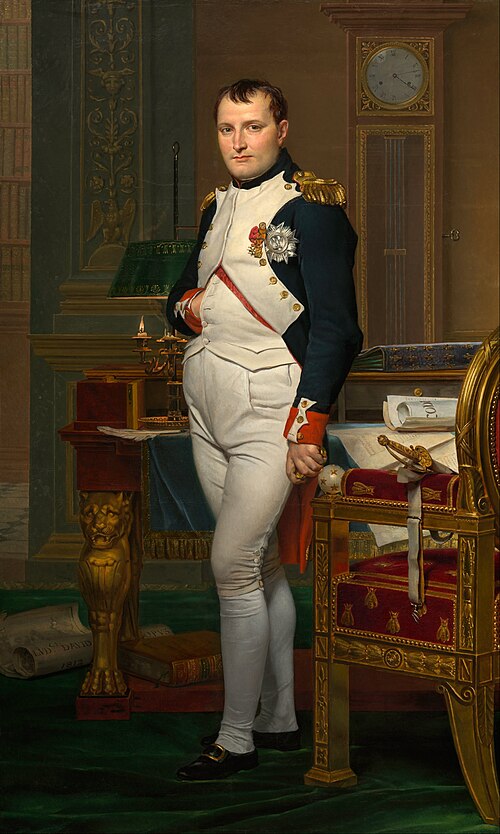
Napoleon Bonaparte
General · Modern
82.4Total
Basic Information
Born
1808
1769
Died
1875
1821
Era
Modern
Modern
Nationality
United States
France
Occupation
Politician
General
Civilization
Western
Western
Score Comparison
Military (10%)
30.9
94.0
Political (20%)
70.5
75.0
Influence (20%)
67.1
82.0
Legacy (20%)
61.8
78.0
Leadership (15%)
84.3
80.0
Strategy (15%)
35.3
93.0
TOTAL
60.9
82.4
Rankings
🥇
Napoleon BonaparteLeader
Mil: 94.0Pol: 75.0Inf: 82.0
82.4
🥈
Andrew Johnson
Mil: 30.9Pol: 70.5Inf: 67.1
60.9
+21.5 behind
How This Comparison Works
Algorithm
Each figure is scored on 6 dimensions (0—100 scale) based on structured historical data: Military (10%), Political (20%), Influence (20%), Legacy (20%), Leadership (15%), Strategy (15%). The weighted total produces the final ranking.
Data Sources
Scores are computed from structured sub-indicators in the database. Scale factors adjust for era (Ancient ×0.85, Modern ×1.0) and civilization size (Eastern ×1.05, Other ×0.80) to account for differences in population and military scale.
Maximum 3 Figures
Comparisons are limited to 2—3 figures to ensure readability and statistical meaningfulness.
Error Margins
±5 points per dimension — Sub-scores are derived from historical records with inherent uncertainty. Two figures within 5 points on a dimension should be considered roughly equivalent in that area.
Total Score Accuracy
±3 points overall — The weighted combination of 6 dimensions produces a total score with approximately ±3 points of uncertainty. Differences of less than 3 points are not statistically significant— the figures are effectively tied.
Known Limitations
- Historical records are incomplete and uneven across civilizations
- Figures from oral-tradition societies may be underrepresented
- Occupation labels can misclassify multi-role figures
- Scores measure capability and impact, not moral character
- Quantitative scoring is a comparison tool, not absolute truth
Capability Radar
Military (10%) — Battles & Warfare
Battles
25
95
Win Rate
27
90
Expansion
29
95
Political (20%) — Governance & Reform
Reform
15
95
Diplomacy
20
80
Economy
20
85
Influence (20%) — Cultural & Global Reach
Cultural
10
85
Global
20
90
Legacy (20%) — Historical Impact
Historical
40
95
Longevity
30
90
Leadership (15%) — Power & Stability
Tenure
60
85
Stability
10
70
Strategy (15%) — Tactics & Innovation
Strategy
29
95
Tactics
32
98
Reform
37
92
Analysis will be generated on first visit.
Scores and timeline are available below. The page will refresh automatically when ready.
Andrew Johnson — Complete Timeline
1865 AD
Succeeded to the PresidencyPolitical Action◆ Major
Upon Abraham Lincoln's assassination, Johnson became the 17th president. He took office during the final stages of the Civil War and faced the challenge of Reconstruction.
Presidential SuccessionReconstructionLincoln Assassination
Impact: national
Announced Reconstruction PlanPolitical Action◆ Major
Johnson issued a proclamation granting amnesty to most former Confederates and allowing Southern states to rejoin the Union quickly. His lenient plan excluded African Americans from political participation.
ReconstructionAmnestySouthern States
Impact: nationaldestructive
1866 AD
Vetoed the Civil Rights Act of 1866Political Action◆ Major
Johnson vetoed the Civil Rights Act, which granted citizenship and equal rights to African Americans. Congress overrode his veto, marking the first major override of a presidential veto on a major bill.
Civil RightsVetoReconstruction
Impact: nationaldestructive
1867 AD
Signed the Alaska PurchasePolitical Action◆ Major
Johnson approved the purchase of Alaska from Russia for $7.2 million. The acquisition added 586,412 square miles to U.S. territory, though it was initially criticized as 'Seward's Folly'.
Territorial ExpansionAlaskaDiplomacy
Impact: globalconstructive
1868 AD
Impeachment by the House of RepresentativesPolitical Action◆ Major
The House impeached Johnson for violating the Tenure of Office Act by removing Secretary of War Edwin Stanton. He was the first U.S. president to be impeached.
ImpeachmentTenure of Office ActStanton
Impact: nationaldestructive
Acquitted by the SenatePolitical Action◆ Major
Johnson was acquitted by the Senate by one vote, falling short of the two-thirds majority needed for conviction. He remained in office but was politically weakened.
Impeachment TrialAcquittalSenate
Impact: national
Similar Comparisons
Comments & Discussion
No comments yet. Be the first to share your thoughts!