Loading...
This comparison has not been analyzed yet.
One-time AI generation (~1 minute). Scores and timeline are already available below.
Andrej Plenkovic vs Mohammad Dahlan
Andrej Plenkovic leads by 4.6 pts · 2 figures compared
…
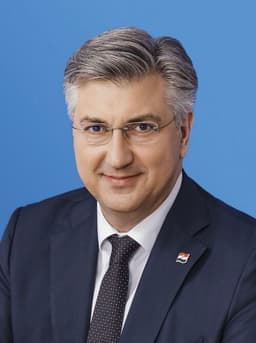
Andrej Plenkovic
Politician · Modern
49.6Total

Mohammad Dahlan
Politician · Modern
45.0Total
Basic Information
Born
1970
1961
Died
—
—
Era
Modern
Modern
Nationality
Croatia
Palestine
Occupation
Politician
Politician
Civilization
Western
Middle Eastern
Score Comparison
Military (10%)
49.3
36.6
Political (20%)
62.7
36.5
Influence (20%)
47.9
49.4
Legacy (20%)
36.7
39.2
Leadership (15%)
66.0
55.3
Strategy (15%)
42.6
53.8
TOTAL
49.6
45.0
Andrej Plenkovic — Complete Timeline
2016 AD
Appointed Prime Minister of CroatiaPolitical Action◆ Major
Plenkovic was appointed as the Prime Minister of Croatia, leading a coalition government of the Croatian Democratic Union (HDZ) and the Bridge of Independent Lists (Most). His government focused on economic recovery, tax reform, and EU integration.
AppointmentPrime MinisterCoalition
Impact: national
2020 AD
Croatia assumed the rotating presidency of the Council of the European UnionPolitical Action◆ Major
Under Plenkovic's leadership, Croatia held the rotating presidency of the Council of the EU. The presidency managed the EU's response to the COVID-19 pandemic, including the adoption of the NextGenerationEU recovery fund.
EU PresidencyCOVID-19Recovery Fund
Impact: regionalconstructive
Re-elected Prime Minister of CroatiaPolitical Action◆ Major
Plenkovic was re-elected as Prime Minister after the HDZ won the parliamentary election. He formed a new government with the support of minority parties, continuing his focus on economic recovery and EU funds.
Re-electionPrime MinisterEU Funds
Impact: national
2023 AD
Croatia adopted the euro as its currencyPolitical Action
Under Plenkovic's government, Croatia adopted the euro as its official currency, replacing the kuna. This was a major step in economic integration with the EU, facilitating trade and travel.
Euro AdoptionEconomic IntegrationEU
Impact: regionalconstructive
Mohammad Dahlan — Complete Timeline
1994 AD
Appointed Fatah Security Chief in GazaPolitical Action◆ Major
Dahlan was appointed by Yasser Arafat as the head of the Preventive Security Force in Gaza. He built a security apparatus that became a key instrument of Fatah's authority in the Gaza Strip during the Oslo Accords period.
Oslo AccordsSecurityFatah
Impact: regional
2007 AD
Exiled to UAEPolitical Action◆ Major
After Hamas took control of Gaza in June 2007, Dahlan fled to the United Arab Emirates. He lived in exile, becoming a businessman and maintaining political influence while being barred from returning to Palestine.
ExileHamas takeoverFatah
Impact: nationaltragic
2011 AD
Expelled from FatahPolitical Action◆ Major
Dahlan was expelled from Fatah by Mahmoud Abbas amid accusations of corruption and plotting against the leadership. This internal split weakened Fatah and deepened factional divisions within the Palestinian Authority.
Fatah splitCorruptionAbbas
Impact: nationaldestructive
This comparison has not been analyzed yet.
One-time AI generation (~1 minute). Scores and timeline are already available below.
Rankings
🥇
Andrej PlenkovicLeader
Mil: 49.3Pol: 62.7Inf: 47.9
49.6
🥈
Mohammad Dahlan
Mil: 36.6Pol: 36.5Inf: 49.4
45.0
+4.6 behind
How This Comparison Works
Algorithm
Each figure is scored on 6 dimensions (0—100 scale) based on structured historical data: Military (10%), Political (20%), Influence (20%), Legacy (20%), Leadership (15%), Strategy (15%). The weighted total produces the final ranking.
Data Sources
Scores are computed from structured sub-indicators in the database. Scale factors adjust for era (Ancient ×0.85, Modern ×1.0) and civilization size (Eastern ×1.05, Other ×0.80) to account for differences in population and military scale.
Maximum 3 Figures
Comparisons are limited to 2—3 figures to ensure readability and statistical meaningfulness.
Error Margins
±5 points per dimension — Sub-scores are derived from historical records with inherent uncertainty. Two figures within 5 points on a dimension should be considered roughly equivalent in that area.
Total Score Accuracy
±3 points overall — The weighted combination of 6 dimensions produces a total score with approximately ±3 points of uncertainty. Differences of less than 3 points are not statistically significant— the figures are effectively tied.
Known Limitations
- Historical records are incomplete and uneven across civilizations
- Figures from oral-tradition societies may be underrepresented
- Occupation labels can misclassify multi-role figures
- Scores measure capability and impact, not moral character
- Quantitative scoring is a comparison tool, not absolute truth
Capability Radar
Military (10%) — Battles & Warfare
Battles
27
5
Win Rate
32
5
Expansion
38
5
Political (20%) — Governance & Reform
Reform
55
20
Diplomacy
60
45
Economy
55
15
Influence (20%) — Cultural & Global Reach
Cultural
10
15
Global
15
20
Legacy (20%) — Historical Impact
Historical
10
20
Longevity
10
15
Leadership (15%) — Power & Stability
Tenure
65
40
Stability
50
10
Strategy (15%) — Tactics & Innovation
Strategy
38
10
Tactics
44
10
Reform
41
15
Similar Comparisons
Comments & Discussion
No comments yet. Be the first to share your thoughts!