Loading...
This comparison has not been analyzed yet.
One-time AI generation (~1 minute). Scores and timeline are already available below.
Andrej Plenkovic vs Micheline Calmy-Rey
Micheline Calmy-Rey leads by 3.3 pts · 2 figures compared
…
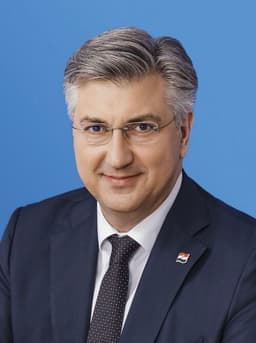
Andrej Plenkovic
Politician · Modern
49.6Total

Micheline Calmy-Rey
Politician · Modern
52.9Total
Basic Information
Born
1970
1945
Died
—
—
Era
Modern
Modern
Nationality
Croatia
Switzerland
Occupation
Politician
Politician
Civilization
Western
Western
Score Comparison
Military (10%)
49.3
50.0
Political (20%)
62.7
62.7
Influence (20%)
47.9
54.1
Legacy (20%)
36.7
43.3
Leadership (15%)
66.0
66.0
Strategy (15%)
42.6
42.4
TOTAL
49.6
52.9
Andrej Plenkovic — Complete Timeline
2016 AD
Appointed Prime Minister of CroatiaPolitical Action◆ Major
Plenkovic was appointed as the Prime Minister of Croatia, leading a coalition government of the Croatian Democratic Union (HDZ) and the Bridge of Independent Lists (Most). His government focused on economic recovery, tax reform, and EU integration.
AppointmentPrime MinisterCoalition
Impact: national
2020 AD
Croatia assumed the rotating presidency of the Council of the European UnionPolitical Action◆ Major
Under Plenkovic's leadership, Croatia held the rotating presidency of the Council of the EU. The presidency managed the EU's response to the COVID-19 pandemic, including the adoption of the NextGenerationEU recovery fund.
EU PresidencyCOVID-19Recovery Fund
Impact: regionalconstructive
Re-elected Prime Minister of CroatiaPolitical Action◆ Major
Plenkovic was re-elected as Prime Minister after the HDZ won the parliamentary election. He formed a new government with the support of minority parties, continuing his focus on economic recovery and EU funds.
Re-electionPrime MinisterEU Funds
Impact: national
2023 AD
Croatia adopted the euro as its currencyPolitical Action
Under Plenkovic's government, Croatia adopted the euro as its official currency, replacing the kuna. This was a major step in economic integration with the EU, facilitating trade and travel.
Euro AdoptionEconomic IntegrationEU
Impact: regionalconstructive
Micheline Calmy-Rey — Complete Timeline
2003 AD
Led Swiss Foreign Policy as Federal CouncillorPolitical Action◆ Major
Calmy-Rey was elected to the Federal Council, heading the Federal Department of Foreign Affairs from 2003 to 2011. She advocated for Swiss neutrality while engaging with the EU and UN, and promoted human rights and peacebuilding.
Foreign PolicyFederal CouncilNeutrality
Impact: globalconstructive
2007 AD
Elected President of the Swiss ConfederationPolitical Action◆ Major
Calmy-Rey was elected President of the Swiss Confederation for the year 2007, becoming the first woman to hold the office. She focused on foreign policy, including Switzerland's relations with the European Union and international organizations.
PresidencyFirst Female PresidentSwiss Politics
Impact: nationalprogressive
2008 AD
Championed the 'Swissness' InitiativePolitical Action
Calmy-Rey supported the 'Swissness' initiative, which aimed to protect Swiss cultural identity and products in the context of globalization. The initiative led to stricter regulations on the use of Swiss symbols and labels.
Cultural IdentitySwissnessGlobalization
Impact: nationalconstructive
2010 AD
Advocated for UN ReformsPolitical Action
Calmy-Rey called for reforms of the United Nations Security Council, arguing for a more representative and effective body. She emphasized the need for greater inclusion of small states and developing countries.
UN ReformInternational RelationsDiplomacy
Impact: globalconstructive
2011 AD
Re-elected President of the Swiss ConfederationPolitical Action
Calmy-Rey was re-elected as President of the Swiss Confederation for 2011, a rare second term. She continued her work on foreign policy and social issues, including promoting gender equality and sustainable development.
PresidencyRe-electionGender Equality
Impact: nationalconstructive
This comparison has not been analyzed yet.
One-time AI generation (~1 minute). Scores and timeline are already available below.
Rankings
🥇
Micheline Calmy-ReyLeader
Mil: 50.0Pol: 62.7Inf: 54.1
52.9
🥈
Andrej Plenkovic
Mil: 49.3Pol: 62.7Inf: 47.9
49.6
+3.3 behind
How This Comparison Works
Algorithm
Each figure is scored on 6 dimensions (0—100 scale) based on structured historical data: Military (10%), Political (20%), Influence (20%), Legacy (20%), Leadership (15%), Strategy (15%). The weighted total produces the final ranking.
Data Sources
Scores are computed from structured sub-indicators in the database. Scale factors adjust for era (Ancient ×0.85, Modern ×1.0) and civilization size (Eastern ×1.05, Other ×0.80) to account for differences in population and military scale.
Maximum 3 Figures
Comparisons are limited to 2—3 figures to ensure readability and statistical meaningfulness.
Error Margins
±5 points per dimension — Sub-scores are derived from historical records with inherent uncertainty. Two figures within 5 points on a dimension should be considered roughly equivalent in that area.
Total Score Accuracy
±3 points overall — The weighted combination of 6 dimensions produces a total score with approximately ±3 points of uncertainty. Differences of less than 3 points are not statistically significant— the figures are effectively tied.
Known Limitations
- Historical records are incomplete and uneven across civilizations
- Figures from oral-tradition societies may be underrepresented
- Occupation labels can misclassify multi-role figures
- Scores measure capability and impact, not moral character
- Quantitative scoring is a comparison tool, not absolute truth
Capability Radar
Military (10%) — Battles & Warfare
Battles
27
29
Win Rate
32
31
Expansion
38
33
Political (20%) — Governance & Reform
Reform
55
55
Diplomacy
60
65
Economy
55
50
Influence (20%) — Cultural & Global Reach
Cultural
10
30
Global
15
35
Legacy (20%) — Historical Impact
Historical
10
40
Longevity
10
20
Leadership (15%) — Power & Stability
Tenure
65
60
Stability
50
55
Strategy (15%) — Tactics & Innovation
Strategy
38
41
Tactics
44
40
Reform
41
41
Similar Comparisons
Comments & Discussion
No comments yet. Be the first to share your thoughts!