Loading...
Amin al-Hafiz vs Julius Caesar
Julius Caesar leads by 43.5 pts · 2 figures compared
…
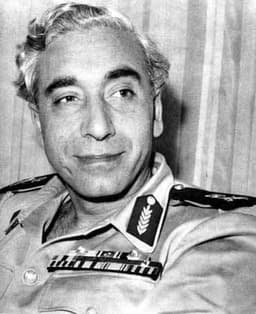
Amin al-Hafiz
General · Modern
39.3Total

Julius Caesar
General · Ancient
82.8Total
Basic Information
Born
1921
-100
Died
—
-44
Era
Modern
Ancient
Nationality
Syria
Roman Republic
Occupation
General
General
Civilization
Middle Eastern
Western
Score Comparison
Military (10%)
10.2
88.0
Political (20%)
33.6
78.0
Influence (20%)
48.6
85.0
Legacy (20%)
37.5
82.0
Leadership (15%)
48.4
80.0
Strategy (15%)
45.0
85.0
TOTAL
39.3
82.8
Amin al-Hafiz — Complete Timeline
1963 AD
Became President of SyriaPolitical Action◆ Major
Amin al-Hafiz became President of Syria after the Baathist coup, serving as a leading figure in the party's early rule. His presidency was marked by internal Baathist factionalism and conflict with the Muslim Brotherhood.
PresidencyBaath Party
Impact: national
1966 AD
Overthrown by Salah JadidPolitical Action◆ Major
Amin al-Hafiz was overthrown in a coup led by Salah Jadid, a rival Baathist faction. He was imprisoned and later exiled, as the more radical neo-Baathists took control of Syria.
CoupBaath Factionalism
Impact: nationaldestructive
Julius Caesar — Complete Timeline
58 BC
Gallic WarsWar◆ Major
Caesar, as proconsul of Gaul, launched a series of campaigns that conquered all of Gaul (modern France, Belgium, and parts of Switzerland). He fought numerous battles, including against the Helvetii, the Belgae, and the Gallic chieftain Vercingetorix. The wars brought immense wealth and a loyal army to Caesar.
Gallic WarsConquestRoman Expansion
Impact: regional
49 BC
Crossing the RubiconPolitical Action◆ Major
Caesar led Legio XIII across the Rubicon River into Italy, defying the Roman Senate's order to disband his army. This act triggered a civil war against Pompey and the Optimates, ultimately leading to Caesar's dictatorship and the end of the Roman Republic.
Roman Civil WarEnd of RepublicPower Struggle
Impact: global
48 BC
Battle of PharsalusWar◆ Major
Caesar's outnumbered army defeated the larger forces of Pompey the Great at Pharsalus in Greece. Caesar's tactical use of a reserve line to counter Pompey's cavalry charge proved decisive. Pompey fled to Egypt, where he was assassinated, leaving Caesar as the undisputed master of the Roman world.
Roman Civil WarBattleDecisive Victory
Impact: regional
44 BC
Appointment as Dictator for LifePolitical Action◆ Major
The Roman Senate appointed Caesar dictator perpetuo (dictator for life), granting him unprecedented personal power. This move concentrated military, legislative, and judicial authority in one person, effectively ending the Roman Republic's traditional system of checks and balances and alarming many senators.
DictatorshipEnd of RepublicPower Consolidation
Impact: regionaldestructive
Assassination on the Ides of MarchPolitical Action◆ Major
A group of Roman senators, led by Marcus Junius Brutus and Gaius Cassius Longinus, stabbed Caesar to death at a meeting of the Senate in the Theatre of Pompey. The assassination was intended to restore the Republic, but instead triggered another civil war that led to the rise of the Roman Empire.
AssassinationRoman PoliticsEnd of Republic
Impact: globaldestructive
Expert Analysis
amin-al-hafiz-vs-julius-caesar
# The General and the Ghost
On the Ides of March, 44 BCE, Julius Caesar fell beneath twenty-three dagger strokes in the Senate chamber of Rome, his blood pooling on the marble floor where he had once stood as master of the known world. Nineteen centuries later, in 1966, Amin al-Hafiz was dragged from the presidential palace in Damascus by his own party comrades, bound for a prison cell and eventual exile in Iraq. Both were generals who seized power; both were overthrown by men they had trusted. Yet one name echoes through millennia as the architect of empire, while the other has faded into a footnote of Syrian politics. What separates a Caesar from a footnote? The answer lies not in the drama of their falls, but in the substance of their rises.
Origins
Julius Caesar was born into the patrician Julii clan, a family of ancient lineage but modest political fortunes in the late Roman Republic. His childhood unfolded against the backdrop of civil wars between Marius and Sulla, and he learned early that survival required nimble alliances and ruthless ambition. The Republic was decaying—its institutions buckling under the weight of empire, its Senate paralyzed by factionalism. Caesar absorbed this chaos as a young man, watching how power flowed to those bold enough to seize it.
Amin al-Hafiz was born in 1921 in Aleppo, Syria, then part of the French Mandate. He grew up in a world of colonial domination, Arab nationalism, and the humiliations of a region carved up by European powers. Where Caesar inherited a crumbling order, al-Hafiz inherited no order at all—only the dream of a unified Arab nation that seemed always just out of reach. He became a soldier in the Syrian army, a path common for ambitious men from modest backgrounds in the post-colonial Middle East. But the army he joined was less an institution than a battlefield of competing ideologies: Baathism, Nasserism, communism, and Islamism all vied for the souls of its officers.
Rise to Power
Caesar’s ascent was a masterclass in strategic patience. He climbed the traditional Roman ladder of offices—quaestor, aedile, praetor—but he did so while building a power base outside the system. His conquest of Gaul between 58 and 50 BCE was not merely a military campaign; it was a political enterprise. He forged a loyal army, amassed staggering wealth, and cultivated a public image as the champion of the common people against the oligarchic Senate. When the Senate ordered him to disband his army, he crossed the Rubicon River in 49 BCE, a decision that meant civil war or death. He chose war, and won.
Amin al-Hafiz rose through a different crucible. The Baath Party, founded on principles of Arab unity, socialism, and freedom, was a secretive movement of intellectuals and officers. In 1963, a coup brought the Baathists to power in Syria, and al-Hafiz emerged as president. His score of 50.0 in political acumen reflects a man who reached the top not through genius but through being in the right faction at the right time. He was a general with a military rating of 19.9—a number that suggests he commanded more through party loyalty than battlefield brilliance. His rise was the product of a coup, not a conquest.
Leadership & Governance
Caesar governed with audacity and vision. As dictator, he reformed the calendar (creating the Julian calendar we still use in modified form), initiated massive public works, extended Roman citizenship to provincial elites, and began land reforms to settle his veterans. He centralized power but also modernized the state. His military rating of 88.0 and strategy of 88.0 reflect a commander who understood that war and politics were inseparable: he defeated Pompey at Pharsalus in 48 BCE not just with superior tactics, but by understanding that his enemy’s aristocratic army would collapse if its leadership were divided.
Al-Hafiz governed Syria during a period of intense internal factionalism within the Baath Party. His political score of 50.0 suggests a leader who could hold power but could not transform it. He implemented socialist economic policies and aligned Syria with the Soviet Union, but his regime was consumed by the struggle between the party’s civilian wing and its military officers. He lacked Caesar’s capacity to project authority beyond the immediate circle of power. While Caesar reshaped Rome’s destiny, al-Hafiz could not even shape his own party’s future.
Triumph & Tragedy
Caesar’s greatest triumph was the conquest of Gaul, a campaign he chronicled in *Commentarii de Bello Gallico*—a work of propaganda and literature that made him a legend in his own lifetime. His tragedy was that he could not translate military victory into stable governance. By accepting the title “dictator for life,” he violated the Republic’s deepest taboo and sealed his fate. The Ides of March was a murder born of fear: his assassins believed they were saving the Republic, but they only plunged Rome into another civil war.
Al-Hafiz’s triumph was simply becoming president—a position he held for three years. His tragedy was the coup of 1966, when his own deputy, Salah Jadid, with the support of a rising officer named Hafez al-Assad, overthrew him. He was imprisoned, then exiled. He died in 2009 in Aleppo, largely forgotten. His score of 48.9 in legacy reflects a man who left no lasting institution, no monument, no reform that outlasted his fall.
Character & Destiny
Caesar was driven by an insatiable need for glory—*gloria* in the Roman sense: fame earned through great deeds. He was reckless yet calculating, generous yet ruthless. When pirates captured him as a young man, he laughed at their ransom demand, insisted they ask for more, and later returned to crucify them. This combination of charm, cruelty, and supreme confidence defined his trajectory. He believed he was destined for greatness, and he made that belief a self-fulfilling prophecy.
Al-Hafiz was a product of his environment, not its shaper. He rose through a system where loyalty to party mattered more than personal vision. He lacked Caesar’s strategic imagination and his willingness to break every rule. Where Caesar rewrote the rules of Roman politics, al-Hafiz simply played by the rules of Baathist infighting—and lost when a more ruthless player emerged.
Legacy
Caesar’s legacy is monumental. His name became synonymous with imperial authority—*Kaiser* in German, *Tsar* in Russian. He transformed the Republic into an empire, even if he did not live to see it. His writings remain classics of military literature. His reforms endured. His assassination made him a martyr and a cautionary tale. He is remembered not just as a conqueror but as the man who made the modern world possible by destroying an obsolete system.
Amin al-Hafiz is remembered, if at all, as a placeholder in Syrian history—a general who reached the presidency but could not hold it. His legacy score of 48.9 places him among those who governed but did not govern well. He was a symptom of his era’s instability, not a solution to it. The Baathist state he helped create would later be hijacked by Hafez al-Assad, who built a dynasty that lasted decades. Al-Hafiz was simply the first to fall.
Conclusion
The difference between Caesar and al-Hafiz is not merely a matter of scale—one ruled an empire, the other a small country. It is a matter of vision and execution. Caesar understood that power must be seized, consolidated, and institutionalized. He transformed his personal ambition into a new political order. Al-Hafiz seized power but could not consolidate it; he was a general who never truly commanded, a politician who never truly governed. One left a world transformed; the other left a footnote. In the end, history remembers not those who rise to power, but those who know what to do with it.
Rankings
🥇
Julius CaesarLeader
Mil: 88.0Pol: 78.0Inf: 85.0
82.8
🥈
Amin al-Hafiz
Mil: 10.2Pol: 33.6Inf: 48.6
39.3
+43.5 behind
How This Comparison Works
Algorithm
Each figure is scored on 6 dimensions (0—100 scale) based on structured historical data: Military (10%), Political (20%), Influence (20%), Legacy (20%), Leadership (15%), Strategy (15%). The weighted total produces the final ranking.
Data Sources
Scores are computed from structured sub-indicators in the database. Scale factors adjust for era (Ancient ×0.85, Modern ×1.0) and civilization size (Eastern ×1.05, Other ×0.80) to account for differences in population and military scale.
Maximum 3 Figures
Comparisons are limited to 2—3 figures to ensure readability and statistical meaningfulness.
Error Margins
±5 points per dimension — Sub-scores are derived from historical records with inherent uncertainty. Two figures within 5 points on a dimension should be considered roughly equivalent in that area.
Total Score Accuracy
±3 points overall — The weighted combination of 6 dimensions produces a total score with approximately ±3 points of uncertainty. Differences of less than 3 points are not statistically significant— the figures are effectively tied.
Known Limitations
- Historical records are incomplete and uneven across civilizations
- Figures from oral-tradition societies may be underrepresented
- Occupation labels can misclassify multi-role figures
- Scores measure capability and impact, not moral character
- Quantitative scoring is a comparison tool, not absolute truth
Capability Radar
Military (10%) — Battles & Warfare
Battles
5
95
Win Rate
5
92
Expansion
5
97
Political (20%) — Governance & Reform
Reform
20
90
Diplomacy
20
85
Economy
15
82
Influence (20%) — Cultural & Global Reach
Cultural
10
88
Global
10
94
Legacy (20%) — Historical Impact
Historical
15
95
Longevity
10
96
Leadership (15%) — Power & Stability
Tenure
30
75
Stability
10
60
Strategy (15%) — Tactics & Innovation
Strategy
5
94
Tactics
5
96
Reform
5
88
Similar Comparisons
Comments & Discussion
GallicSwordsman6/17/2026
Caesar didn't just win battles—he engineered a system that outlasted him. Amin al-Hafiz rose through Ba'athist coups and fell the same way, never building beyond the clique. Caesar's Commentaries shaped military doctrine for centuries; al-Hafiz's legacy is a footnote in Syrian chaos. That's the gap between empire and ephemera.
历史纠错员6/17/2026
说真的,把恺撒跟哈菲兹放一起比也太离谱了吧?恺撒跨过卢比孔河时是在和元老院斗,背后是整个罗马的体制对抗,而哈菲兹不过是1963年复兴党政变里爬上来的一颗棋子,连叙利亚真正的强人阿萨德都还没露头。两个人除了“被背叛”这个表面情节,其他根本不是一个量级。小学生写论文才这么乱对比。
QuaestorSkeptic6/17/2026
I find it telling that the comparison leans hard on their "falls" as the dramatic key. But what about the metrics of their rises? Caesar conquered Gaul, invaded Britain, and overhauled Roman governance. Al-Hafiz presided over a stagnation so deep his own party purged him in less than three years. The equivalence is a parlor trick—it collapses if you apply any standard beyond "leader got stabbed or jailed."
哈菲兹的法国6/17/2026
各位忘了关键一点:恺撒是出身贵族、在罗马中心权力场练出来的,哈菲兹是在法国委任统治下的阿勒颇长大,连国家主权都没见过。1921年出生的叙利亚人,这辈子大部分时间活在殖民跟军事政变里,他能拿什么资源跟恺撒比?这不是谁更厉害的问题,是这两个人的历史起点压根不在地球同一层。