Loading...
This comparison has not been analyzed yet.
One-time AI generation (~1 minute). Scores and timeline are already available below.
Amago Tsunehisa vs Manuel II Palaiologos
Amago Tsunehisa leads by 12.6 pts · 2 figures compared
…

Amago Tsunehisa
Emperor · Medieval
52.6Total
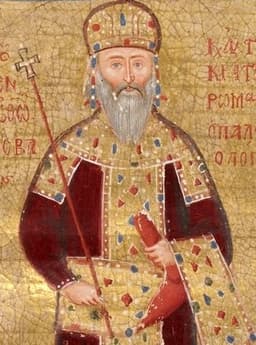
Manuel II Palaiologos
Emperor · Medieval
40.0Total
Basic Information
Born
1458
1350
Died
1541
1425
Era
Medieval
Medieval
Nationality
Japan
Byzantine Empire
Occupation
Emperor
Emperor
Civilization
Eastern
Western
Score Comparison
Military (10%)
45.0
10.2
Political (20%)
53.8
33.6
Influence (20%)
51.8
53.3
Legacy (20%)
43.3
43.3
Leadership (15%)
72.0
45.0
Strategy (15%)
55.0
30.3
TOTAL
52.6
40.0
Amago Tsunehisa — Complete Timeline
1486 AD
Assassination of Amago KiyosadaPolitical Action◆ Major
Amago Tsunehisa orchestrated the assassination of his uncle Amago Kiyosada, the clan head, seizing control of the Amago clan. This act of treachery established Tsunehisa as the new leader and began the clan's rise to power.
AssassinationClan CoupAmago Rise
Impact: regionaldestructive
1517 AD
Battle of Arita-NakaideWar
Amago Tsunehisa defeated the forces of the Ouchi clan at Arita-Nakaide in Aki Province, halting Ouchi expansion into the San'in region. The battle solidified Amago control over their newly conquered territories.
BattleOuchi ConflictSan'in
Impact: regional
1518 AD
Conquest of Izumo ProvinceWar◆ Major
Amago Tsunehisa completed the conquest of Izumo Province, defeating the local Kyogoku clan and capturing Gassantoda Castle. This victory made the Amago the dominant power in the San'in region of western Honshu.
ConquestIzumoGassantoda Castle
Impact: regional
1537 AD
Retirement and SuccessionPolitical Action
Amago Tsunehisa retired as clan head and passed leadership to his grandson Amago Haruhisa. This orderly succession ensured the continued strength of the Amago clan during a period of expansion.
SuccessionRetirementAmago Clan
Impact: regionalconstructive
Manuel II Palaiologos — Complete Timeline
1394 AD
Defense of Constantinople during the Ottoman siegeWar◆ Major
Manuel II oversaw the defense of Constantinople during a prolonged Ottoman blockade by Sultan Bayezid I. The city held out until the Ottoman defeat at the Battle of Ankara in 1402 temporarily relieved pressure.
SiegeOttoman WarsByzantine Empire
Impact: regional
1399 AD
Travel to Western Europe to seek aid against the Ottoman EmpirePolitical Action◆ Major
Manuel II Palaiologos traveled to the courts of Western Europe, including England, France, and the Holy Roman Empire, to request military assistance against the Ottoman siege of Constantinople. He met with King Henry IV of England and King Charles VI of France, but secured no substantial military aid.
DiplomacyOttoman WarsByzantine Empire
Impact: regional
1400 AD
Writing of religious dialogues and theological worksCultural
Manuel II composed several theological works, including dialogues on Christianity and Islam, and letters. His writings reflect his intellectual engagement with religious issues during the decline of the Byzantine Empire.
TheologyLiteratureByzantine Culture
This comparison has not been analyzed yet.
One-time AI generation (~1 minute). Scores and timeline are already available below.
Rankings
🥇
Amago TsunehisaLeader
Mil: 45.0Pol: 53.8Inf: 51.8
52.6
🥈
Manuel II Palaiologos
Mil: 10.2Pol: 33.6Inf: 53.3
40.0
+12.6 behind
How This Comparison Works
Algorithm
Each figure is scored on 6 dimensions (0—100 scale) based on structured historical data: Military (10%), Political (20%), Influence (20%), Legacy (20%), Leadership (15%), Strategy (15%). The weighted total produces the final ranking.
Data Sources
Scores are computed from structured sub-indicators in the database. Scale factors adjust for era (Ancient ×0.85, Modern ×1.0) and civilization size (Eastern ×1.05, Other ×0.80) to account for differences in population and military scale.
Maximum 3 Figures
Comparisons are limited to 2—3 figures to ensure readability and statistical meaningfulness.
Error Margins
±5 points per dimension — Sub-scores are derived from historical records with inherent uncertainty. Two figures within 5 points on a dimension should be considered roughly equivalent in that area.
Total Score Accuracy
±3 points overall — The weighted combination of 6 dimensions produces a total score with approximately ±3 points of uncertainty. Differences of less than 3 points are not statistically significant— the figures are effectively tied.
Known Limitations
- Historical records are incomplete and uneven across civilizations
- Figures from oral-tradition societies may be underrepresented
- Occupation labels can misclassify multi-role figures
- Scores measure capability and impact, not moral character
- Quantitative scoring is a comparison tool, not absolute truth
Capability Radar
Military (10%) — Battles & Warfare
Battles
45
10
Win Rate
50
10
Expansion
55
5
Political (20%) — Governance & Reform
Reform
50
15
Diplomacy
65
60
Economy
45
10
Influence (20%) — Cultural & Global Reach
Cultural
35
30
Global
15
20
Legacy (20%) — Historical Impact
Historical
40
35
Longevity
30
25
Leadership (15%) — Power & Stability
Tenure
60
40
Stability
50
15
Strategy (15%) — Tactics & Innovation
Strategy
65
20
Tactics
60
15
Reform
40
5
Similar Comparisons
Comments & Discussion
No comments yet. Be the first to share your thoughts!